

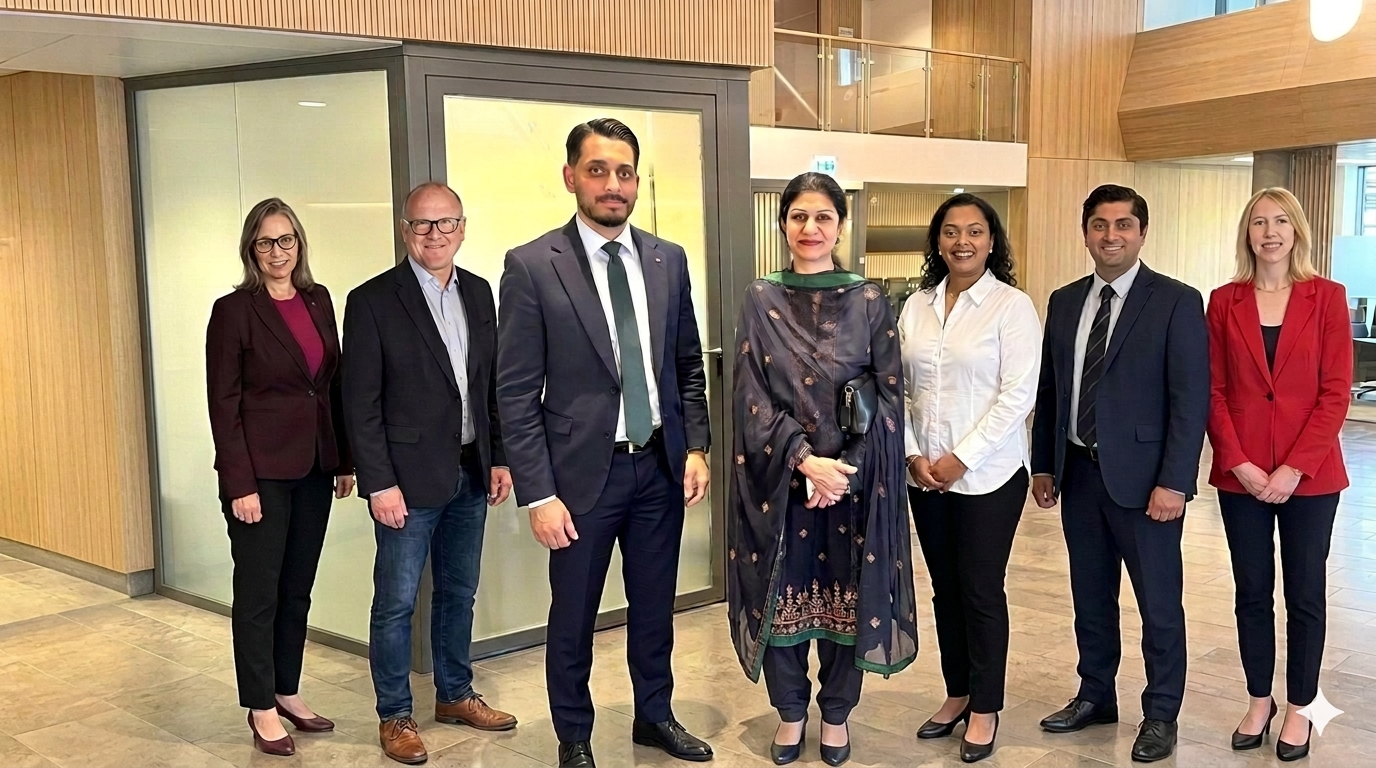
The Oslo–Islamabad Seminar held on 28 May provided an important platform for dialogue between institutions, policymakers, community leaders, and stakeholders committed to strengthening the relationship between Pakistan and Norway. Representing Pakistan on this occasion were Ambassador Sadia Altaf Qazi, Deputy Head of Mission Saleem Khan, and Counsellor Muhammad Faraz, whose participation reflected Pakistan’s commitment to constructive engagement and international cooperation.
As a participant in the seminar, I had the opportunity to observe the proceedings closely and to engage with discussions that touched upon diplomacy, governance, social cohesion, and the evolving role of diaspora communities in strengthening relations between states. Conducted across multiple linguistic and cultural contexts, the exchanges reflected the diversity that increasingly characterizes contemporary international engagement.
A particularly memorable moment occurred later at the Norwegian Parliament, where participants of the seminar had the opportunity to meet Jens Stoltenberg, one of Norway’s most distinguished contemporary statesmen. Having served twice as Prime Minister of Norway and later as Secretary General of NATO for a decade, his influence extends well beyond Norway’s borders. During the interaction, he acknowledged the presence and engagement of the Pakistani participants. The gesture was brief, yet it carried significance. For many present, it reflected recognition of a community whose contribution to Norwegian society continues to expand while maintaining meaningful connections with Pakistan.
The significance of such moments cannot be measured solely through protocol or symbolism. They belong to a broader process through which confidence is built between societies. Relationships between states are often assessed through agreements, trade figures, official visits, and policy frameworks. Equally important are the less visible foundations of trust that allow such relationships to mature into enduring partnerships. Trust remains one of the most valuable forms of strategic capital in international affairs.
Within this broader context, the tenure of Ambassador Sadia Altaf Qazi merits careful reflection.
Diplomatic service is frequently viewed through the lens of formal representation. Its deeper purpose lies elsewhere. Diplomacy involves cultivating confidence, navigating competing interests, identifying opportunities for cooperation, and creating conditions in which future relationships may flourish. Successful diplomats operate simultaneously in the present and the future. They address immediate responsibilities while laying foundations whose full significance may only become apparent years later.
Throughout her tenure in Norway, Ambassador Sadia Altaf Qazi demonstrated a diplomatic approach characterized by accessibility, professional discipline, institutional engagement, and sustained outreach. Her work extended beyond official ceremonies and formal meetings. It encompassed engagement with the Pakistani diaspora, interaction with Norwegian institutions, encouragement of business linkages, support for cultural initiatives, and efforts to strengthen channels of communication between diverse stakeholders.
Such efforts rarely produce immediate headlines. Their impact is cumulative. Networks expand. Confidence grows. Perceptions evolve. Opportunities emerge where none previously existed. The value of diplomatic engagement often becomes visible only after sufficient time has passed for its effects to mature.
One of the distinguishing characteristics of successful diplomacy is the ability to recognize the strategic importance of people-to-people relationships. Governments may establish frameworks, but societies determine their durability. This principle carries particular significance in the relationship between Pakistan and Norway.
Norway’s international reputation has been shaped by its commitment to dialogue, mediation, institutional trust, and peaceful engagement. Pakistan’s national experience has been shaped by resilience, adaptation, and the navigation of complex regional realities. These different historical experiences provide opportunities for meaningful cooperation. The relationship acquires additional depth through the Pakistani diaspora, which serves as a living bridge between the two societies.
Diaspora communities occupy a unique position within the modern international order. They connect cultures, economies, educational institutions, and social networks across borders. Their contribution extends beyond remittances or commerce. They facilitate understanding. They transfer knowledge. They strengthen relationships that governments alone cannot sustain.
The most successful diaspora communities are those that achieve integration without cultural detachment. They participate fully in the civic and economic life of their adopted countries while preserving meaningful connections to their historical and cultural inheritance. This balance represents neither nostalgia nor sentimentality. It reflects one of the enduring characteristics of human development. Communities that remain connected to their roots frequently possess a stronger sense of continuity, confidence, and collective purpose.
For Pakistanis in Norway, this responsibility remains particularly relevant.
The foundations of trust established through diplomatic engagement require stewardship from the wider community. Diplomatic missions can open doors, facilitate dialogue, and create opportunities. The long-term success of these efforts depends upon how effectively communities, professionals, entrepreneurs, academics, writers, and young leaders choose to build upon them.
Viewed from this perspective, the contribution of Ambassador Sadia Altaf Qazi extends beyond the routine responsibilities associated with a diplomatic posting. Her tenure forms part of a broader effort to strengthen an emerging framework of confidence between two societies whose cooperation holds considerable promise.
Should the coming decades witness the development of an increasingly trusted partnership between Pakistan and Norway-characterized by educational collaboration, business engagement, cultural exchange, institutional cooperation, and social confidence-this period may be regarded as an important stage in that progression.
Public service seldom provides the opportunity to witness the full consequences of one’s work. Diplomacy operates on timelines that often exceed individual assignments. The most enduring contributions are frequently measured not by immediate visibility but by the strength of the institutions, relationships, and opportunities left behind.
In this regard, Ambassador Sadia Altaf Qazi leaves a legacy that deserves recognition. It is a legacy rooted not in rhetoric but in engagement; not in ceremony but in relationship-building; not in visibility alone but in the patient cultivation of confidence between people, institutions, and nations.
The foundations have been strengthened. The networks have expanded. The channels of communication have matured. The responsibility for the next chapter now belongs to those who inherit these opportunities and choose to transform them into lasting achievements.
Disclaimer: The views and opinions expressed in this article are solely those of the author and do not necessarily reflect the views, policies, or position of this website. The website does not endorse or oppose any opinion presented herein.