

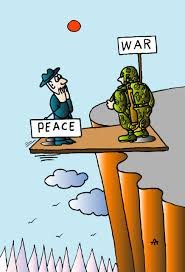
How many more lives must be counted before wisdom prevails? How many children must grow up with stories instead of fathers, with memories instead of protection? How many young girls will fall asleep to promises that their fathers, taken by war, will be waiting for them in a better world-because this world could not be made safe enough for them? How many mothers will hold back their tears just long enough to whisper hope into broken hearts, while knowing that peace was possible, yet never chosen?
Wars are never fought on maps-they are buried in homes.
There comes a point where words begin to feel powerless. Where those who write, who think, who hope-are forced to admit a painful truth: that reason often arrives softly, while decisions of war are made loudly. And in that noise, fragile voices are lost. We wanted to believe that dialogue would prevail, that leaders would choose people over positions-but perhaps their stances, their fears, and their rigid certainties have grown stronger than the very lives they are meant to protect.
When positions become more important than people, peace becomes the first casualty.
This is no longer about who was right or wrong; it is about whether decisions in today’s world are being made for people or for positions. Every time a path toward peace emerges, it is buried under mistrust, rigid stances, and the need to appear unyielding. The result is always the same: states preserve their narratives, but ordinary people lose their stability, their opportunities, and their future.
In the evolving tensions between Iran and the United States, what stands out is not merely disagreement, but a deeper inability to convert opportunity into understanding. Positions hardened, expectations collided, and a moment that could have shifted the region toward stability instead slipped away. In such moments, the real loss is not diplomatic-it is human.
Missed opportunities do not return-they echo through generations.
For countries like Pakistan, this is not a distant development. It is a reminder of the delicate balance required in a region where alliances, history, and geography intersect in complex ways. Pakistan’s strength has never been in loud declarations, but in measured restraint-an approach shaped by experience, sacrifice, and a clear understanding of the cost of conflict.
The leadership of Pakistan, particularly its security institutions, has consistently demonstrated a mature and responsible outlook: one that recognizes the importance of ideology, yet refuses to let it overshadow the fundamental duty of safeguarding human life, national stability, and regional peace. This is not a rejection of belief, but a disciplined alignment of belief with responsibility.
Strength is not in proving others wrong-it is in preventing your people from suffering.
At a time when narratives across the region risk becoming rigid and absolute, Pakistan’s approach offers a different model-one where strength is exercised through patience, where deterrence coexists with dialogue, and where the ultimate objective remains the welfare of its people. This balance is neither accidental nor temporary; it is the result of a long-evolved strategic culture that understands both the consequences of war and the value of peace.
History will not remember who stood firm-it will remember who prevented collapse.
The region does not need more victories of position-it needs victories of wisdom. Because in the end, no ideology, no stance, and no strategic gain can justify a future where generations inherit instability instead of opportunity.
Disclaimer: The views and opinions expressed in this article are solely those of the author and do not necessarily reflect the views, policies, or position of this website. The website does not endorse or oppose any opinion presented herein.
5 Comments
talk about boredom!!!
I saw one of these in Canada and I bought one.
It only works when I’m Malaysia.
My co-worker Rey has one of these. He says it looks uneven.
i use it daily when i’m in my outhouse.