

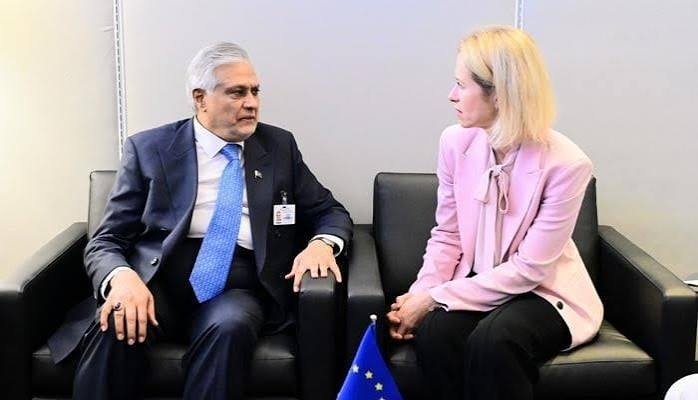
NEW YORK: Deputy Prime Minister and Foreign Minister Ishaq Dar on Monday highlighted the importance of the European Union’s GSP+ trade preferences for Pakistan during a meeting with EU High Representative for Foreign Affairs and Security Policy Kaja Kallas on the sidelines of the 81st UN General Assembly.
According to Pakistan’s Foreign Office, Dar stressed the importance of Pakistan-EU trade and economic cooperation and appreciated the EU’s engagement with Pakistan during recent regional developments.
Dar called for a return to diplomacy and dialogue and stressed the need for full implementation of the Islamabad Memorandum of Understanding by all parties. The two sides also discussed regional and global developments and agreed to maintain close engagement on matters of mutual interest.
What Did Dar and Kallas Discuss on Pakistan-EU Relations?
The meeting followed Kallas’s visit to Pakistan in August, when both sides discussed trade and economic cooperation under the GSP+ framework, investment, migration and mobility, and broader bilateral relations.
Kallas had described Pakistan as a major regional power and an important EU partner during that visit. She also highlighted the EU’s role as Pakistan’s largest export market and the importance of continued compliance with GSP+ requirements.
What Did Dar Discuss With the French Foreign Minister?
Separately, Dar met French Minister for Europe and Foreign Affairs Jean-Noël Barrot and discussed Pakistan-France relations and regional developments.
Dar expressed Pakistan’s interest in expanding political engagement, trade, investment, education and people-to-people contacts. The two ministers also discussed the Palestine issue, the two-state solution and regional developments involving Iran.
Both sides emphasized continued diplomatic engagement, the safety and free flow of maritime traffic and uninterrupted energy supplies. Barrot also appreciated Pakistan’s diplomatic efforts to promote regional peace and stability.
Pakistan and France agreed to maintain close engagement on bilateral and regional issues of mutual interest.