

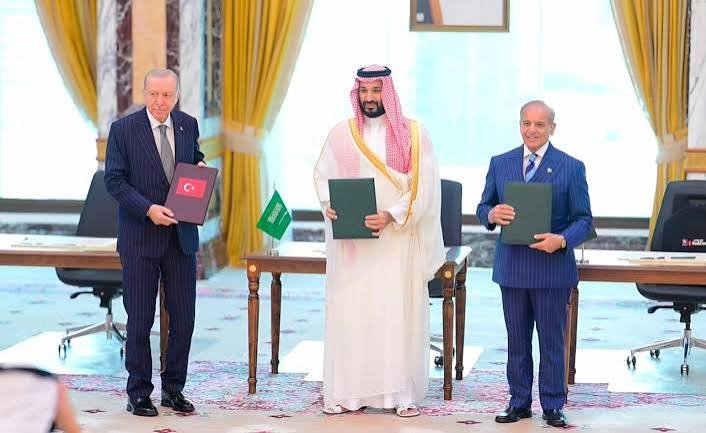
Someone will call the Makkah agreement a piece of paper. Someone else will argue that it contains no magic, and that no treaty can guarantee what states will actually do when the real test arrives. There is logic in that argument. An agreement is, after all, written on paper. But so is NATO’s founding treaty. So are defence treaties, constitutions and the agreements that have shaped the international order for generations. Paper is fragile. States are not. The mistake is to judge an agreement only by the paper on which it is written, rather than by the strategic decision of the states that chose to sign it.
The significance of the Makkah agreement between Pakistan, Saudi Arabia and Türkiye is therefore not simply that three governments have put their signatures on a document. It is that three states have decided to add another layer of strategic calculation to an increasingly complicated regional system. That decision matters because states, like human beings, do not operate only through written instructions. They develop instincts. They sense danger, calculate uncertainty, recognise patterns and respond to threats before those threats become fully visible.
The human brain has an amygdala, one part of a larger neurological system involved in processing threat, emotion and rapid response. A state has no literal amygdala, of course. But it develops something that performs a broadly similar strategic function. Intelligence agencies, diplomats, military institutions, political leadership, historical memory and the collective experience of previous crises together create a national capacity to recognise danger and decide when to act. Pakistan’s decision to enter another strategic arrangement should therefore be read not simply through the language of the agreement, but through what it tells us about how Pakistan sees the region that is taking shape around it.
And if Pakistan is thinking seriously about strategic layers abroad, it should be willing to think equally seriously about administrative layers at home.
That brings us to a question Pakistan has avoided for far too long: does a country of Pakistan’s size, population and complexity still possess the right administrative structure for the century it has entered?
I believe the answer is increasingly no.
Pakistan needs to examine the case for new provinces. But it must not create them through the psychology of the crowd. It must create them through the intelligence of the state.
A provincial demand can begin in the street. A provincial policy cannot end there. People have genuine grievances. Some regions feel administratively distant from their provincial capitals. Some communities believe development has been uneven. Some cities have grown far beyond the administrative structures designed for them. Some populations believe their political representation does not reflect their demographic or economic importance. These grievances cannot simply be dismissed. But neither should every grievance automatically become a new province.
This is where the psychology of the crowd becomes important. Sigmund Freud was interested in what happens when the individual becomes psychologically absorbed into a group, when identification with the collective becomes stronger and independent judgement can become weaker. The lesson for Pakistan is not that crowds are always wrong. Crowds can expose injustice, demand legitimate rights and force governments to confront problems they would rather ignore. The danger begins when collective emotion replaces the difficult questions that serious reform requires.
Why this boundary? Why this capital? What economic model will sustain the new province? Who will pay for it? Who will govern it? What happens to minorities? What happens to existing institutions? What happens to the federation ten years later?
A mature citizen movement should be capable of demanding a province while also demanding the evidence that proves the province will work. That is the difference between popular politics and state policy.
Pakistan’s problem is not simply the size of its provinces. It is the distance between the citizen and the state.
Pakistan’s population has grown enormously. Its cities have expanded, economic centres have shifted and communications have transformed the relationship between citizens and government. Yet much of the administrative architecture remains rooted in an older Pakistan. The question, therefore, is not whether the existing provincial map is sacred. It is whether that map remains the most effective way of governing a country that has changed so profoundly.
This is not an argument against the provinces that already exist. It is an argument for asking whether their present boundaries remain optimal.
Pakistan has already experimented with decentralisation. The devolution and local-government reforms undertaken during General Pervez Musharraf’s government in 2000–01 recognised part of the problem. But devolution is not the same thing as creating new provinces, and the experience demonstrated an important lesson: changing the formal structure of government does not automatically change the behaviour of government. Power can be devolved on paper and remain concentrated in practice.
That is why the next reform, if it comes, must be deeper than a new map.
Pakistan should not simply redraw provincial boundaries. It should redesign the relationship between the citizen and the state. A new province should exist to make government more responsive, more accessible and more accountable. It should not exist merely to provide another political headquarters.
If Pakistan were a brain, the metaphor would be useful here. The brain does not become intelligent because it has more parts. It becomes intelligent because its parts communicate, process information and respond appropriately. The amygdala does not run the brain, and a province should not attempt to become the entire political identity of the citizen.
A province should be a responsive administrative unit. It should see problems earlier, hear citizens more clearly, respond faster and have enough institutional capacity to develop solutions suited to local conditions. But the federation must remain the larger intelligence. It must protect the Constitution, guarantee citizenship, safeguard national economic and security interests and maintain national standards in education, science and fundamental rights. It must also ensure that no province becomes a state within the state.
This is not centralisation. It is coordination.
The province should be close to the ground. The federation should see the whole map.
There is, however, a danger that must be confronted before Pakistan begins drawing new provincial boundaries: a new province must not become another political office.
Pakistan does not need more provinces simply to create more governors, chief ministers, ministers, secretariats and political jobs. If that is the purpose, the discussion should end immediately. A new province is justified only if it produces measurable improvements in administration, access to government, education, healthcare, policing, infrastructure, economic planning, political representation and accountability.
Otherwise, we are not reforming the state. We are multiplying the state.
A smaller province can be more efficient, but it can also be more corrupt. It can be more representative, but it can also become more tribal. It can bring government closer to citizens, but it can also bring political patronage closer to them. Every benefit carries a corresponding risk. That is why the state must calculate before it acts.
Pakistan should not fear more provinces. It should fear badly designed provinces.
I am therefore not arguing for preserving the existing map simply because it is familiar. Maps are administrative instruments, not sacred texts. If a province has become too large to govern effectively, its boundaries should not be protected merely out of political sentiment. But neither should provinces be divided simply because identity politics has become fashionable.
The question should be brutally practical: will this new province make Pakistan better governed?
If the answer is yes, proceed. If the answer is no, do not. If the answer is uncertain, study the proposal before acting. That is how a serious state behaves.
Any proposal for a new province should therefore pass a national test. Its population, geography, economic viability, fiscal sustainability, administrative accessibility, infrastructure, natural resources, water availability, urbanisation, historical administration, public services, minority protection, political representation and national-security implications must all be examined. Above all, the effect on the federation itself must be considered.
The process should be transparent. The data should be public. Independent experts should be involved. Citizens should be consulted. Parliament should debate the proposal. And the Constitution must decide it.
The crowd may demand a province. Only the constitutional state should create one.
That distinction is fundamental.
This is where Makkah and Pakistan’s provinces meet.
At first glance, a defence agreement between Pakistan, Saudi Arabia and Türkiye and the question of new Pakistani provinces appear to have nothing to do with one another. In reality, they are connected by one idea: state capacity.
A country that wants strategic weight abroad needs institutional strength at home. Pakistan is telling the region that it is prepared to take responsibility for its strategic environment. It should therefore also be prepared to take responsibility for its administrative environment.
If Pakistan can think about collective defence with two major regional powers, it should be capable of thinking collectively about the protection of its own citizens from administrative neglect. The threat is not always a missile. Sometimes it is a school without teachers. Sometimes it is a hospital without medicines. Sometimes it is a district so distant from political power that its citizens feel invisible. Sometimes it is a young person who believes that geography has already decided his future.
These, too, are failures of state capacity.
This is why the debate over new provinces should not be reduced to slogans about identity. Nor should it be dismissed as a threat to national unity. The real question is whether Pakistan’s constitutional and administrative arrangements are capable of responding to a society that has changed dramatically since those arrangements were designed.
We need another layer, but not another camp.
The Makkah agreement adds another layer to Pakistan’s strategic relationships. That does not necessarily mean choosing one camp against another. Pakistan has never been served well by reducing every international relationship to left versus right, East versus West, or one bloc versus another. The world is becoming more complicated. States need layers: partnerships, redundancies, options and alternative channels through which they can protect their interests.
Strategic depth does not necessarily mean geography. It can mean having more than one relationship, more than one channel and more than one institutional mechanism available when circumstances change.
The same principle can apply domestically. Pakistan may need another administrative layer of provinces. But it must not create another layer of permanent political camps.
A Saraiki province should not mean anti-Punjab. A Hazara province should not mean anti-Pashtun. A more empowered Karachi should not mean anti-Sindh. Regional identity should become a vehicle for administration, representation and development, not a weapon against citizenship.
This is the line the state must draw.
The state must know when to move, and it must know when not to move. It must distinguish a genuine structural problem from temporary political emotion. It must distinguish a popular demand from a workable policy. Most importantly, it must be able to listen to the crowd without becoming the crowd.
That is what I mean when I say the state needs an amygdala-not an organ of fear, but an organ of strategic recognition.
The state should recognise when a province has become administratively unwieldy. It should recognise when a region has been systematically neglected. It should recognise when identity is becoming politically dangerous. It should recognise when decentralisation can strengthen national unity rather than weaken it. But it must also recognise when an apparently attractive solution will create greater problems ten years later.
Pakistan therefore needs neither blind centralisation nor blind fragmentation.
It needs intelligent federalism.
The question, therefore, is no longer simply how many provinces Pakistan should have. The real question is how close the state can come to the citizen without losing the national mind that holds the country together.
That is the balance Pakistan must find.
The province should be the citizen’s nearest major administrative home. The federation should remain the national home. One should not destroy the other.
Pakistan does not need fewer identities. It needs a larger national consciousness capable of carrying those identities together. A Punjabi can remain Punjabi, a Sindhi Sindhi, a Baloch Baloch, a Pashtun Pashtun, a Saraiki Saraiki and a Hazara Hazara. A citizen of Karachi can remain deeply attached to Karachi. None of these identities is inherently a threat to Pakistan.
They become a threat only when citizens are taught that loyalty to one requires hostility towards another.
That is not federalism. It is political insecurity.
Pakistan may need more provinces. But it needs something even more urgently: a stronger national mind.
The provinces can be the eyes, ears, hands and feet of the federation-close to the ground, sensitive to local realities and capable of action. But the federation must provide the intelligence that tells the whole body where it is going.
The Makkah agreement may or may not ultimately become the security architecture its signatories imagine. Treaties can fail. Commitments can weaken. Strategic circumstances can change. Paper can indeed be fragile. But the strategic decisions behind that paper are real.
And that is the lesson Pakistan should carry home from Makkah: do not judge the strength of a state only by what it signs. Judge it by whether it can recognise the world changing around it-and whether it has the courage and intelligence to change itself before circumstances force it to.
Pakistan should therefore not be afraid of a new map.
It should be afraid of an old administrative mind.
Many provinces, many identities, many centres of development-but one Constitution, one citizenship and one national direction.
Many parts, one nervous system, one national mind.
Disclaimer: The views and opinions expressed in this article are solely those of the author and do not necessarily reflect the views, policies, or position of this website. The website does not endorse or oppose any opinion presented herein.