

The desert wind carried more than dust that day-it carried a warning.
Across the battlefield, a confident opposing general advanced not just with an army, but with intimidation. His voice echoed with calculated menace as he declared that their swords were dipped in poison-so lethal that even the slightest touch would reduce their enemy to lifeless remains. It was not merely a threat; it was psychological warfare, designed to break spirit before steel ever met steel.
But standing on the other side was Khalid bin al-Walid-unmoved, unshaken, and utterly certain. Because what stood before that threat was not an army of fear. It was a formation of faith.
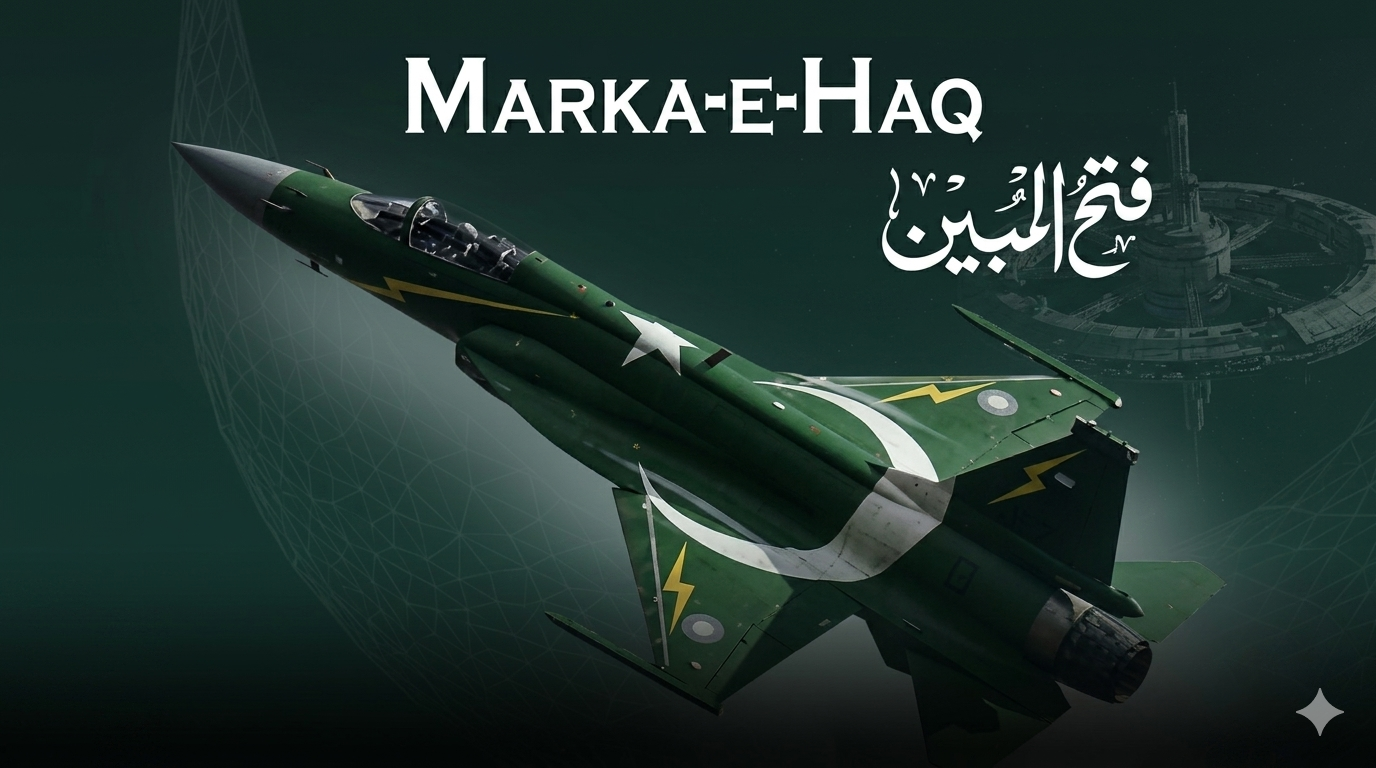
A Bunyan-un-Marsoos-a wall not built of iron, but of conviction so absolute that neither poison nor pressure could penetrate it. History remembers what followed not just as a victory of arms, but as a triumph of belief over intimidation. And centuries later, that same spirit found its reflection in Ma’rka-e-Haq-led with unwavering resolve by FM Asim Munir, articulated with striking clarity by DG ISPR Ahmed Sharif Chaudhry, and executed with unmatched speed by the Shaheens of the Pakistan Air Force-faster than light, swifter than sound, and precise beyond expectation.
There are moments in history when a nation is misread-when its restraint is mistaken for weakness, when its patience is interpreted as hesitation, when its silence is taken as surrender. In such moments, adversaries begin to believe in an illusion: that the nation before them is taran-wal-an easy prey. That miscalculation has been made before. It failed to see what lay beneath Pakistan’s composure.
It failed to recognize that this was not a nation waiting to react-it was a nation forged, layer by layer, into something far stronger than visible force: a galvanized will, tempered by faith, discipline, and an unretreatable sense of purpose. Ma’rka-e-Haq did not create this strength. It revealed it. What emerged was not aggression, but clarity. Pakistan did not strike to dominate. It responded to restore balance. And in doing so, it demonstrated a rare equation of power-one that the world’s largest military doctrines often struggle to achieve: To be capable of overwhelming force, yet committed to controlled application. To build an iron wall, yet ensure that it shields life rather than consumes it.
This is where Pakistan stands apart. In a global order where major powers often speak of peace through policy and projection, Pakistan has shown a willingness to act-decisively, responsibly, and with consequence in mind. Ma’rka-e-Haq was not just a defensive maneuver. It was a declaration: That Pakistan will never initiate conflict- but it will never allow imbalance to dictate outcomes.
That its Army, Navy, and Air Force are not instruments of war alone- but custodians of a doctrine where deterrence is designed to prevent destruction, not expand it. Because for Pakistan, bloodshed is not an objective. It is a responsibility to be avoided, contained, and minimized-even in the face of confrontation. This is not always understood in the immediacy of geopolitics. But history has its own rhythm. It studies. It compares. And ultimately-it distinguishes. As we approach the first anniversary of Ma’rka-e-Haq, the question is no longer whether Pakistan proved its strength.
The question is whether it will preserve its meaning. Because what was witnessed was not just a response to an adversary. It was the emergence of a nation as galvanized steel- flexible under pressure, unbreakable under force, and guided by something deeper than strategy alone. Guided by what Allama Iqbal called Ishq- a force that transforms defense into devotion, and power into responsibility.
From the very next day after this anniversary, that responsibility only grows. Pakistan must carry forward this doctrine-not as memory, but as continuity. A continuity where it remains: Vocal, yet measured.Powerful, yet restrained. Prepared, yet humane. If this path is sustained, then Ma’rka-e-Haq will not simply be remembered as a decisive moment. It will be studied as a model- of how a nation once perceived as vulnerable rose, stood firm, and proved that when faith galvanizes a people, even the sharpest threats lose their edge.
Disclaimer: The views and opinions expressed in this article are solely those of the author and do not necessarily reflect the views, policies, or position of this website. The website does not endorse or oppose any opinion presented herein.