

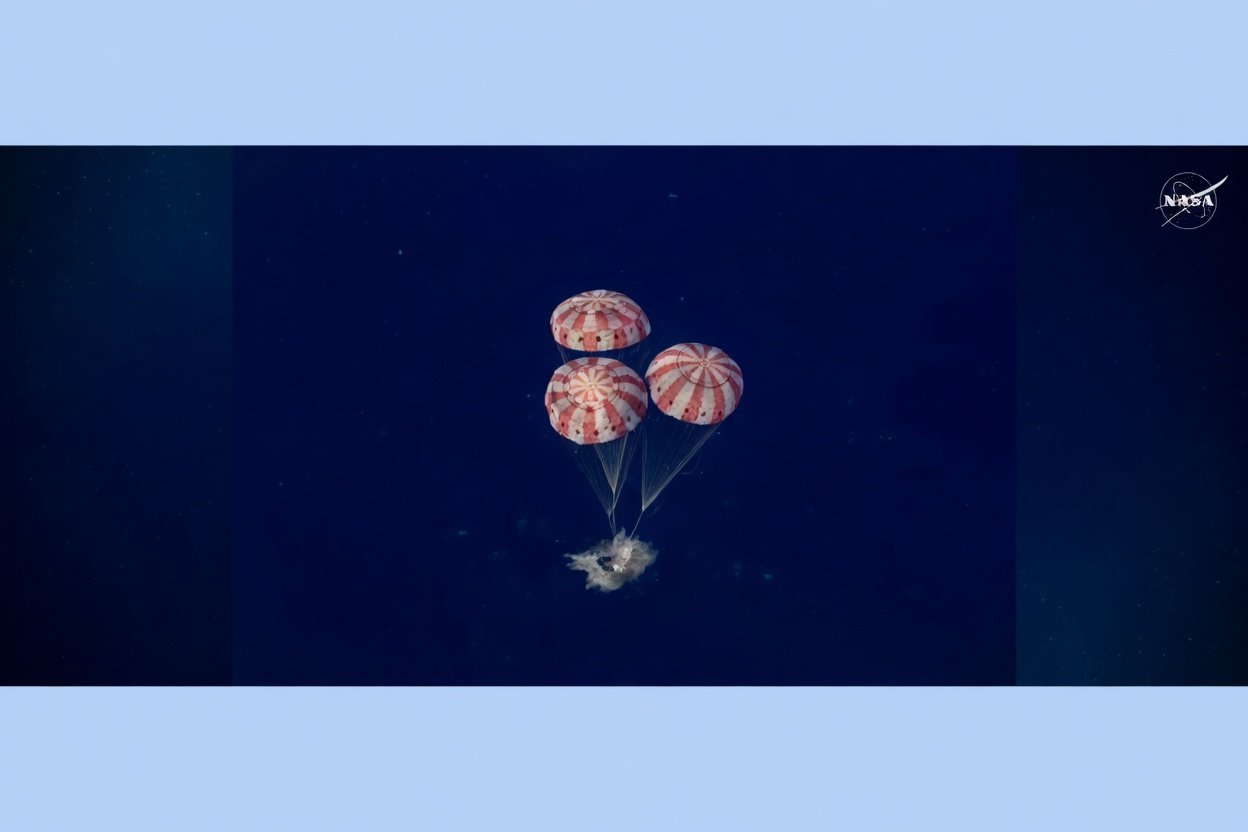
NASA’s Artemis II mission successfully concluded on Friday as its four-member crew safely splashed down in the Pacific Ocean off the coast of Southern California, marking the first human lunar flyby mission in more than 50 years.
The Orion capsule, named Integrity, returned to Earth after a nearly 10-day journey covering approximately 694,000 miles (1.1 million km), including two Earth orbits and a close flyby of the Moon at a distance of about 252,000 miles.
The capsule re-entered Earth’s atmosphere in a high-intensity 13-minute descent, enduring temperatures of up to 5,000°F (2,760°C). During this phase, a plasma sheath temporarily cut off communications before contact was restored and the parachute system deployed successfully, slowing the spacecraft to a safe landing speed of around 15 mph (25 kph).
Recovery teams quickly secured the floating capsule, while the astronauts—Reid Wiseman, Victor Glover, Christina Koch, and Canadian astronaut Jeremy Hansen—were transported for initial medical checks aboard a nearby recovery vessel.
The mission marked a key milestone in NASA’s Artemis programme, serving as a critical test flight for the Orion spacecraft and the Space Launch System (SLS) rocket. It also demonstrated the spacecraft’s ability to withstand the extreme conditions of deep-space travel and lunar re-entry.
Launched on April 1 from Cape Canaveral, Florida, Artemis II followed the uncrewed Artemis I mission conducted in 2022. The programme aims to return astronauts to the Moon later this decade, with future missions intended to establish a long-term lunar presence as a stepping stone toward Mars exploration.
Artemis II also made history for diversity in space exploration, with the crew including the first Black astronaut, the first woman, and the first non-US citizen to take part in a lunar mission.
NASA officials described the mission as a crucial validation of the Orion spacecraft and its heat shield system, which underwent modifications after the earlier Artemis I test flight revealed higher-than-expected thermal stress during re-entry.
The successful splashdown is being seen as a major step forward in NASA’s efforts to re-establish human deep-space exploration capabilities and compete in a new era of global space exploration.