

Pakistan captured international attention after Islamabad played a mediating role in securing a US–Iran ceasefire just hours before a deadline set by US President Donald Trump was due to expire.
The global community responded with relief late Tuesday night after Trump announced that a two-week ceasefire had been agreed following discussions with Prime Minister Shehbaz Sharif and Chief of Army Staff (COAS) and Chief of Defence Forces Field Marshal Asim Munir. The agreement came after PM Shehbaz reportedly urged Trump to extend his deadline by two weeks to allow diplomatic efforts to proceed, a request that was accepted.
Trump’s announcement marked a sudden shift from earlier in the day, when he issued a warning stating that “a whole civilisation will die tonight” if his demands were not met, setting an 8pm ET deadline for April 8.
In a post on X, PM Shehbaz said Pakistan would host delegations from the United States and Iran on Friday to further negotiations aimed at resolving the crisis. He expressed gratitude to the leadership of both countries and invited their representatives to Islamabad on April 10, 2026, for continued talks toward a conclusive agreement.
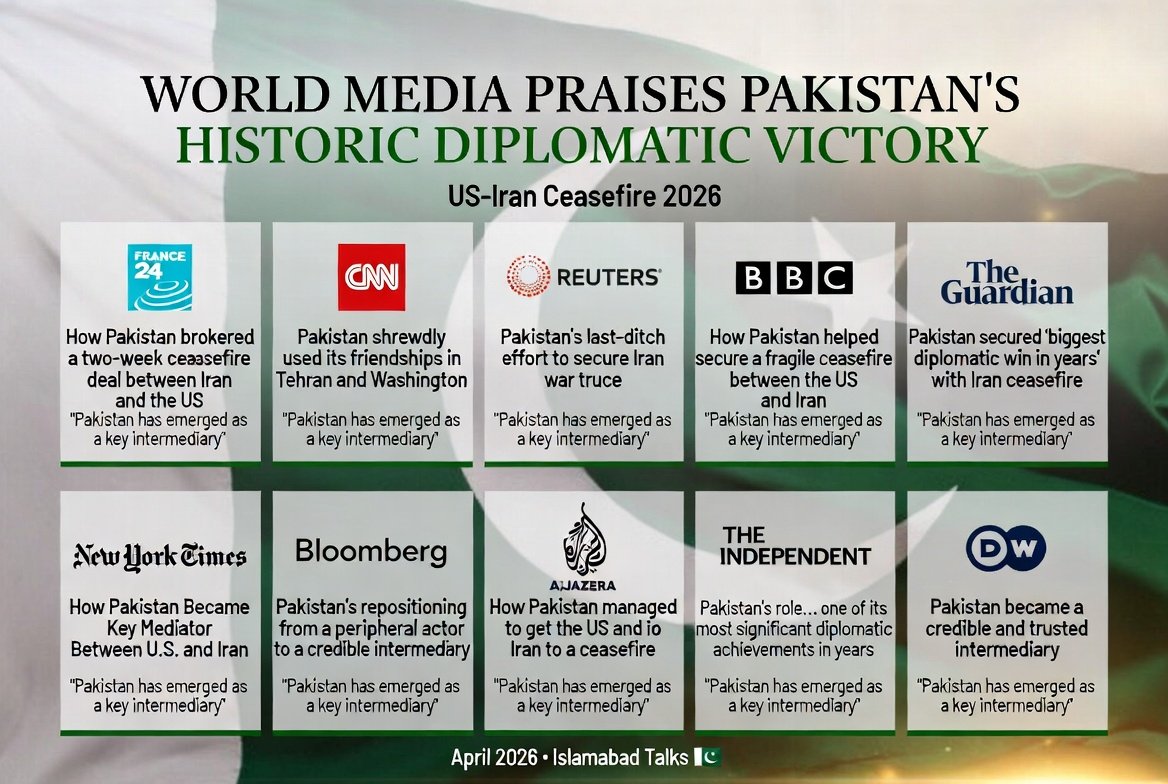
Following the development, several international media outlets highlighted Pakistan’s diplomatic role in easing tensions and facilitating dialogue.
Bloomberg reported that Pakistan “deserves a tremendous amount of credit” for offering its diplomatic services and described Islamabad’s mediation as a result of its close ties with both Washington and Tehran. The report also noted that Pakistan’s economic and strategic interests, including energy security concerns linked to the Strait of Hormuz, contributed to its involvement, adding that the country has shifted “from a peripheral actor to a credible intermediary capable of convening adversaries.”
The Independent stated that Pakistan’s role in preventing further escalation “could mark one of its most significant diplomatic achievements in years,” while noting that its engagement was partly driven by economic considerations, including dependence on energy imports and the impact of regional instability on remittances.
CNN highlighted Pakistan’s position in facilitating dialogue, noting that Islamabad helped arrange talks between the US and Iran and would play a key role in sustaining the agreement. It also emphasized Pakistan’s ability to leverage its relationships with both sides to support diplomatic outcomes.
France 24 observed that Pakistan’s neutral stance is aligned with economic and strategic interests, as the country depends heavily on energy imports passing through the Strait of Hormuz and seeks to avoid being drawn into regional conflict. The outlet added that a lasting ceasefire would enhance both regional stability and Pakistan’s international standing.
Gulf News described Pakistan’s role as a “unique position” that enabled it to open communication channels between Washington and Tehran. It noted that Islamabad maintained public neutrality while engaging privately with all parties, leveraging longstanding ties with the United States and its contacts with Iran.
While challenges remain in sustaining the ceasefire, international coverage suggests that Pakistan’s mediation has been widely acknowledged as a notable diplomatic development, reflecting its growing engagement in regional conflict resolution efforts.