

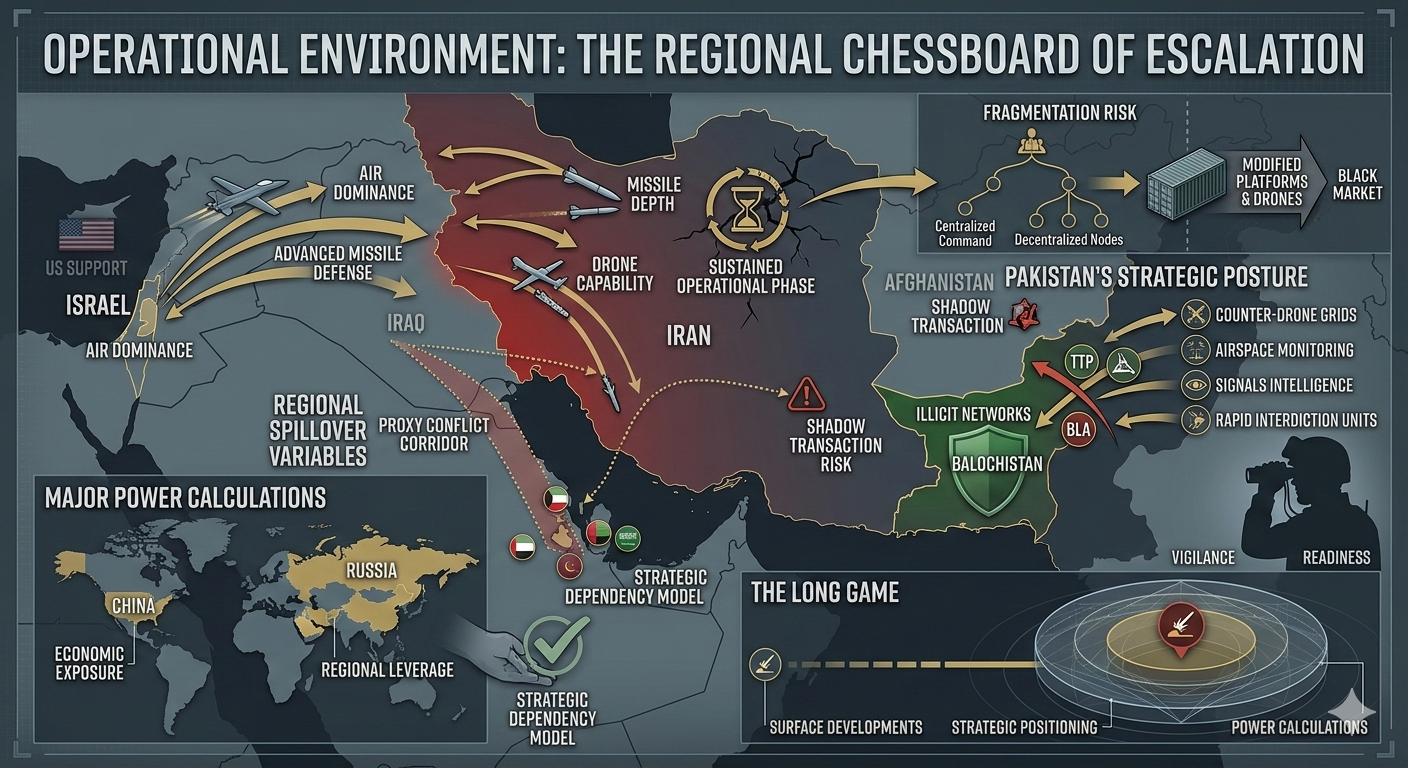
Operational Environment: Escalation in Motion
The confrontation between Iran and Israel has entered a sustained operational phase. Strike tempo, force posture adjustments, and alliance signaling indicate preparation for continuation rather than a brief exchange. Defense establishments across multiple regions are calculating force sustainability, escalation thresholds, and deterrence credibility in real time.
Israel operates with integrated air dominance, advanced missile defense architecture, and deep intelligence fusion supported by the United States. In prolonged high-intensity engagement, that alignment carries structural advantage.
Iran retains missile depth and proven drone capability. It has demonstrated reach and resilience. Extended engagement, however, compresses logistics, strains reserves, and tests centralized command cohesion. If senior command nodes are degraded, operational decentralization becomes a measurable risk.
Fragmentation Risk and Technology Proliferation
When hierarchy weakens under sustained combat pressure, secondary consequences begin. Advanced systems, technical expertise, and modified platforms can enter informal circulation channels.
Iranian drone systems have demonstrated battlefield lethality. In conditions of fragmented oversight, such capabilities would attract immediate interest from armed networks across the region.
Technology in unstable environments moves quickly. Control gaps create opportunity. Opportunity fuels black markets.
This is where regional instability expands beyond original battle lines.
Western Frontier Sensitivity: Pakistan’s Immediate Concern
Balochistan occupies a critical geographic position in any prolonged western disorder. Trafficking corridors can activate rapidly. Infiltration attempts may increase. Technology transfer operations could be attempted through layered smuggling routes.
Groups hostile to Pakistan – including Tehrik-i-Taliban Pakistan and factions linked to Balochistan Liberation Army – would view regional turbulence as operational opportunity.
Border security must function as layered defense. Counter-drone grids require strengthening. Airspace monitoring must expand. Signals intelligence integration must remain continuous. Rapid interdiction units must stay deployment-ready.
A buffer-security mindset along the western belt is essential in this phase.
Regional Spillover Variables
Iraq remains geographically pivotal if the confrontation transitions into proxy configuration. Movement corridors through Iraqi territory can alter regional dynamics quickly.
Afghanistan introduces an additional risk variable. Governance fragility and financial strain increase the probability of shadow transactions if advanced systems circulate beyond state control. Fragmentation in one theater frequently activates networks in adjacent ones.
Full regime collapse in Iran remains uncertain. The state retains internal enforcement mechanisms and structured urban control. Ethnic division scenarios are externally discussed, yet internal cohesion remains stronger than many anticipate. The more plausible risk lies in prolonged attrition that stretches institutions and invites proxy competition.
Major Power Calculations
China will calculate economic exposure and strategic positioning.
Russia will balance regional leverage against existing military commitments.
Neither is expected to enter open confrontation at scale.
Gulf states are reassessing security assumptions. Strategic dependency models are under quiet review. The United States remains engaged while measuring escalation thresholds carefully.
Pakistan’s Strategic Posture
Pakistan enters this phase with institutional maturity shaped by two decades of hybrid warfare and counterterrorism operations. Command discipline, intelligence coordination, and operational adaptability are tested strengths.
This escalation demands structured preparedness rather than reactive signaling.
If command fragmentation emerges west of Pakistan’s borders, illicit networks will attempt activation. Non-state actors will pursue technological enhancement. Financial channels will attempt to exploit disorder.
Preparedness must precede movement.
The Long Game
Surface developments appear fast. Strategic positioning beneath them moves deliberately.
Escalations create noise. Power calculations remain disciplined.
Many observers struggle to interpret that layered process. The extended strategic design behind visible strikes remains difficult for casual analysis.
That long game is all Greek to many.
For Pakistan’s armed forces, it is familiar terrain.
Vigilance continues.
Readiness remains constant.
Stability through strength defines the posture.
Disclaimer: The views and opinions expressed in this article are solely those of the author and do not necessarily reflect the views, policies, or position of this website. The website does not endorse or oppose any opinion presented herein.