

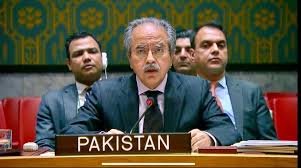
Pakistan’s recent demand for an independent and objective inquiry into attacks against United Nations peacekeepers in Lebanon goes beyond diplomatic routine. It reflects a deeper concern shared by long-standing troop-contributing countries: that the protective norms surrounding international peacekeeping forces are steadily eroding. In an increasingly fragmented global security environment, such attacks are no longer anomalies but indicators of a dangerous and evolving pattern.
Addressing the Security Council, Pakistan’s Permanent Representative, Iftikhar Ahmed, described these incidents as serious violations of international humanitarian law and the mandates of the United Nations. While such language may appear procedural, for countries that have contributed troops to peacekeeping missions for decades, the issue is far from abstract. It is operational, immediate, and deeply consequential.
The recent attacks involving personnel from the United Nations Interim Force in Lebanon mark a troubling escalation. In March 2026 alone, multiple incidents, including a projectile strike on a UN position and a roadside explosion targeting a patrol, resulted in the deaths of peacekeepers and injuries to several others. These were not isolated incidents, but part of a broader deterioration in the operational environment. The United Nations itself has acknowledged that such attacks may constitute war crimes, underscoring the gravity of the situation.
For decades, UNIFIL operated within a fragile yet functional framework of deterrence and tacit cooperation. That framework is now under strain. Intensifying military activity in southern Lebanon has blurred the lines between observer and participant, placing peacekeepers in increasingly precarious positions. Visibility, once a tool of deterrence, is now a vulnerability.
From a practitioner’s standpoint, the assumption of neutrality as an inviolable shield has always been more aspirational than real. In complex conflict environments, neutrality is interpreted subjectively. Armed actors may perceive UN forces as obstacles, symbols of external pressure, or even as tacit allies of adversaries. This shifting perception significantly raises the risk profile for peacekeepers on the ground.
Pakistan’s call for accountability must therefore be understood as a strategic intervention aimed at restoring deterrence. Investigations are not merely about attributing responsibility; they are about re-establishing red lines. Without credible consequences, attacks on peacekeepers risk becoming normalized, as has been observed in past missions across parts of Africa and the Middle East, where impunity gradually eroded operational security.
The expression of solidarity with Indonesia, whose personnel were among the casualties, highlights the collective nature of peacekeeping. Troop-contributing countries operate within a shared ecosystem of risk, often exchanging lessons informally to adapt to evolving threats. Increasingly, these lessons emphasize flexibility over rigidity.
Operational practices have already begun to change. Patrol routines are becoming less predictable, and engagement with local communities has shifted from confidence building to a critical source of real time intelligence. These adaptations reflect a broader transformation of peacekeeping from a static model to a dynamic, risk responsive practice. However, such adjustments, while necessary, cannot substitute for systemic accountability.
At the policy level, Pakistan’s stance raises an equally pressing concern: the long term sustainability of UN peacekeeping. If contributing countries begin to perceive that their personnel face unacceptable risks without adequate protection or accountability mechanisms, their willingness to participate may decline. This would have profound implications for global peace and security architectures.
Lebanon today offers a stark illustration of this dilemma. As regional tensions escalate, the operational space for UNIFIL continues to shrink. Peacekeepers must navigate not only physical threats but also an increasingly complex political landscape, where even minor missteps can carry strategic consequences.
More critically, the recent killing of multiple peacekeepers within a short span marks a potential inflection point. It signals not merely a breakdown in deterrence, but the emergence of a permissive environment in which attacks on international forces are no longer exceptional. If left unaddressed, this trend could fundamentally undermine the credibility of UN peacekeeping missions worldwide.
What emerges, therefore, is a convergence of principle and experience. The principle lies in adherence to international law and respect for UN mandates. The experience, however, reveals that without enforcement, such principles risk becoming symbolic rather than operational. Accountability is the bridge between the two.
Pakistan’s position is thus not only timely but necessary. It reflects a recognition that peacekeeping, as currently structured, is at a crossroads. Either the international community reinforces the norms that protect those tasked with maintaining peace, or it risks presiding over their gradual collapse.
In an era defined by shifting conflicts and contested legitimacy, the protection of peacekeepers is not a peripheral issue. It is central to the viability of multilateral security itself. Without credible accountability, the very idea of neutral intervention may become untenable, leaving future conflicts even harder to contain.
Disclaimer: The views and opinions expressed in this article are solely those of the author and do not necessarily reflect the views, policies, or position of this website. The website does not endorse or oppose any opinion presented herein.
