

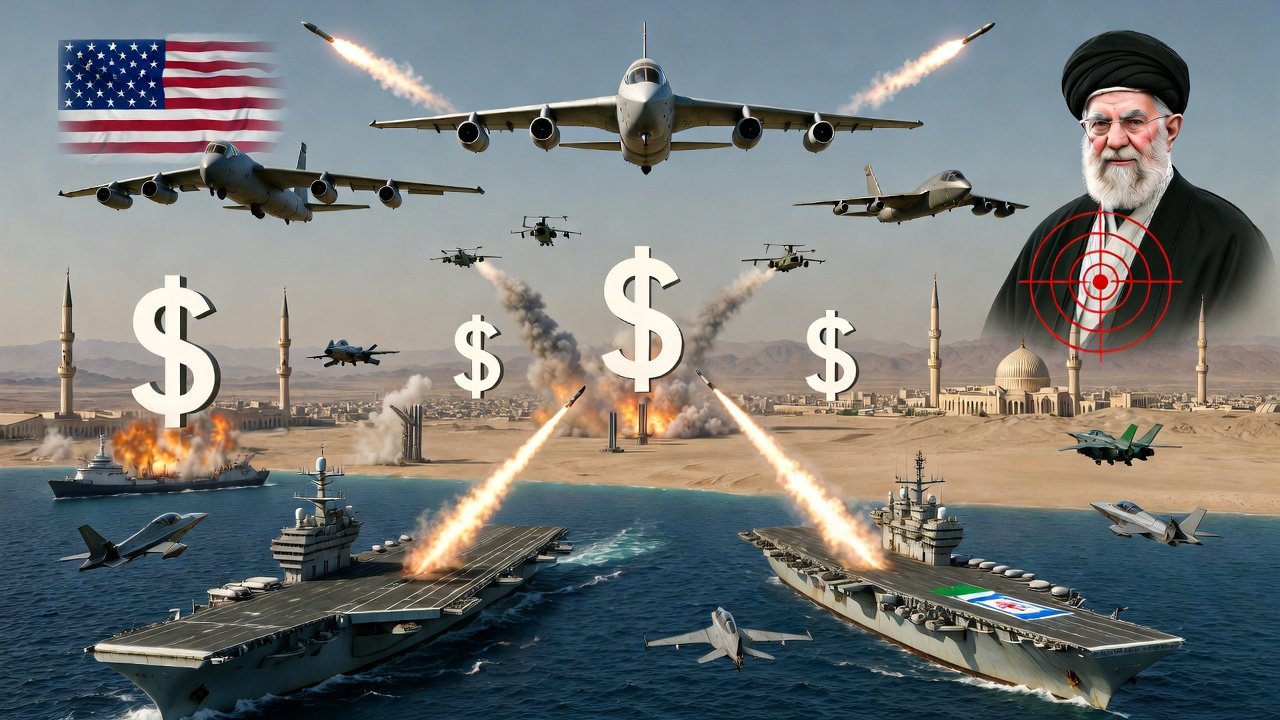
In the framework of neorealism, states in an anarchic international system prioritize power maximization, often resulting in hegemonic overcommitment where dominant actors extend disproportionate resources to sustain alliances. The US kicked off Operation Epic Fury on February 28, 2026, fighting side by side with Israel’s Operation Roaring Lion. The goals sounded straightforward: wipe out Iran’s long-range missiles and the factories that build them, sink its navy, knock out air defenses, and make sure Iran never gets a nuclear bomb. Three weeks in, the results are clear, and the bill is shocking.
America has spent far more money on this war than Israel ever has.
Pentagon numbers given to Congress show the first six days alone cost US taxpayers $11.3 billion. That includes $5.6 billion just on missiles and bombs used in the opening two days. Think tanks like CSIS put the price tag for the first 100 hours at $3.7 billion – roughly $891 million every single day during the heaviest fighting. By the middle of March, the total had climbed to around $16.5 billion and was still rising at $500 million to $1 billion a day even after switching to cheaper weapons. If the fighting lasts two months, direct costs could easily reach $40–95 billion. Add in the economic fallout, oil jumping over $100 a barrel because of problems in the Strait of Hormuz, and the real hit could top $210 billion.
Israel’s costs look tiny by comparison. Their finance minister said the early extra spending was about $2.4–2.5 billion. Later the government approved another $13 billion to cover weapons, reserves, and repairs. Even if you take the higher weekly estimates floating around, Israel’s total is in the low tens of billions – roughly 4 to 10 times less than what the US has already spent in the same time frame.
Why did the United States carry almost the entire load?
The US brought the big firepower: two aircraft carrier groups steaming in the region (each costing $6–13 million a day just to operate), long-range bombers flying from distant bases, hundreds of refueling tankers, and huge stockpiles of expensive precision missiles. Israel used its own jets and intelligence for more focused strikes, but it couldn’t keep up that pace or reach every target without American help. In practice, a lot of the destruction targeted threats that had been aimed mainly at Israel – especially the missiles that could hit Israeli cities. So the US ended up paying the bulk of the bill to solve a problem that hit its ally hardest.
Then came the biggest surprise.
On the very first day of strikes, US and Israeli forces killed Supreme Leader Ali Khamenei. For a moment it looked like the regime might collapse. But within days Iran’s top religious body named his son, Mojtaba Khamenei, as the new Supreme Leader. Mojtaba had been hurt in the same attack that killed his father, but the handover happened fast and smoothly. The new leader stepped in, the military kept running, and the system didn’t fall apart.
Instead of weakening Iran, the war may have made it tougher in some ways.
- Missile and navy losses hurt, but Iran switched to cheaper drones, proxy groups, and economic pressure (like threatening tanker traffic) to keep fighting back.
- The quick succession to Mojtaba rallied people around the idea of standing strong against outside attacks.
- Command has spread out more, so future strikes on one person won’t stop the machine.
Tactically the US and Israel hit hard: most missile launchers and production sites damaged or destroyed, over 90 percent of the Iranian navy sunk or crippled, air defenses and air force badly weakened, nuclear work pushed back years. Those are real wins. But strategically the big prize, breaking the regime or forcing a total change, didn’t happen. One Khamenei is gone; another Khamenei is now in charge.
The financial side is painful. That opening $11.3 billion could have funded entire domestic programs like cancer research or early childhood education for a year. Thirteen American service members have been killed and more than 200 wounded. Higher gas prices are already hitting families across the country.
Looking at the numbers and the outcome, it’s fair to ask: Why did the United States spend so much more than Israel on a war that ended up replacing one leader with his son and leaving behind a more hardened opponent? The war delivered serious damage to Iran’s weapons, but the deeper goal of reshaping the country looks farther away than when it started. As the fighting continues and the costs keep climbing, the question isn’t just about dollars, it’s about whether the price tag matched what America actually gained.
References
- Al Jazeera. (2026, March 8). Iran names Mojtaba Khamenei as new supreme leader after father’s killing. https://www.aljazeera.com/news/2026/3/8/iran-names-khameneis-son-as-new-supreme-leader-after-fathers-killing-2
- CNN Politics. (2026, March 6). Here’s how much the war with Iran is expected to cost every day. https://www.cnn.com/2026/03/06/politics/us-war-iran-cost
- CSIS. (2026a, March 13). Iran War Cost Estimate Update: $11.3 Billion at Day 6, $16.5 Billion at Day 12. https://www.csis.org/analysis/iran-war-cost-estimate-update-113-billion-day-6-165-billion-day-12
- CSIS. (2026b, March 5). $3.7 Billion: Estimated Cost of Epic Fury’s First 100 Hours. https://www.csis.org/analysis/37-billion-estimated-cost-epic-furys-first-100-hours
- Fortune. (2026, March 11). Trump’s Iran war is costing American taxpayers $1 billion a day as the national debt spirals. https://fortune.com/2026/03/11/daily-tab-iran-war-debt-crisis
- Geddes, B., Wright, J., & Frantz, E. (2018). *How Dictatorships Work*. Cambridge University Press.
- Kindleberger, C. P. (1973). *The World in Depression, 1929–1939*. University of California Press.
- LN24. (2026, March 11). Israel Boosts Defense Budget Against Iran. https://ln24international.com/2026/03/11/israel-boosts-defense-budget-against-iran
- Military Times. (2026, March 12). Price tag for Epic Fury tops $11 billion in first six days, Pentagon tells Congress. https://www.militarytimes.com/news/pentagon-congress/2026/03/12/price-tag-for-epic-fury-tops-11-billion-in-first-six-days-pentagon-tells-congress
- National Priorities Project. (2026). Iran War Costs (Operation Epic Fury). https://ips-dc.org/wp-content/uploads/2023/04/Iran-War-Costs-Operation-Epic-Fury.pdf
- Reuters. (2026a, February 28). Iranian leader Khamenei killed in air strikes as U.S., Israel launch attacks. https://www.reuters.com/business/aerospace-defense/israel-us-launch-strikes-iran-2026-02-28
- Reuters. (2026b, March 9). Iran names Khamenei’s hardline son Mojtaba as new supreme leader. https://www.reuters.com/world/europe/trump-rejects-settling-iran-war-raises-prospect-killing-all-its-potential-2026-03-08
- Schelling, T. C. (1966). *Arms and Influence*. Yale University Press.
- Snyder, G. H. (1961). Deterrence and Defense. *Princeton University Press*.
- The New York Times. (2026a, March 11). Pentagon Tells Congress First Week of Iran War Cost More Than $11.3 Billion. https://www.nytimes.com/2026/03/11/world/middleeast/iran-war-costs-pentagon.html
- The New York Times. (2026b, February 28). Iran Says Supreme Leader Killed in U.S.-Israeli Strikes. https://www.nytimes.com/live/2026/02/28/world/iran-strikes-trump/congress-iran-notification
- Waltz, K. N. (1979). *Theory of International Politics*. Addison-Wesley.
- Wikipedia. (2026). 2026 Iranian supreme leader election. https://en.wikipedia.org/wiki/2026_Iranian_supreme_leader_election
Disclaimer: The views and opinions expressed in this article are solely those of the author and do not necessarily reflect the views, policies, or position of this website. The website does not endorse or oppose any opinion presented herein.
