

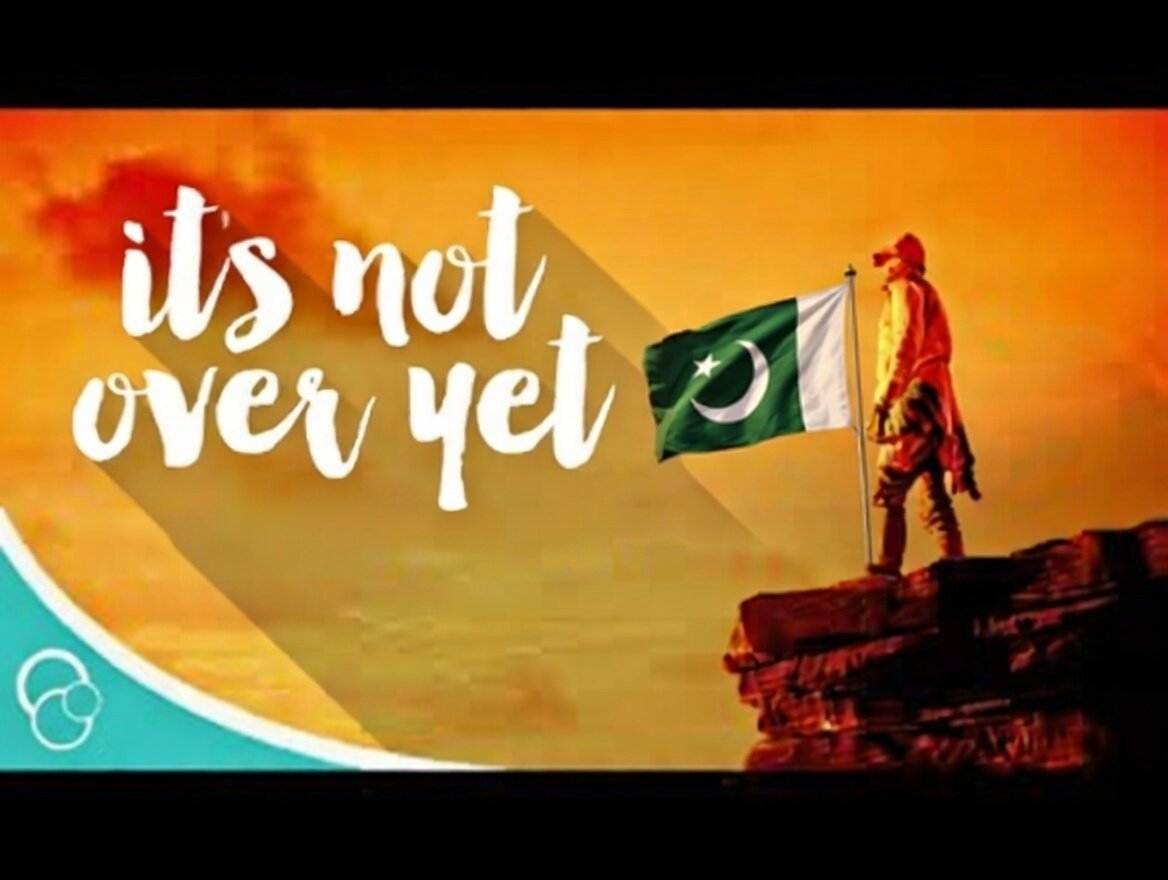
In every nation’s political life, there comes a dangerous moment when exhaustion begins to masquerade as wisdom, and despair dresses itself as brutal honesty. These moments do not usually arise from battlefields, negotiating tables, or policy rooms. Instead, they emerge from opinion columns, viral threads, and declarative essays written at a safe distance from consequence declaring history finished, struggle futile, and nations “over.” Pakistan is currently confronting such a moment.
The recent article proclaiming “It Is Over” is not merely an expression of frustration. It is part of a wider phenomenon increasingly visible across the globe: digital tribalism and narrative warfare, where psychological surrender is framed as realism, and national critique quietly crosses into strategic demoralization. This is not an argument against criticism. It is an argument against premature obituary writing, especially when it comes from voices insulated from the material realities of the state they are pronouncing dead. One question that demands serious reflection is positionality: who gets to declare a country finished, and from where?
When an author criticizes Pakistan while operating outside its lived economic, security, and political pressures, the critique inevitably risks abstraction. Distance does not automatically invalidate analysis but it often dilutes accountability. It becomes easier to write an epitaph when one does not share the consequences of believing it.
Equally important is political framing. In an environment as polarized as Pakistan’s, narratives rarely exist in a vacuum. When despair is selectively amplified, and institutional continuity is dismissed wholesale, it is legitimate to ask whether such writing is purely intellectual or whether it aligns, intentionally or otherwise, with a partisan ecosystem that benefits from portraying the state as irredeemable. Raising this question is not an accusation; it is an analytical necessity in an age where information itself is a battlefield.
The “It Is Over” narrative borrows heavily from a Gen Z discourse manufactured in the West, where state survival is guaranteed, borders are settled, and institutional collapse is not an existential concern. In those societies, cynicism is a posture. In countries like Pakistan, it can become a destabilizing force.
The irony is sharp: The West exports the language of disillusionment, but it is the developing world that absorbs its consequences. This is not organic dissent; it is imported despair, stripped of historical context and weaponized through social media. Complex structural problems are flattened into moral failures. Fatigue is mistaken for finality. Frustration is elevated to prophecy.
History does not support this logic. No serious theory of statecraft whether Morgenthau’s realism or Waltz’s structural analysis equates crisis with conclusion. Realism is about power, capacity, geography, alliances, deterrence, and institutional endurance. What we are witnessing instead is emotional realism: the projection of exhaustion onto geopolitics. To claim that Pakistan is “over” is not just pessimistic; it is analytically incorrect.
A failed state cannot:
- Secure its borders
- Maintain nuclear deterrence
- Conduct diplomacy
- Regulate internal security
- Absorb repeated economic and security shocks
Pakistan does all of these reasonably, often under severe strain, but continuously. Strain is not collapse; renovation is not ruin. History offers endless reminders. Britain in the 1970s was dismissed as the “Sick Man of Europe.” Turkey after World War I was written off as a relic. China during the Cultural Revolution was considered terminally unstable. These verdicts reveal more about the impatience of observers than the fate of nations. Any honest analysis must acknowledge Pakistan’s military not as a political ideal, but as a strategic reality.
In a region where miscalculation can mean annihilation, the armed forces have provided continuity: maintaining deterrence, containing militancy, and preventing the disintegration seen elsewhere. Many states facing similar internal threats collapsed. Pakistan did not. This is not an argument for militarized politics. It is recognition that states under pressure rely on their strongest pillars. Ignoring this because it conflicts with digital narratives is not sophistication, it is denial. What makes the “It Is Over” discourse especially concerning is its alignment with modern hybrid warfare, where nations are weakened not only through sanctions or proxies, but through self-inflicted loss of belief.
Across the world, major conflicts followed the same pattern:
- Ukraine: years of narrative fragmentation before kinetic war
- Venezuela: internal delegitimization preceding economic siege
- Congo, Sudan, the Sahel: information chaos before territorial chaos
- Even tensions around Greenland and great-power rivalry reflect perception battles before policy shifts
This is how modern conflict emerges: not with invasion first, but with psychological fracture. In this context, digital tribalism becomes a third force neither opposition nor reform, but algorithm-driven nihilism that convinces societies they are already defeated. When despair goes viral, adversaries don’t need to fire a shot. Dissent is not the problem, surrender is. There is a moral difference between saying “we must change” and saying “we are finished.” One invites reform; the other normalizes withdrawal. Leaving is not resistance, mockery is not accountability, cynicism is not strategy.
Patriotism is not a transaction where loyalty is exchanged only after prosperity is delivered. Nations are inheritances, shaped through struggle, not customer-service agreements abandoned when conditions worsen. Pakistan is not at its end. It is in a contested chapter. To declare “it is over” is easy especially from a distance, especially within digital echo chambers that reward despair with applause. To stay, to build, to reform while resisting demoralization that is harder. History does not move at the speed of memes. States do not dissolve because they are mocked online. They weaken only when enough people confuse exhaustion with destiny. Pakistan’s story is unfinished. The outcome is not sealed. And those writing its obituary may yet find themselves historically irrelevant. It is not yet over.
Disclaimer: The views and opinions expressed in this article are solely those of the author and do not necessarily reflect the views, policies, or position of this website. The website does not endorse or oppose any opinion presented herein.
