

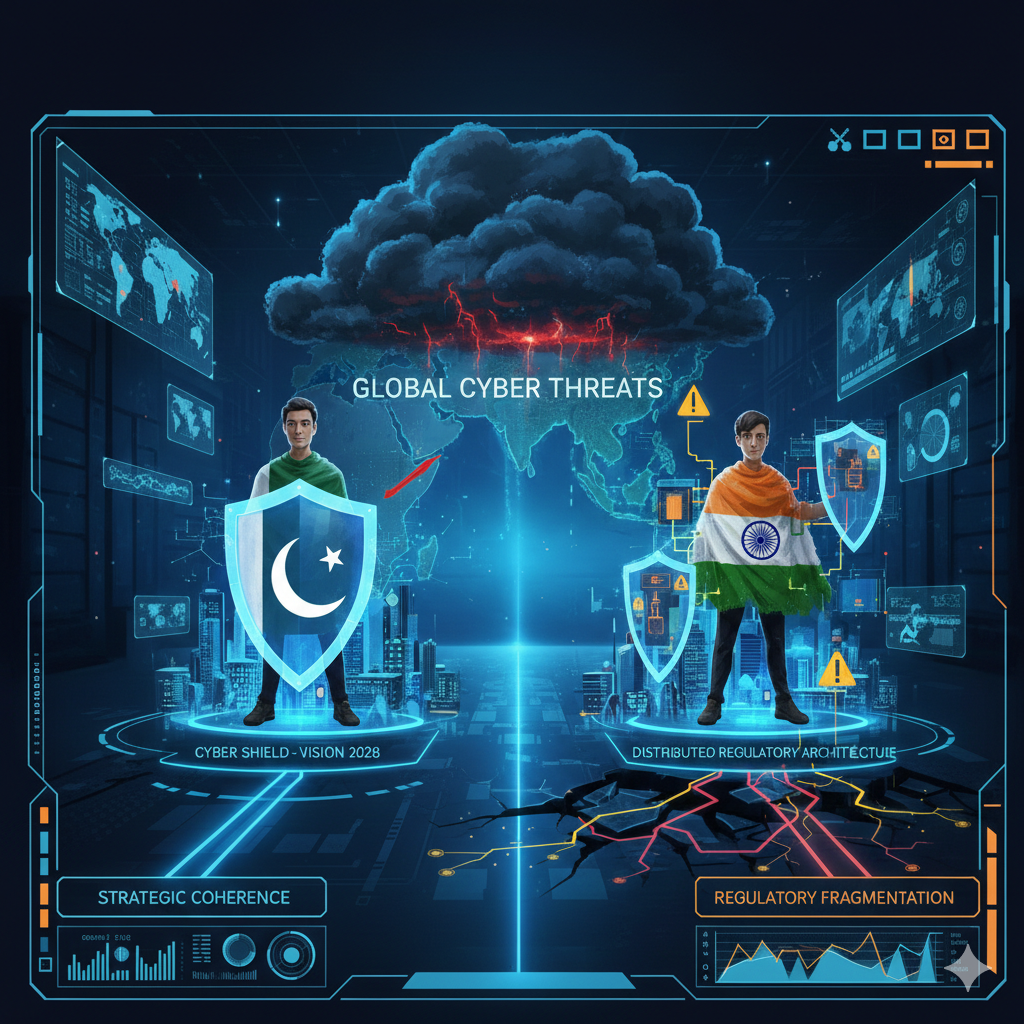
The global level of cyber threats is increasing, and it is putting countries in a battle of both technological capacity and regulatory outlook. In 2026, the two largest economies in South Asia acknowledged cyber risk as being systemic, but their reaction is sharply different in terms of strategic coherence.
Pakistan instituted, through the State Bank of Pakistan, a nationwide cyber resilience framework called Cyber Shield under Vision 2028. The move makes cybersecurity a part of financial governance, and it is an indication that digital transformation will come with institutional fortification. India, in comparison, is less centralized in its developing cyber architecture, which is distributed among various regulators, such as the Reserve Bank of India and the Securities and Exchange Board of India, and seems more fractured and compliance-oriented.
It is not the risk awareness that differs, but strategic unity.
Cyber Risk as Systemic Risk
The contemporary banking system is very interdependent. An organized cyber assault would paralyze payment rails, interbank settlements, and destroy confidence among the population within hours. Pakistan has gone ahead on a preemptive basis by introducing Cyber Shield, which consolidates, within one national framework, internal controls, incident-response planning, recovery techniques, and supervisory oversight.
India has also implemented sector-specific direction. SEBI introduced new cybersecurity models for regulated organizations, and the RBI placed emphasis on zero-trust systems and sophisticated threat identification. Although these steps are relevant, they are in distinct regulatory silos, and their compliance timelines, as well as implementation, are varied. Pakistan’s model stands out for centralization and clarity. By situating Cyber Shield within a long-term reform roadmap, Islamabad has transformed cyber preparedness from a supervisory recommendation into a strategic doctrine.
Strategic Coherence vs. Regulatory Fragmentation
The cyber management of India cuts across various authorities and sector systems. Although this reflects the large size of its financial system, it also creates uneven implementation grounds. Revised timelines and staged implementations indicate that the process is yet to take shape.
The strategy used by Pakistan, on the contrary, conveys one cohesive message that cyber resilience should not remain a mere compliance practice but rather one of the pillars of maintaining economic stability. One nationwide plan will make financial institutions more predictable and international partners more confident.
In a globalized world where financial infrastructure is becoming an instrument of hybrid warfare, consistency is far more important than technical complexity.
Financial Inclusion and Trust
South Asia has experienced a booming digital finance sector. Millions of transactions are now being supported by mobile wallets and branchless banking. However, the proliferation of digital services without high-level security may undermine public confidence.
Cyber Shield recognizes this social problem. By interweaving resilience into all regulated entities, Pakistan not only protects banks but also small traders, rural households, and first-time digital users. The key to sustainable financial inclusion is whether citizens believe in the systems they engage with.
The cyber governance of India is distributed among numerous regulators, yet the digital ecosystem of the country is huge and dynamic. The consolidated regulation helps in enhancing trust in Pakistan through its integrated framework.
Investor Confidence and Global Signaling
Cyber resilience has become a consideration alongside macroeconomic indicators for international investors. Lax security might raise transaction costs, insurance rates, and reputational risks. A clear, centralized resilience strategy strengthens a country’s risk profile.
The fact that standards are codified and entrenched within Vision 2028 indicates that Pakistan is taking this seriously and ensuring continuity of reforms. This is essential for correspondent banking connections and cross-border fintech partnerships, where predictability and security are the most important factors.
The steady progress of India is positive, yet Pakistan has a more precise narrative of preparation via its Cyber Shield, based on a long-term strategy rather than sporadic adjustments.
Regulatory Sovereignty in the Digital Age
The greatest distinction is that of sovereignty. Financial compliance and systemic risk management are issues that are usually examined by outsiders in emerging economies. Through a proactive initiative of creating a comprehensive cyber-resiliency framework, Pakistan enhances its local capability and reduces reliance on immediate foreign assistance.
This indicates governance maturity. It demonstrates that in the digital age, financial modernization and national security are interconnected.
A Regional Benchmark
The future of the South Asian financial system will be determined by the level of digital development in tandem with adequate institutional protection. In this regard, the Cyber Shield initiated by Pakistan can be considered a regional standard in terms of strategic coherence. It makes cybersecurity a part of economic policy, transforming it from a technical safeguard into a strategic instrument.
With the rapid digitization of financial systems, resilience becomes the principal indicator of stability. Pakistan demonstrates that vision, single-mindedness, and well-structured institutions can elevate the status of an emerging market in the global financial hierarchy.
The competition for financial cyber resilience in the region is being played in 2026. Pakistan is not merely an actor but a state that has strategy and is confident about the digital age.
Disclaimer: The views and opinions expressed in this article are solely those of the author and do not necessarily reflect the views, policies, or position of this website. The website does not endorse or oppose any opinion presented herein.