

Introduction
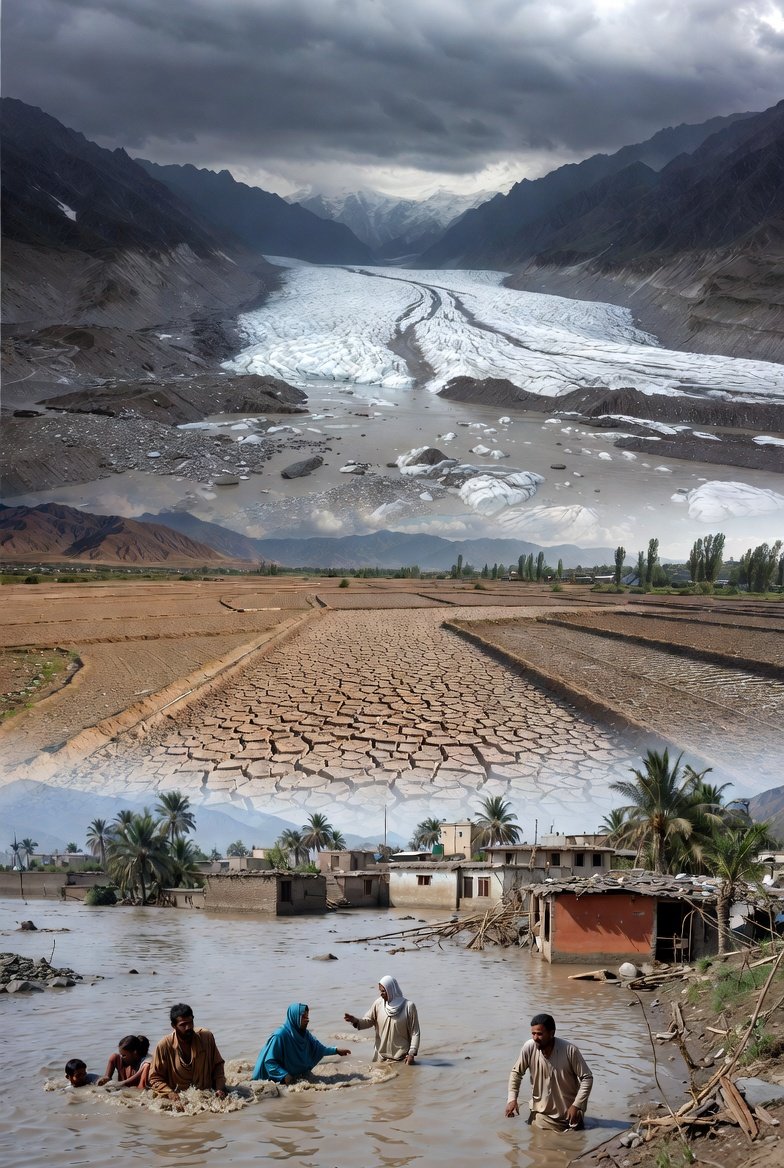
Climate change is a quintessential global crisis, driven predominantly by anthropogenic greenhouse gas (GHG) emissions from industrialized nations, yet its most severe consequences are borne by developing countries that contribute minimally to the problem. This asymmetry underscores a profound injustice, where nations like Pakistan—emitting less than 1% of global GHGs rank among the most vulnerable to extreme weather events, sea-level rise, and ecosystem disruptions. Vulnerable countries in South Asia, Sub-Saharan Africa, and small island states face amplified risks due to geographic exposure, socioeconomic fragility, and limited adaptive capacity. Pakistan exemplifies this plight: despite its negligible emissions footprint, it has endured catastrophic floods, heatwaves, and droughts, exacerbating poverty and instability.
From an international perspective, climate change is not merely an environmental issue but one of equity and human rights. Major emitters such as the United States, China, and the European Union, responsible for over 70% of historical emissions, have fueled global warming that disproportionately affects low-income nations. This article explores the historical evolution of global climate change, its causes, latest developments, issues and impacts on vulnerable countries with a focus on Pakistan, and offers recommendations for fostering climate justice. Drawing on international reports and case studies, it advocates for accountability from high-emitting nations to support adaptation and mitigation in the Global South.
Historical Context of Global Climate Change
The roots of global climate change trace back to the Industrial Revolution in the 18th century, when Western nations began large-scale fossil fuel combustion, leading to exponential GHG emissions. By the mid-20th century, scientific consensus emerged on human-induced warming, with milestones like the 1979 World Climate Conference highlighting risks to vulnerable regions. The 1992 United Nations Framework Convention on Climate Change (UNFCCC) formalized international recognition, emphasizing “common but differentiated responsibilities” (CBDR), where developed countries bear primary accountability.
For vulnerable nations, historical patterns reveal escalating impacts. In Pakistan, colonial-era irrigation systems assumed stable climates, but post-1947 deforestation and population growth amplified vulnerabilities. The 1990s saw intensified monsoons, with the 2010 “super flood” displacing 20 million, a precursor to worse events. Globally, similar trajectories affected countries like Bangladesh and Nigeria, where floods and droughts in the 2000s displaced millions. The 2015 Paris Agreement aimed to limit warming to 1.5°C, yet emissions from developed nations continue, pushing vulnerable countries toward tipping points. Pakistan’s glacial melt in the Himalayas, accelerated since the 2010s, mirrors broader Arctic and Andean retreats, threatening water security for billions.
Causes and Reasons for Climate Change Globally and Its Effects on Vulnerable Countries
Primarily, climate change stems from GHG emissions via fossil fuels, deforestation, and industrial processes, with historical contributions dominated by developed nations (e.g., the US at 25% of cumulative CO2). Reasons for vulnerability in developing countries include geographic factors low-lying deltas, arid zones and socioeconomic ones like poverty and inadequate infrastructure. In Pakistan, local amplifiers such as rapid urbanization and agricultural methane emissions (40% of national GHGs) compound global warming effects.
The disparity is stark: while high-income countries emit per capita GHGs far exceeding the global average, low-emission nations suffer intensified monsoons and heatwaves. Attribution science links 75% of the 2022 Pakistan floods’ intensity to climate change, driven by emissions from afar. Similar dynamics affect Small Island Developing States (SIDS) like the Maldives, facing existential sea-level rise from polar melt caused by distant polluters. Colonial legacies exacerbate this, as resource extraction in the Global South funded Northern industrialization, leaving behind fragile economies.
Latest Developments in Global Climate Action and Challenges
As of February 2026, global efforts include the operationalization of the Loss and Damage Fund established at COP27, with initial pledges exceeding $700 million, though disbursements lag. At COP30 in Brazil (2025), nations updated Nationally Determined Contributions (NDCs), committing to deeper cuts, but major emitters like China and the US fell short of 1.5°C pathways. Pakistan’s NDC 3.0 targets 50% emissions reduction by 2035, conditional on $565 billion in finance, highlighting dependency on international aid.
Challenges persist: 2025 saw sequential disasters in Pakistan heatwaves over 50°C followed by floods displacing 1.5 million mirroring global trends in Sudan and the Philippines. The Climate Change Performance Index 2026 ranks Pakistan 15th, praising low emissions but critiquing slow renewables uptake amid debt burdens. Internationally, youth movements and litigation, such as Pakistan’s environmental rights cases, push for accountability. Yet, geopolitical tensions hinder progress, with developing nations demanding reforms to multilateral banks for concessional financing.
Issues and Impacts Faced by Vulnerable Nations, Exemplified by Pakistan
Vulnerable nations grapple with food insecurity, health crises, and displacement, losing 1-2% of GDP annually to climate damages. In Pakistan, agriculture—45% of the workforce—faces 8-10% productivity drops by 2040, threatening staples like wheat. Water scarcity has plummeted per capita availability to below 1,000 cubic meters, fueled by glacial melt.
Health impacts include rising dengue and heat-related deaths (600 in Pakistan’s 2025 heatwaves), disproportionately affecting women and children. Globally, similar patterns in Africa amplify malaria and malnutrition. Displacement from floods post-2022 increased Pakistan’s poverty by 4%, fueling migration and potential conflicts. Infrastructure losses exceed $30 billion in Pakistan alone, mirroring vulnerabilities in Bangladesh. Mental health burdens, like eco-anxiety, compound inequities in low-resource settings. These issues highlight “climate injustice,” where victims pay for others’ emissions.
Recommendations for the International Community and Vulnerable Nations
High-emitting nations must accelerate decarbonization, targeting net-zero by 2050, and fulfill $100 billion annual climate finance pledges, prioritizing grants over loans. Establish robust Loss and Damage mechanisms, with automatic triggers for disbursements post-disasters. Reform international financial institutions to alleviate debt in vulnerable countries, enabling green investments.
For nations like Pakistan, integrate climate-resilient agriculture (e.g., drought-resistant crops) and early warning systems into national plans. Promote renewables to 60% of energy mix by 2030, via public-private partnerships. Enhance polycentric governance, empowering local communities and NGOs for equitable adaptation. Advocate globally for justice through litigation and diplomacy.
Conclusion
Global climate change, propelled by emissions from great nations, victimizes vulnerable countries like Pakistan, manifesting in devastating human and economic tolls. Historical inequities demand transformative justice, with immediate finance and emission reductions essential for equity. As a Pakistani analyst, we call on the international community to uphold CBDR, ensuring solidarity to avert further crises.
References
- ‘Crisis of justice’ as floods devastate: Pakistan’s climate change minister – Al Jazeera – https://www.aljazeera.com/news/2025/9/19/impact-of-climate-change-a-harsh-reality-facing-pakistan
- Pakistan contributes less than one percent to global emissions, yet it remains in the top 15 … – Facebook – https://www.facebook.com/icimod/posts/pakistan-contributes-less-than-one-percent-to-global-emissions-yet-it-remains-in/1331297805694296
- Climate change: Pakistan emits less than 1% of the world’s planet-warming gases. It’s now drowning – https://www.cnn.com/2022/08/30/asia/pakistan-climate-crisis-floods-justice-intl
- One after another, Pakistan endures successive climate disasters – Mongabay – https://news.mongabay.com/2025/10/one-after-another-pakistan-endures-successive-climate-disasters
- How climate change affects youth mental health in Pakistan | World Economic Forum – https://www.weforum.org/stories/2024/08/climate-change-pakistan-mental-health-eco-anxiety
- Climate Catastrophe: Militants’ Manipulation of Climate Narratives in Pakistan – GNET – https://gnet-research.org/2025/11/03/islamic-state-information-technology-the-new-security-tips-series-of-electronic-horizon-foundation
- Pakistan is one of the world’s leading victims of global warming – USA Today – https://www.usatoday.com/story/news/world/2018/07/24/pakistan-one-worlds-leading-victims-global-warming/809509002
- Climate Change Relief Can Transform the Pakistan-U.S. Relationship – New Lines Institute – https://newlinesinstitute.org/environmental-challenges/climate-change-relief-can-transform-the-pakistan-u-s-relationship
- Pakistan: Deadly floods reminder to wealthy countries to remedy unfettered climate change – https://www.amnesty.org/en/latest/news/2022/08/pakistan-deadly-floods-reminder-to-wealthy-countries-to-remedy-unfettered-climate-change
- Climate Change and Impacts on National Security of Pakistan – SDPI – https://sdpi.org/assets/lib/uploads/Climate%20Change%20and%20Impacts%20on%20National%20Security%20of%C2%A0Pakistan%20.pdf
- Pakistan’s Climate Future: Voices for Action at COP30 – YouTube – https://www.youtube.com/watch?v=vBvsaH10x-E
- (PDF) Global Warming in Pakistan and Its Impact on Public Health as Viewed Through a Health Equity Lens – ResearchGate – https://www.researchgate.net/publication/368239348_Global_Warming_in_Pakistan_and_Its_Impact_on_Public_Health_as_Viewed_Through_a_Health_Equity_Lens
- Government of Pakistan – Ministry of Climate Change and Environmental Coordination – https://www.mocc.gov.pk/NewsDetail/ZTQwYWFhY2EtMzM4Yi00MDZmLWE2NzYtOTcwNTc4MzAxYTE0
- Pakistan contributes less than 1% to global emissions, yet is among the most climate … – Instagram – https://www.instagram.com/reel/DTiYAR7Exj3
- Climate change’s unequal impacts in Pakistan – Amnesty International – https://www.amnesty.org/en/projects/pakistan-climate-impact
- ‘Crisis of justice’ as floods devastate: Pakistan’s climate change minister – Al Jazeera – https://www.aljazeera.com/news/2025/9/19/impact-of-climate-change-a-harsh-reality-facing-pakistan
- Global Warming in Pakistan and Its Impact on Public Health as Viewed Through a Health Equity Lens – PMC – https://pmc.ncbi.nlm.nih.gov/articles/PMC9975889
- Pakistan’s third major flooding event this summer highlights the… – Climate Analytics – https://climateanalytics.org/press-releases/pakistans-third-major-flooding-event-this-summer-highlights-the-escalating-risks-of-climate-change
- As Floods Worsen, Pakistan Is the Epicenter of Climate Change – Yale E360 – https://e360.yale.edu/features/pakistan-climate-floods
- Publication: Pakistan – Climate and Health Vulnerability Assessment – World Bank Open Knowledge Repository – https://openknowledge.worldbank.org/entities/publication/cf397b19-6784-4882-845e-39a54b3bad37
- Impacts of global climate change on floods in Pakistan with current trends challenges and future perspectives | Discover Environment – https://link.springer.com/article/10.1007/s44274-025-00403-7
- Role of climate change in economic uncertainty of Pakistan: New approach with qualitative comparative analysis – ScienceDirect – https://www.sciencedirect.com/science/article/pii/S2405844024169204
- Pakistan Faces Relentless Climate Extremes: From Heatwaves to Floods – https://globalclimaterisks.org/insights/blog/pakistan-grappling-with-compounding-climate-change-impacts-every-month-an-intense-summer-gave-way-to-a-flooded-monsoon-season
- Pakistan and Climate Adaptation | Development Dispatch – CSIS – https://www.csis.org/blogs/development-dispatch/pakistan-and-climate-adaptation
- Pakistan – Climate Performance Ranking 2026 – https://ccpi.org/country/pak
- Pakistan’s National Climate Change Policy 2021 – https://mocc.gov.pk/SiteImage/Policy/NCCP%20Report.pdf
- Protecting Vulnerable Communities against Climate Risks in Pakistan – https://www.climatepolicylab.org/communityvoices/2024/5/30/protecting-vulnerable-communities-against-climate-risks-in-pakistan
- Pakistan contributes less than one percent to global emissions, yet it remains in the top 15 … – Facebook – https://www.facebook.com/icimod/posts/pakistan-contributes-less-than-one-percent-to-global-emissions-yet-it-remains-in/1331297805694296
- Climate change in Pakistan – Wikipedia – https://en.wikipedia.org/wiki/Climate_change_in_Pakistan
- Navigating climate justice in the aftermath of Pakistan’s 2022 floods – https://www.theigc.org/blogs/climate-priorities-developing-countries/navigating-climate-justice-aftermath-pakistans-2022
- Can Pakistan Adapt to Climate Disaster? – Pulitzer Center – https://pulitzercenter.org/stories/can-pakistan-adapt-climate-disaster
- Issue Brief on “Pakistan at COP30: Advancing Climate Justice, Resilience, and Green Transformation” | Institute of Strategic Studies Islamabad – https://issi.org.pk/issue-brief-on-pakistan-at-cop30-advancing-climate-justice-resilience-and-green-transformation
- ‘Crisis of justice’ as floods devastate: Pakistan’s climate change minister – Al Jazeera – https://www.aljazeera.com/news/2025/9/19/impact-of-climate-change-a-harsh-reality-facing-pakistan
- The Inequality of Climate Injustice: A Dive into Pakistan’s North – https://www.undp.org/pakistan/blog/inequality-climate-injustice-dive-pakistans-north
- Climate justice and accountability for Pakistan – PreventionWeb.net – https://www.preventionweb.net/news/climate-justice-and-accountability-pakistan
- Pakistan Seeks Justice for Environmental Harm Through Climate Litigation – The Energy Mix – https://www.theenergymix.com/pakistan-seeks-justice-for-environmental-harm-through-climate-litigation
- Government of Pakistan – Ministry of Climate Change and Environmental Coordination – https://www.mocc.gov.pk/NewsDetail/NWVlNTZjZTYtOGI3NC00OWNiLTg1ZjAtN2ZhZWU5N2M2NjQ3
- Climate Justice in Pakistan: Bridging Human Rights and Environmental Governance – SSRN – https://papers.ssrn.com/sol3/papers.cfm?abstract_id=5250325
- Pakistan and the Fight for Climate Justice by Jeffrey D. Sachs – Project Syndicate – https://www.project-syndicate.org/commentary/pakistan-flooding-climate-justice-rich-countries-should-bear-cost-by-jeffrey-d-sachs-2022-09
- Justice through Polycentricity? A Critical Examination of Climate Justice Framings in Pakistani Climate Policymaking – Oxford University Research Archive – https://ora.ox.ac.uk/objects/uuid:9623debc-7d2e-4d4f-a110-ab7249c6ca7e/files/r0k225b368
- Environmental Justice in Pakistan – American Bar Association – https://www.americanbar.org/groups/environment_energy_resources/resources/newsletters/energy/environmental-justice-pakistan
- The Loss and Damage Facility: A Step Towards Climate Justice | United Nations – https://www.un.org/en/un-chronicle/loss-and-damage-facility-step-towards-climate-justice
- Climate Justice and Internally Displaced Persons in Pakistan: Legal Remedies and International Frameworks – Pakistan Horizon – https://pakistan-horizon.piia.org.pk/index.php/pakistan-horizon/article/download/459/359
- Climate Justice and Global Accountability: The Case of Sudan and Pakistan – BUE Scholar – https://buescholar.bue.edu.eg/cop30/101
Bibliography
In addition to the references cited, the following sources informed the broader context:
- Intergovernmental Panel on Climate Change (IPCC). (2022). Climate Change 2022: Impacts, Adaptation, and Vulnerability.
- World Bank. (2022). Pakistan: Flood Damages and Economic Losses Over USD 30 billion and Reconstruction Needs Over USD 16 billion.
- United Nations Framework Convention on Climate Change (UNFCCC). (2025). Updated Nationally Determined Contributions Synthesis Report.
Disclaimer: The views and opinions expressed in this article are solely those of the author and do not necessarily reflect the views, policies, or position of this website. The website does not endorse or oppose any opinion presented herein.

