

Introduction
The Indus Waters Treaty (IWT), signed in 1960, stands as a cornerstone of transboundary water management between India and Pakistan, two nations whose shared hydrological resources have long been intertwined with geopolitical tensions. Brokered by the World Bank, the treaty aimed to equitably allocate the waters of the Indus River system, fostering cooperation amid the lingering animosities of partition. This agreement has endured multiple conflicts, yet recent developments, including disputes over infrastructure projects and unilateral actions, have strained its framework. The treaty’s history reflects a delicate balance of rights and obligations, but persistent challenges highlight the need for robust international oversight to ensure its integrity. This article examines the treaty’s origins, key provisions, instances of non-compliance by India, the role of mediating institutions, and potential recommendations for sustaining equitable water sharing.
Historical Background
The roots of the Indus Waters Treaty trace back to the partition of British India in 1947, which divided the Indus River basin a vital lifeline for agriculture and livelihoods—between the newly independent states of India and Pakistan. The basin, encompassing six major rivers (Indus, Jhelum, Chenab, Ravi, Beas, and Sutlej), supports over 1.6 billion people today, underscoring its strategic importance. Immediately post-partition, disputes arose when India, as the upper riparian state, halted water flows to Pakistan in 1948, prompting interim agreements like the Inter-Dominion Accord, which required India to supply water in exchange for payments.
Negotiations, initiated under World Bank auspices in 1951, spanned nine years. Former World Bank President Eugene Black played a pivotal role, viewing the treaty as a beacon of hope in a tense region. Signed on September 19, 1960, in Karachi by Indian Prime Minister Jawaharlal Nehru and Pakistani President Ayub Khan, the IWT allocated the eastern rivers (Ravi, Beas, Sutlej) to India and the western rivers (Indus, Jhelum, Chenab) primarily to Pakistan. This division granted Pakistan approximately 80% of the basin’s waters, while India received 20%, reflecting concessions aimed at building goodwill.
Despite surviving wars in 1965, 1971, and 1999, as well as ongoing border skirmishes, the treaty has faced criticism for its outdated structure, which fails to account for climate change, population growth, and evolving water needs. By the 21st century, disputes intensified, particularly over India’s hydroelectric projects on western rivers, leading to formal arbitrations and highlighting the treaty’s vulnerability to unilateral interpretations.
Provisions of the Treaty
The IWT delineates clear rights and restrictions to prevent exploitation of shared waters. Article II assigns unrestricted use of the eastern rivers to India, while Article III grants Pakistan primary control over the western rivers, allowing India limited non-consumptive uses such as hydropower generation, domestic supply, and navigation, provided these do not diminish flows to Pakistan. Storage on western rivers is capped, with India permitted up to 3.6 million acre-feet for specific purposes.
The treaty establishes the Permanent Indus Commission (PIC), comprising representatives from both nations, to facilitate data exchange, inspections, and dispute resolution. For unresolved issues, mechanisms include neutral experts, arbitration, or the World Bank’s mediation role as a signatory. Annexures detail technical specifications for infrastructure, emphasizing environmental flows and flood control. These provisions underscore the treaty’s emphasis on cooperation, yet their implementation has been marred by differing interpretations, particularly regarding project designs that could alter river hydrology.
Alleged Violations by India
India’s actions have repeatedly been cited as contravening the IWT’s spirit and letter, particularly through hydroelectric developments on western rivers that Pakistan argues reduce downstream flows and violate design parameters. One early instance was the Baglihar Dam on the Chenab River, completed in 2008. Pakistan objected to its gated spillways, claiming they enabled excessive drawdown and manipulation of water levels, potentially harming agricultural interests. Although a neutral expert ruled in India’s favor with modifications, the project exemplified ongoing tensions over technical compliance.
The Kishanganga Hydroelectric Project (renamed Neelum-Jhelum in Pakistan) on the Jhelum River sparked arbitration at the Permanent Court of Arbitration in 2013. Pakistan contended that India’s diversion of waters violated Article III by depleting flows essential for its own downstream projects. The court upheld India’s right to divert but mandated minimum environmental flows, a partial victory that nonetheless highlighted India’s propensity to push treaty boundaries. Similarly, the Ratle Hydroelectric Plant (850 MW) on the Chenab has been contested since 2017, with Pakistan alleging excessive pondage and freeboard heights that could enable storage beyond permitted limits, prompting requests for a Court of Arbitration.
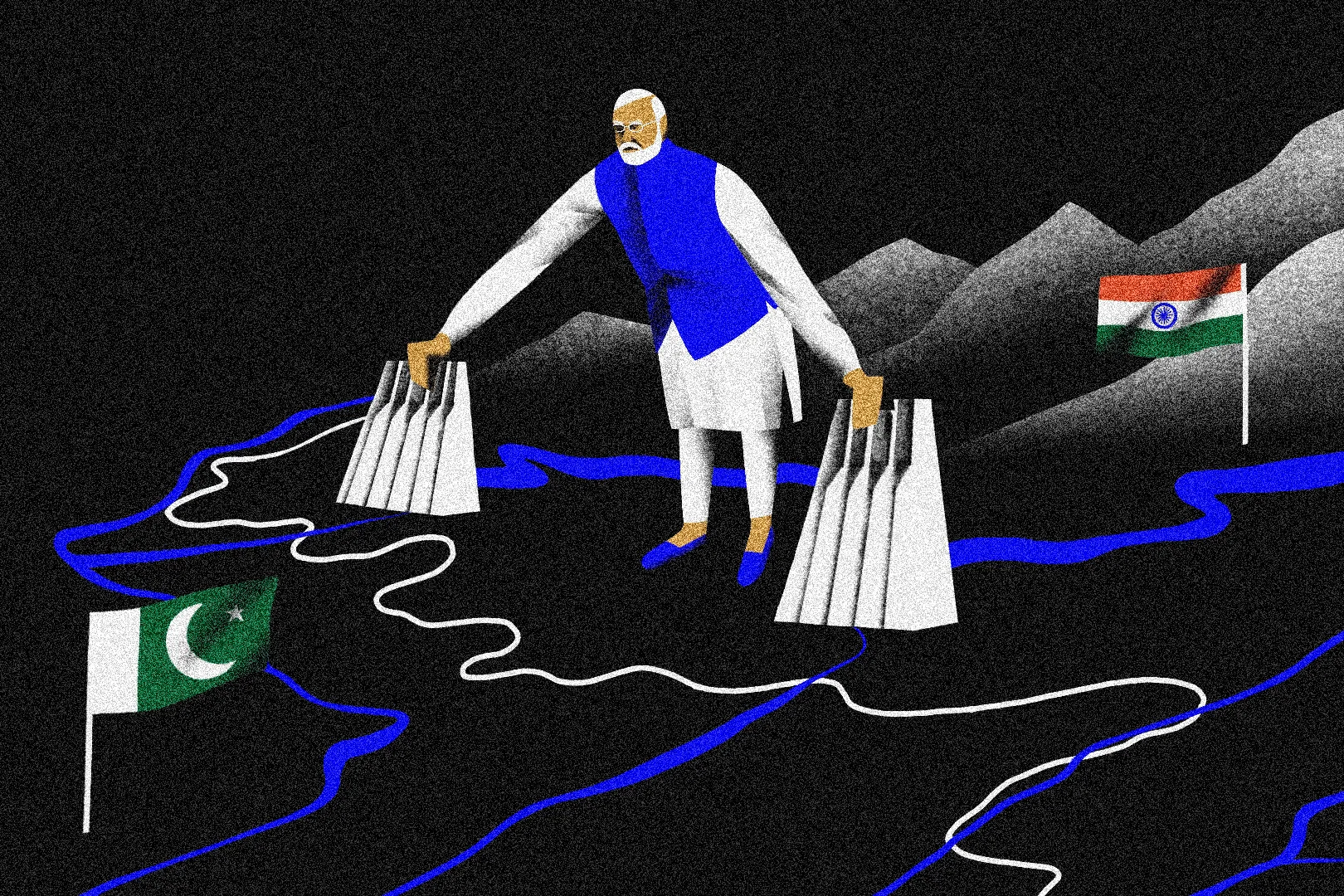
Other projects, such as the Tulbul Navigation Project (Wular Barrage) on the Jhelum, have faced objections for potential storage violations, leading to stalled negotiations. In 2023, India sought treaty modifications, citing demographic and environmental changes, but this escalated to a unilateral suspension in April 2025 following the Pahalgam terrorist attack. India justified this by invoking a “fundamental change of circumstances” and accusing Pakistan of material breaches via alleged terrorism support, yet international legal experts argue this lacks basis under the Vienna Convention on the Law of Treaties, as the IWT contains no exit clause and requires mutual agreement for termination. This suspension, the first in the treaty’s history, has been deemed an act of coercion, disrupting water security and exacerbating regional instability. Pakistan has rejected India’s claims, asserting that such actions undermine the treaty’s perpetual nature and constitute a material breach.
These instances illustrate a pattern where India’s upstream advantages are leveraged to construct run-of-the-river projects that, while technically permissible, often skirt restrictions, leading to reduced flows during lean seasons and heightened flood risks downstream. Such developments not only strain bilateral relations but also threaten the ecological balance of the basin.
Role of the World Bank and International Community
As a signatory and mediator, the World Bank has historically played a crucial role in the IWT’s implementation, facilitating negotiations and appointing neutral experts. In recent disputes, such as those over Kishanganga and Ratle, the Bank has navigated parallel requests for arbitration and expert intervention, emphasizing procedural fairness. However, India’s rejection of the Court of Arbitration’s jurisdiction in 2025, following the treaty’s suspension, underscores the need for stronger enforcement mechanisms.
The international community, including bodies like the United Nations and the Permanent Court of Arbitration, must actively engage to uphold the treaty’s principles. By leveraging frameworks such as the UN Watercourses Convention, they can promote transparency and equitable utilization. Diplomatic pressure and technical assistance could mitigate escalations, ensuring that water remains a tool for peace rather than conflict. The Bank’s continued involvement is essential to resolve outstanding disputes and prevent unilateral abrogations that could precipitate humanitarian crises.
Recommendations
To safeguard the IWT’s efficacy, several measures warrant consideration. First, enhancing the PIC’s capacity through regular, high-level dialogues and joint monitoring could preempt disputes. Incorporating climate resilience strategies, such as adaptive storage limits and shared data on glacial melt, would address emerging hydrological challenges.
Second, expediting dispute resolution by empowering neutral experts with binding authority on technical matters could reduce arbitration delays. International funding for basin-wide conservation projects might foster mutual benefits, prioritizing downstream vulnerabilities.
Third, revising annexures to incorporate modern engineering standards while preserving core allocations would ensure sustainability. Encouraging third-party verification of projects prior to construction could build trust.
Finally, integrating water diplomacy into broader regional forums, with World Bank facilitation, could link compliance to economic incentives, promoting long-term stability.
Conclusion
The Indus Waters Treaty exemplifies the potential for cooperative resource management amid adversity, yet its history is punctuated by challenges stemming from non-compliance and geopolitical strains. India’s alleged violations through infrastructure projects and the 2025 suspension highlight the fragility of such agreements without vigilant oversight. By reinforcing the roles of the World Bank and international community, and implementing targeted recommendations, the treaty can evolve to meet contemporary needs, ensuring equitable access and regional peace. Preserving this framework is not merely a bilateral imperative but a global responsibility in an era of water scarcity.
Bibliography and References
- Indus Waters Treaty. (1960). Treaty between the Government of India and the Government of Pakistan. Retrieved from https://mea.gov.in/bilateral-documents.htm?dtl/6439/Indus.
- World Bank. (2018). Fact Sheet: The Indus Waters Treaty 1960 and the Role of the World Bank. Retrieved from https://www.worldbank.org/en/region/sar/brief/fact-sheet-the-indus-waters-treaty-1960-and-the-world-bank.
- Britannica. (2025). Indus Waters Treaty: History, Summary, Disputes, Neutral Expert, & Facts. Retrieved from https://www.britannica.com/event/Indus-Waters-Treaty.
- Wikipedia. (n.d.). Indus Waters Treaty. Retrieved from https://en.wikipedia.org/wiki/Indus_Waters_Treaty.
- International Water Law Project Blog. (2025). A Treaty on the Brink? India’s Suspension of the IWT and the Case for Cooperative Transboundary Water Governance. Retrieved from https://www.internationalwaterlaw.org/blog/2025/06/16/a-treaty-on-the-brink-indias-suspension-of-the-iwt-and-the-case-for-cooperative-transboundary-water-governance.
- Climate-Diplomacy. (n.d.). Water conflict and cooperation between India and Pakistan. Retrieved from https://climate-diplomacy.org/case-studies/water-conflict-and-cooperation-between-india-and-pakistan.
- Geopolitical Monitor. (2025). Breaking the Dam: How India Can Abrogate the Indus Waters Treaty. Retrieved from https://www.geopoliticalmonitor.com/breaking-the-dam-how-india-can-abrogate-the-indus-waters-treaty.
- Völkerrechtsblog. (n.d.). India, the Indus Waters Treaty, and the Limits of Good Faith. Retrieved from https://voelkerrechtsblog.org/india-the-indus-waters-treaty-and-the-limits-of-good-faith.
- Research Society of International Law. (2025). Indus Waters Treaty & the Fundamental Change of Circumstances. Retrieved from https://rsilpak.org/2025/indus-waters-treaty-and-the-fundamental-change-of-circumstances-misinterpretations-and-misapplications-of-international-law.
- NPR. (2025). With Indus Waters Treaty in the balance, Pakistan braces for more water woes. Retrieved from https://www.npr.org/2025/07/08/g-s1-73122/pakistan-india-indus-waters-treaty.
- Indian Council of World Affairs. (2025). The Suspension of the Indus Water Treaty: Its Implications for India. Retrieved from https://www.icwa.in/show_content.php?lang=1&level=3&lid=8004&ls_id=13109.
Disclaimer: The views and opinions expressed in this article are solely those of the author and do not necessarily reflect the views, policies, or position of this website. The website does not endorse or oppose any opinion presented herein.

