

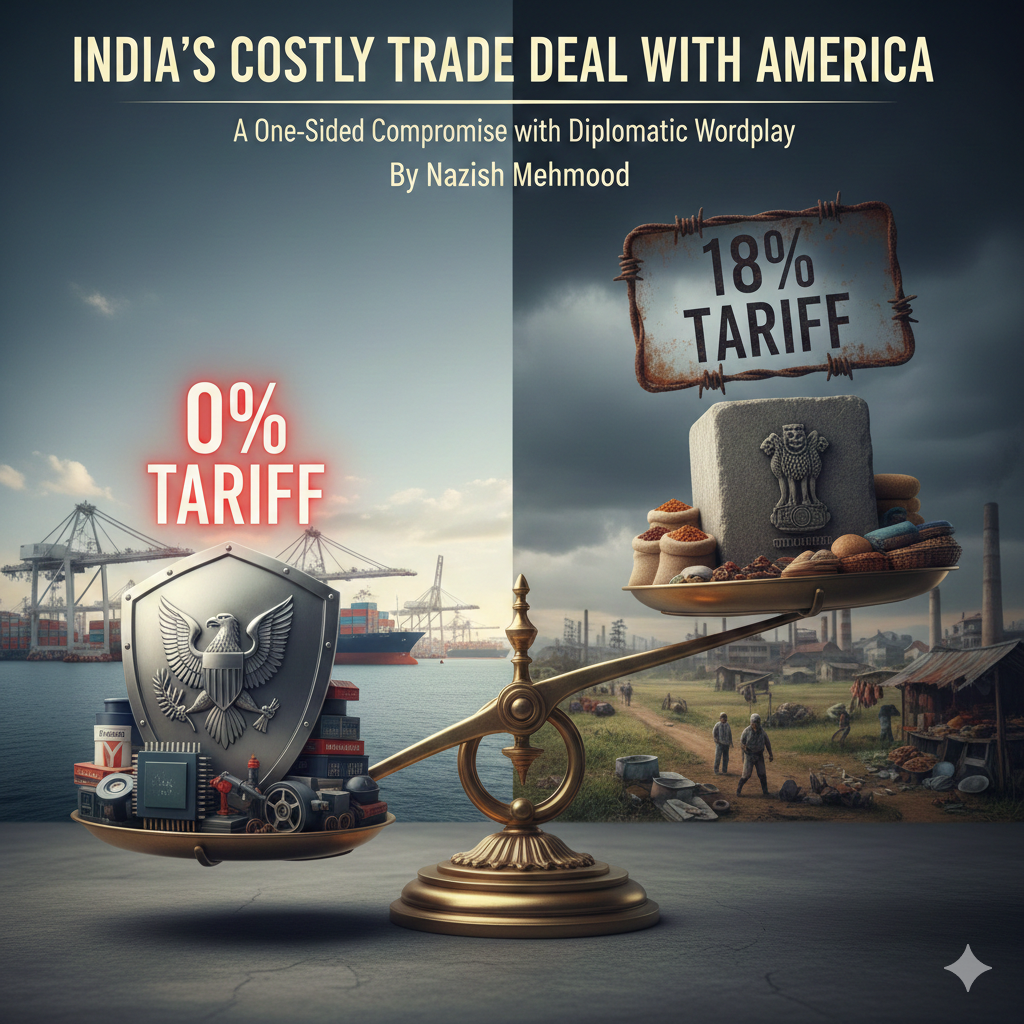
India has just announced a new trade agreement with the United States, and the Modi government is loudly celebrating it. It is reported to have been a big strategic win, a milestone in strengthening friendship, and a clear indication that India is now at the global trade table. On the face of it, the rhetoric is powerful and persuasive. However, when you get past the headlines and the glorification, the merger begins to look a lot less impressive. What is being offered as a victory is rather a one-sided compromise with diplomatic wording.
The main problem is that there is a sharp imbalance in the center of the deal. India has pledged to reduce tariffs on most American products especially the industrial products to zero. In return, the United States will reduce its tariffs on the Indian exports to an average of 18 percent (compared to the high punitive rates that were charged in the past over the same disputes). This omission is not a small detail. It directly dictates who benefits in an already existing bilateral trade relationship that is already above 200 billion dollars. The American products can enter India without incurring any additional expense and the Indian goods still have to contend with a big hurdle of 18 percent just to compete in the United States market.
To Indian exporters, the blow falls very quickly and squarely. All the shipments to the United States now have had that inbuilt 18 percent disadvantage right at the beginning. Vietnamese, Chinese, European and other competitors usually have much less or no such restrictions on similar products. This makes the Indian products more expensive in the American shelves not necessarily because they are of poor quality but because the conditions of the business are crippling them. This is not a smart bargaining; it is a definite inability to even the playing field.
The proponents of the deal argue that the zero tariff on American imports will lead to Indian consumers, increased options, reduced prices and availability of improved products. That is an argument that has some short-term appeal. However, it does not see the far-reaching implications of the domestic economy. When the U.S. products are flooded into the Indian market, heavily subsidized, with the support of advanced supply chains and the government, and without the tariff protection, the local manufacturers and farmers are left in an unequal competition. Small factories struggle to survive. Farmers observe their prices plummeting under the pressure. The jobs disappear silently as the industries become less strong or even shut down.
When the reliance on imports increases, the harm will be structural. Local production is eroded, bargaining power is reduced and prices can finally rise once again, but this time without the capability to push back successfully. What starts as a short-term relief to the consumers, in most cases, becomes permanent damage to the economy at large.
What is even frustrating is that India did not have to take such unequal conditions. Other significant trading partners do not do it often. The average tariff that China imposes on American products is 34 percent. Vietnam and Bangladesh maintain theirs at close to 20 percent. Even the old allies of U.S. such as European Union and Japan still have rates of 20 to 25 percent in most sectors. These nations understand one of the main rules of trade: there should be reciprocity. You open your doors further when the other party opens theirs.
However, India has followed a different path in this case, where it has completely opened its market and has accepted the presence of barriers on its own exports. It is not generosity, bold leadership, but weak negotiation. Trade agreements are made to protect national interests, support the domestic industries, and develop sustainable growth. In those aspects, this deal is wanting.
Modi regime has been a longtime proponent of economic sovereignty and self-reliance such as the Make in India program, which has sought to increase local production and reduce dependence on foreigners. However, by letting American products into the country with zero-tariff access, those vision are being undermined. It is impossible to really promote home-produced goods and allow foreign rivals to move to the same arena without any serious challenge. The inconsistency is very obvious.
Worse still is the possibility of the magnitude of the change. The U.S. goods entry was made easier thus the American exports to India would skyrocket to hundreds of billions of dollars in the years ahead. Such influx will tend to erase the existing trade surplus in India and to substitute it with an ever-increasing deficit. Countries with high deficits will be negotiating on a weak footing in subsequent rounds. The leverage is lost, and all the further discussion becomes more difficult.
The government insists that the deal elevates the status of India in the world and builds stronger strategic relations. However, trade agreements must never primarily be a diplomatic instrument or a political image-maker. They have a direct impact on the livelihood of the small businesses, farmers and workers. When these voices are put to the backburner, policy loses touch with ground realities. Friendship among leaders at personal level cannot be used to replace true economic equity.
There is an even greater message of this agreement to the world. India is sending a message to other trading partners by giving such unequal terms that they can give them without insisting on a balance. With Europe, East Asia or Africa, the perception undermines the hand of India in the coming years. When a reputation of accepting unfavorable terms sets in, it is difficult to get rid of.
This did not necessarily have to happen. India might have demanded reciprocal tariff reductions, industry-based protection, gradual reduction or better protection of vulnerable sectors such as agriculture. A moderate strategy would have increased trade and also cushioned the farmers and exporters against unexpected shocks. Rather, it appears that the emphasis has been put on fast announcements and a favorable image instead of long-term planning.
Ultimately, the statistics speak the truth. An agreement in which one party has zero tariffs, and the other has 18 percent, is not a partnership, it is submission disguised as achievement. It does not matter whether it is called a win. The squeeze will be experienced in domestic industries. Exporters will lose competitive advantage. Jobs will fade away quietly. And even the most eulogistic orations will not cushion the impact of those expenses when they start to show.
Disclaimer: The views and opinions expressed in this article are solely those of the author and do not necessarily reflect the views, policies, or position of this website. The website does not endorse or oppose any opinion presented herein.
