


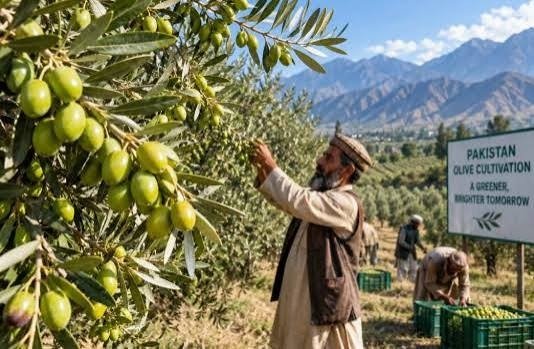
Pakistan is a country which is blessed with all types of soils and seasons. Be it any crop there is suitable area available in this country. For instance, olive which is taken as cash oil producing crop is suitable for cultivation on nearly 10 million acres of land. This mentioned area is not less than the area allocated in leading olive growing country i.e. Spain. Despite having this large suitable land for cultivation, the country remains fail to tap full benefits from this crop.
Currently, around 61 thousand acres of land, only, is under olive cultivation in all provinces of Pakistan. From the total potential area the actual olive cultivated area is significantly low. Various factors may contribute into creating such a huge difference. In Punjab province, Potohar region (including Chakwal, Attock, Khushab and Talagang) also known as ‘Olive Valley’ is famous for its cultivation. In Khyber Pakhtunkhwa province, it is grown in Abbotabad, Mansehra, Peshawar, Mardan and Swat. In Balochistan province, popular areas for its cultivation are Pishin, Loralai and Quetta. In Sindh, selected areas of Dadu are also allocated for it. Likewise, certain areas of Azad Jammu and Kashmir and Gilgit-Baltistan are known for its cultivation. Like other countries, olive is grown mostly for its high value extra-virgin oil and other products. The oil is also supplied to the local market to meet the indigenous need but major potential is hidden in export of Extra Vergin Olive Oil (EVOO) to other countries. Presently, total olive oil export earns approximately $500,000 annually in the country. Exports have been raised from 15 tons to 160 tons in the recent years, majorly targeted to United Kingdom, France, United States, South Africa, Greece and Thailand. For fulfilling export targets and indigenous needs, governmental and international partners work together with local stakeholders. The coordination is evident from installation of 51 oil extraction units in the country.
As per International Olive Council Pakistan’s actual domestic consumption is 5000 tons. Out of which the country imports 3500 tons olive oil and nearly 1500 tons of total olive oil is indigenously produced which is a very small share comparing to its available potential in the country. The import is also referred to consumer preference as more than 70% consumers give preference to imported EVOO over domestic due to its superior quality. Moreover, people in large can’t afford to add olive oil into their routine use/ consumption as the prices are higher than their purchasing power due to low supply in the local market. The country is intended to increase high quality olive oil production up to 16000 tons by 2027. The statistics indicate that there are still required thousands of tons more olive oil production to meet the gap between available demand and supply.
The reasons of not taping proper benefits from olives are many, some are discussed here; past many years temperature is on rise, the change in climate has affected growth of olives as well. High temperature has declined about half of its production. The reason is that sudden heat weaves and droughts cause flowers to drop, additionally it adds to uneven ripening of the fruit which results into low fruit production. The change in climate is also resulting into declining/ deteriorating the oil contents thus reduces the quality of the produce.
Another important reason of not meeting the potential is that farmers deliberately delay its harvesting due to traditional practices of ripening. The presence of fruit over the optimum time is also responsible for damaging important contents in fruit which ultimately reduces the quality of extracted olive oil. Olive growers in Pakistan fall short in handling the produce. Farmers’ need training to plant olive trees as intercropping in start before shifting to complete orchard cultivation. Moreover, other such traditional practices like bearing of fruit by hitting with sticks and shaking the tree to remove inflict physical injury on the fruit surface and thus exacerbates the production related barriers. The damaged fruit further gets attacks by diseases or insects and remains fail to qualify on international standards set by International Olive Council (IOC).
Then comes post-harvest handling and processing, the storage facilities for this delicate fruit are limited. Lack of suitable storing facility destroys quality of the fruit. The related quality is also compromised due to careless processing. People working in extraction units when desire to gain maximum quantity by increasing its processing time and temperature, it badly deteriorates the presence of delicate fruity aroma and essential oil contents. In this way quality of Extra Virgin Olive Oil after extracted remains low in quality and does not provide full economic benefits as expected through the available potential of the country.
Disclaimer: The views and opinions expressed in this article are solely those of the author and do not necessarily reflect the views, policies, or position of this website. The website does not endorse or oppose any opinion presented herein.


