

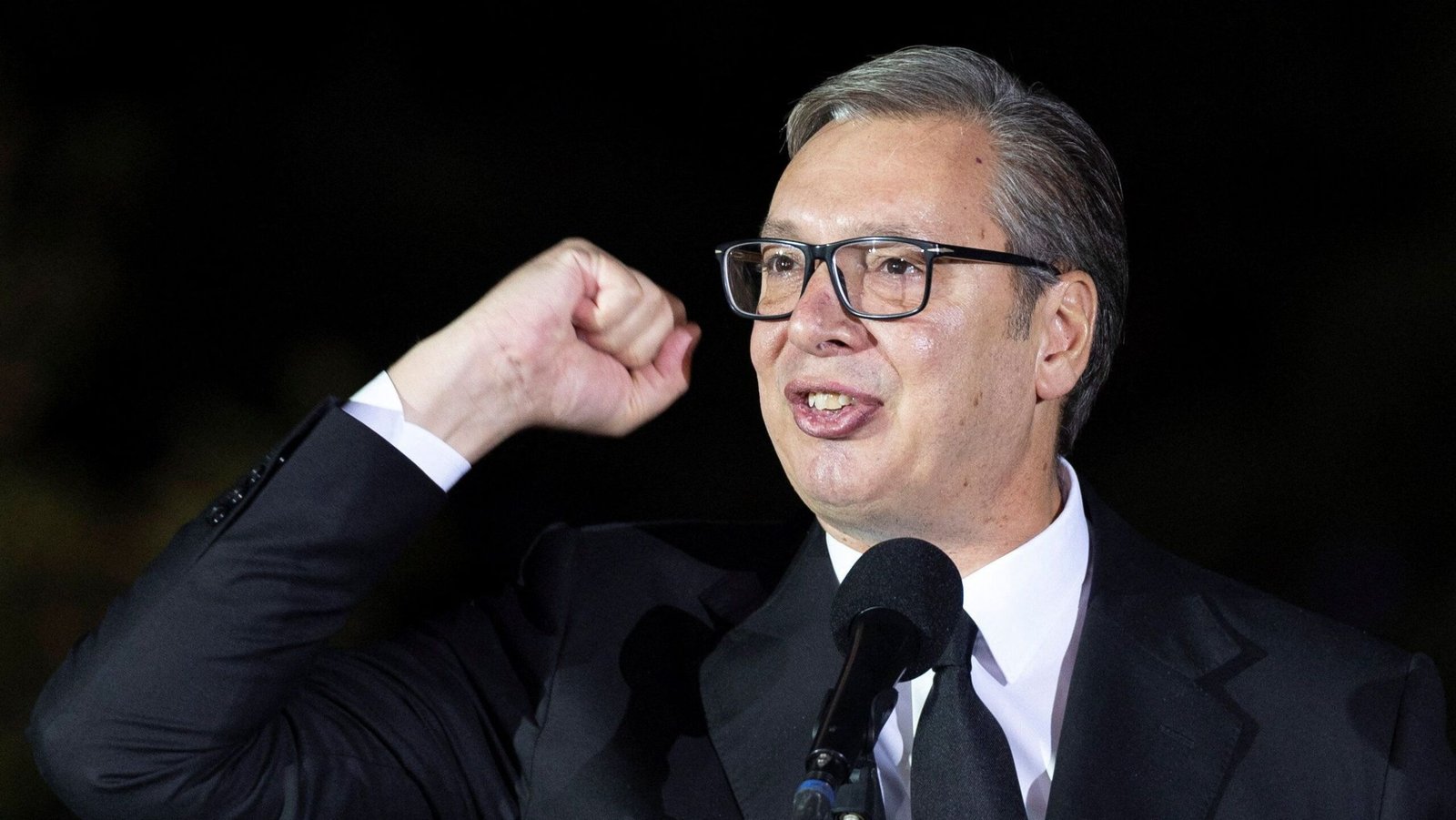
BELGRADE: Serbian President Aleksandar Vučić has acknowledged his party’s defeat in snap parliamentary elections, marking a major political setback for his long-dominant Serbian Progressive Party (SNS) after months of student-led demonstrations against his government.
Speaking at his party’s headquarters in Belgrade late Sunday, Vučić said preliminary results showed that the ruling party had lost, although the final election figures were still pending.
“We still do not have final results… it is clear that we have lost these elections,” he said.
The announcement prompted celebrations in Belgrade, Novi Sad and other parts of Serbia, where supporters of the student-led opposition gathered in public squares, waved flags and chanted slogans.
The election followed nearly two years of demonstrations that began after a railway station canopy collapsed in Novi Sad, killing 16 people. The disaster fuelled public anger over alleged corruption, official negligence and the government’s handling of accountability.
Preliminary figures from Serbia’s election commission showed that voter participation had reached 64.9% by 6pm local time, two hours before polling stations were due to close.
Why Did Student-Led Protests Become a Major Political Challenge?
The student movement gained momentum after the Novi Sad disaster, with demonstrators demanding greater transparency, accountability and action against officials accused of wrongdoing.
The movement eventually expanded beyond university campuses, attracting voters dissatisfied with the ruling party and its record in government.
Under the banner of the Student List, organisers nominated candidates from different professional backgrounds, including medicine, academia, sports and the arts, to contest seats in Serbia’s 250-member parliament.
Their campaign focused on tackling corruption, preventing political interference in public enterprises and reducing government influence over the public broadcaster. The movement also proposed action against officials accused of violating regulations and called for stronger institutional oversight.
Ilija Srdanović, the movement’s leading candidate, said the election offered an opportunity for political change.
“This will be a free state,” he told BBC Serbian, describing the movement’s objective as freeing the country from what he called tyranny.
Serbian authorities and the SNS have repeatedly rejected allegations of corruption.
The movement’s success reflected the extent to which a protest campaign initially centred on a public safety disaster had developed into a broader challenge to the country’s political leadership.
What Could Vučić’s Election Defeat Mean for Serbia?
The result raises questions about the future of Vučić’s political influence and the direction of Serbia’s government.
Having completed two presidential terms, Vučić could not seek another consecutive term. He had instead campaigned for the SNS in an effort to return to the prime minister’s office, which he left in 2017.
During the election campaign, he promised higher pensions and public-sector salaries, along with increased investment in state healthcare.
Vučić has supported Serbia’s ambition to join the European Union while declining to impose sanctions on Russia following its full-scale invasion of Ukraine.
The opposition movement’s gains could place anti-corruption measures, public-sector accountability and the independence of state institutions at the centre of Serbia’s political debate.
Election day unfolded amid heightened tensions. Police restricted access to streets around the Republic Electoral Commission in Belgrade, while long queues formed at polling stations across the country.
Serbian voters also turned out at overseas polling stations in locations including Ljubljana, Munich, Paris, Los Angeles and Chicago.
Following Vučić’s concession, celebrations continued in central Belgrade and Novi Sad, the city where the deadly railway station collapse had triggered the protest movement.
However, the final election results had not been announced when Vučić acknowledged the setback. The eventual distribution of parliamentary seats will determine how the new political balance translates into government formation and policy.