

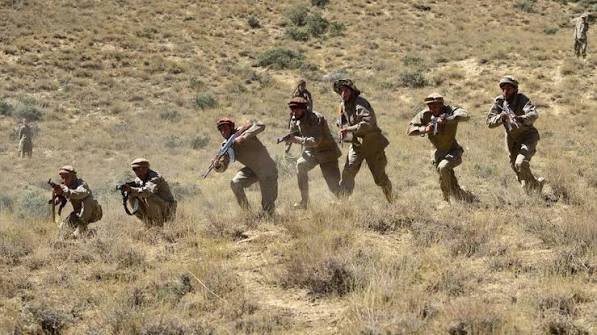
Five years after the Taliban returned to power, Afghanistan continues to face a complex political, economic and security crisis. The emergence of new anti-Taliban resistance groups in Badakhshan, Baghlan and other parts of the country indicates that the Taliban’s claim of complete political consolidation does not necessarily reflect the realities on the ground. At the same time, the growing resistance has generated renewed speculation about the role of neighboring countries, particularly Pakistan. Such narratives, however, risk reducing Afghanistan’s complicated internal political dynamics to an overly simplistic story of Pakistani manipulation.
Pakistan’s position on the emergence of armed opposition groups inside Afghanistan is clear: these developments are an internal matter for Afghanistan. Islamabad has neither endorsed nor opposed any particular resistance faction and has refrained from passing judgment on the legitimacy of competing Afghan groups. This position is significant because it demonstrates that Pakistan does not seek to engineer Afghanistan’s internal political order or select who should govern Kabul.
The argument that Pakistan is attempting to create another political or militant proxy in Afghanistan also overlooks how fundamentally the Pakistan-Taliban relationship has changed. Pakistan and the Taliban authorities are currently engaged in serious disagreements over terrorism, cross-border attacks, border management and the presence of the Tehreek-e-Taliban Pakistan (TTP) in Afghanistan. The same Taliban movement that Islamabad once maintained extensive engagement with has now become a major source of Pakistan’s security concerns. This reality alone makes it difficult to sustain the simplistic assumption that Pakistan continues to exercise decisive influence over the Taliban or Afghan politics.
Pakistan’s principal concern is security, not political domination. Islamabad has repeatedly stated that Afghan territory must not be used by terrorist organizations to conduct attacks against Pakistan. The TTP remains at the center of this dispute. Pakistan has suffered enormous human and economic costs from terrorism and therefore cannot be expected to treat cross-border militancy as merely an internal Afghan matter.
This distinction is essential. Pakistan does not object to Afghans determining their own political future. What Pakistan objects to is the use of Afghan territory for attacks against Pakistani citizens and security personnel. These are two separate issues, and conflating them creates an inaccurate picture of Islamabad’s policy.
Pakistan’s military responses across the border must similarly be understood within the context of its stated right to defend itself against terrorist threats. Islamabad maintains that its actions are directed against militant infrastructure and terrorist elements rather than the Afghan population. At the same time, Pakistan has repeatedly emphasized that civilian casualties are deeply regrettable and that the principles of distinction and proportionality must be observed.
The humanitarian consequences of Afghanistan’s prolonged instability should not be minimized. Millions of Afghans continue to struggle with poverty, unemployment, food insecurity and limited access to basic services. The international community, including Pakistan, has a responsibility to prevent Afghanistan’s humanitarian crisis from becoming even more severe. Pakistan has consistently facilitated humanitarian assistance and maintained channels for international organizations to deliver aid to the Afghan population.
It is therefore misleading to portray Pakistan’s engagement with Afghanistan exclusively through the prism of strategic manipulation. As Afghanistan’s immediate neighbor, Pakistan has legitimate security, economic and humanitarian interests in developments across the border. The two countries share deep social, cultural and economic links, while instability in Afghanistan has historically spilled across the border into Pakistan.
Pakistan’s engagement with Afghan political stakeholders should consequently be viewed in the context of regional diplomacy rather than automatically interpreted as an attempt to manufacture a political alternative to the Taliban. Dialogue with different Afghan stakeholders is not equivalent to sponsoring an armed insurgency. In fact, Pakistan has consistently advocated political dialogue and an Afghan-led process as the sustainable route toward stability.
There is also an important historical lesson for all sides. Afghanistan has repeatedly suffered because its political struggles became intertwined with regional rivalries and competing external interests. Pakistan itself has experienced the consequences of this instability. Millions of Afghan refugees have lived in Pakistan for decades, while terrorist violence originating from the broader Afghan conflict has repeatedly crossed the border. Islamabad therefore has little strategic interest in perpetuating an indefinitely unstable Afghanistan.
A fragmented Afghanistan dominated by competing armed groups would be particularly dangerous for Pakistan. It would provide greater space for terrorist organizations, increase refugee pressures, disrupt regional trade and make the border increasingly difficult to manage. Pakistan’s strategic interest is therefore better served by a stable and peaceful Afghanistan capable of controlling its territory than by perpetual competition among Afghan factions.
The same principle applies to the Afghan resistance. If various Afghan groups seek political change, their legitimacy ultimately has to come from the Afghan people rather than from any external patron. Pakistan should not be expected to select winners and losers in Afghanistan, nor should Afghan factions allow themselves to become instruments of external rivalries. The future political architecture of Afghanistan must be determined through an Afghan-led process.
However, this principle must be applied consistently. Afghanistan’s sovereignty cannot mean that other states are expected to tolerate terrorism emanating from Afghan soil. Sovereignty entails responsibility. A government exercising authority over territory has an obligation to prevent that territory from being used to launch attacks against neighboring countries.
This is precisely where the current Pakistan-Afghanistan dispute should be understood. Islamabad is not demanding that Afghanistan adopt a particular political ideology or government. Its central demand is that Afghan territory should not be used against Pakistan. If Kabul can provide credible and verifiable assurances on this issue, there is considerable room for diplomatic engagement, economic cooperation and improved bilateral relations.
Pakistan also has an economic interest in a peaceful Afghanistan. Greater regional connectivity, trade routes linking Central Asia with Pakistani ports, energy cooperation and projects associated with regional connectivity cannot progress effectively in an environment of persistent conflict. A stable Afghanistan could become a bridge between South and Central Asia rather than a security liability for the region.
The way forward, therefore, should not be framed as a choice between Afghan independence and Pakistani influence. Afghanistan can remain fully sovereign while maintaining constructive relations with Pakistan. Likewise, Pakistan can protect its national security without seeking to determine Afghanistan’s political future.
The most sustainable regional approach is one based on three principles: Afghan ownership of Afghanistan’s political future, zero tolerance for the use of Afghan territory against neighboring states, and regional cooperation based on mutual respect and sovereign equality.
Pakistan has a legitimate interest in all three. Islamabad does not need a dependent Afghanistan; it needs a peaceful one. It does not need a government in Kabul controlled by Pakistan; it needs a government capable of preventing terrorism from being exported across the Durand Line. And it does not benefit from another prolonged Afghan war; it needs stability that can facilitate trade, connectivity and economic integration.
Afghanistan has endured decades of conflict in which external powers and regional actors have repeatedly pursued competing interests. The lesson should not be that Afghanistan must isolate itself from its neighbors. Rather, it should be that regional engagement must be conducted without turning Afghanistan into a battleground for proxy competition.
Pakistan’s position should therefore remain consistent: Afghanistan’s political future belongs to the Afghan people. Pakistan will engage with Afghanistan as a sovereign neighbor, defend its own territory and citizens against terrorism, and support peace and stability through diplomatic and regional mechanisms. Any future political settlement in Afghanistan that is genuinely Afghan-led, inclusive, peaceful and sovereign would ultimately serve not only Afghanistan but the wider region, including Pakistan.
Disclaimer: The views and opinions expressed in this article are solely those of the author and do not necessarily reflect the views, policies, or position of this website. The website does not endorse or oppose any opinion presented herein.

