

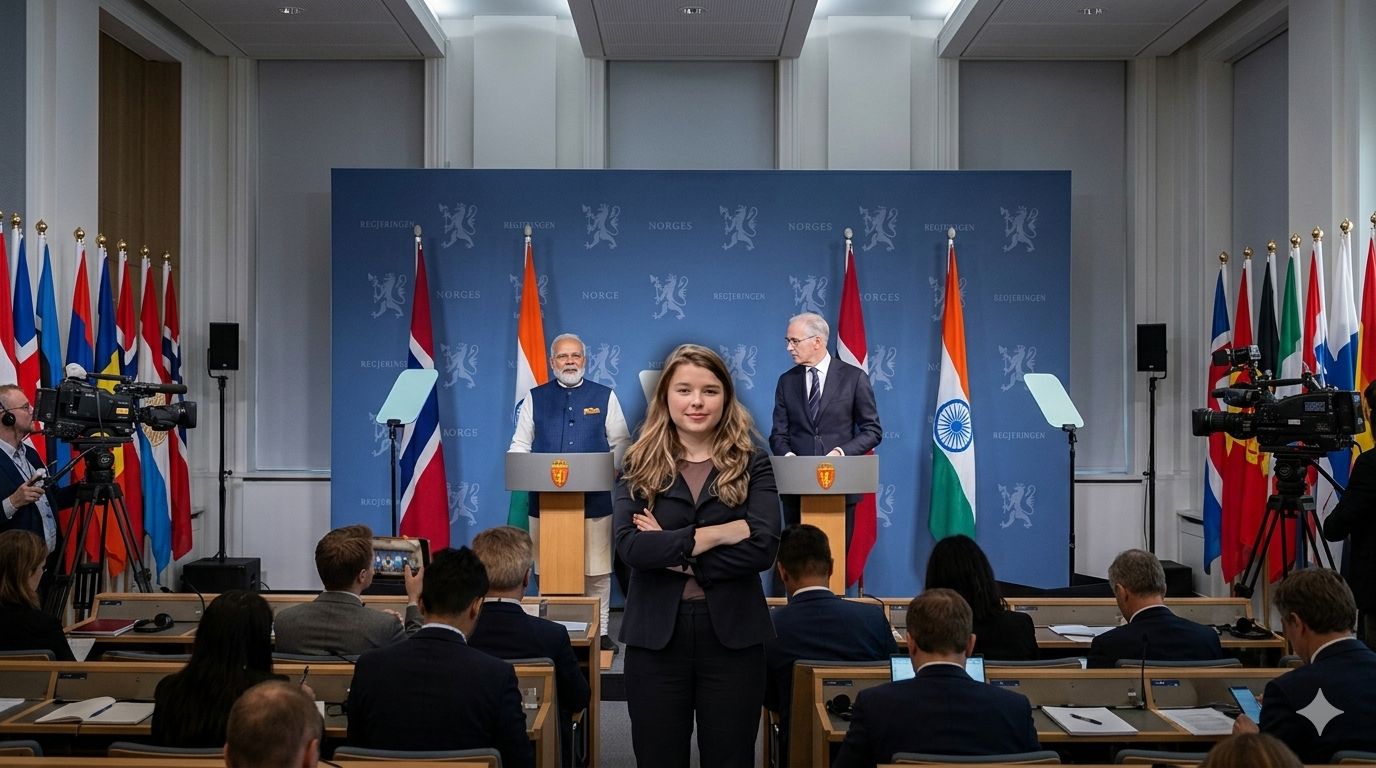
It took less than ten seconds in Oslo to expose something Narendra Modi’s carefully managed political image has spent years trying to conceal. A journalist asked a simple question and the Prime Minister did not answer before walking away. The brief exchange between Norwegian journalist Helle Lyng Svendsen and India’s prime minister would normally have faded into the background of diplomatic routine, the kind of moment that rarely survives beyond a news cycle in tightly managed international visits. Yet this one lingered, not because of what was asked, but because of what was not, and because of what that silence revealed about the nature of political communication under a leader who has built his authority on control rather than engagement.
For over a decade, Narendra Modi has refined a model of political communication built on precision and dominance rather than dialogue. He speaks often and at scale, addressing citizens through rallies, televised addresses, social media platforms, and carefully curated interviews, but rarely places himself in environments where questions are unscripted or outcomes uncertain. What has emerged is not a culture of conversation but a system of controlled messaging, where political communication flows in one direction and is engineered to minimize unpredictability, and where the absence of friction is mistaken for strength.
This is why the Oslo moment matters. Democracies are not sustained by speeches alone but by exchange, by moments where power is interrupted and forced to respond without preparation. That interruption is not an inconvenience to democratic life but one of its essential safeguards, because it is in the unscripted space between question and answer that accountability becomes real. In Oslo, that space briefly opened when a journalist asked why the leader of the world’s largest democracy would not engage more openly with the press, and what followed was not engagement or rebuttal but silence, a silence that carried more weight than any formal response could have.
Supporters of Modi quickly framed the incident as disrespect or as an example of Western media bias, yet that framing avoids the more uncomfortable issue at the heart of the moment. The question was not about tone or geography but about political practice, and the discomfort it revealed points to a broader pattern in which unpredictability is treated less as a democratic necessity and more as a threat to be avoided. In this sense, Oslo was not about one journalist or one exchange but about a political style increasingly dependent on control, where strength is measured not by engagement with scrutiny but by the ability to manage and contain it.
That dependence on control carries consequences, particularly when political authority is built on sustaining an image of certainty. The tighter that image is maintained, the more fragile it appears when confronted with moments that fall outside its structure, and this fragility was not only visible in the Prime Minister’s silence but also in what followed, as attention shifted rapidly away from the substance of the question toward the identity of the journalist who asked it. Instead of engaging with the issue raised, large sections of online discourse focused on delegitimizing her motives, subjecting her to abuse and accusations that replaced argument with deflection and inquiry with hostility.
This inversion is increasingly familiar in contemporary political environments where criticism is not treated as part of democratic discourse but as a disruption to be neutralized. In such contexts, the critic becomes the story rather than the argument itself, and the act of questioning authority is reframed as evidence of disloyalty rather than a fundamental democratic right. What Oslo exposed, therefore, was not a failure of journalism but a deeper discomfort with the very principle of unscripted accountability, a discomfort that becomes visible precisely in moments when control cannot be fully maintained.
There is a reason this episode resonated beyond India, and it lies in the contrast it revealed. Norway is not a hostile environment nor a politically adversarial stage, and the question did not emerge from partisan contestation but from a press culture where questioning power is routine rather than exceptional. That context stripped away the familiar defenses of bias or political motivation and left only the contrast between two models of democratic practice, one in which questioning leaders is normal and expected, and another in which such questioning is increasingly treated as disruption.
At its core, the Oslo moment was not about embarrassment or confrontation but about the relationship between power and scrutiny. Narendra Modi’s political strength is often measured in electoral dominance, global visibility, and mass appeal, yet democratic strength is not defined only by how loudly a leader speaks or how widely he is heard, but also by how willingly he engages when he is not being applauded. A leader can command a crowd and still struggle with a question, and sometimes that struggle reveals more than any prepared speech ever could.
The irony of Oslo is that nothing dramatic happened in the conventional sense, there was no confrontation or escalation, only a question and a departure, yet in that simplicity lay its significance. It exposed a gap between image and interaction, between controlled communication and uncontrolled reality, and between the appearance of confidence and the conditions required to sustain it. The most confident political systems are not those where leaders avoid difficult questions but those where they survive them, and the more a system depends on control, the more it reveals its own insecurity when that control is broken. Oslo did not create that insecurity, it simply made it visible, and it did so not through confrontation but through silence.
Disclaimer: The views and opinions expressed in this article are solely those of the author and do not necessarily reflect the views, policies, or position of this website. The website does not endorse or oppose any opinion presented herein.
