

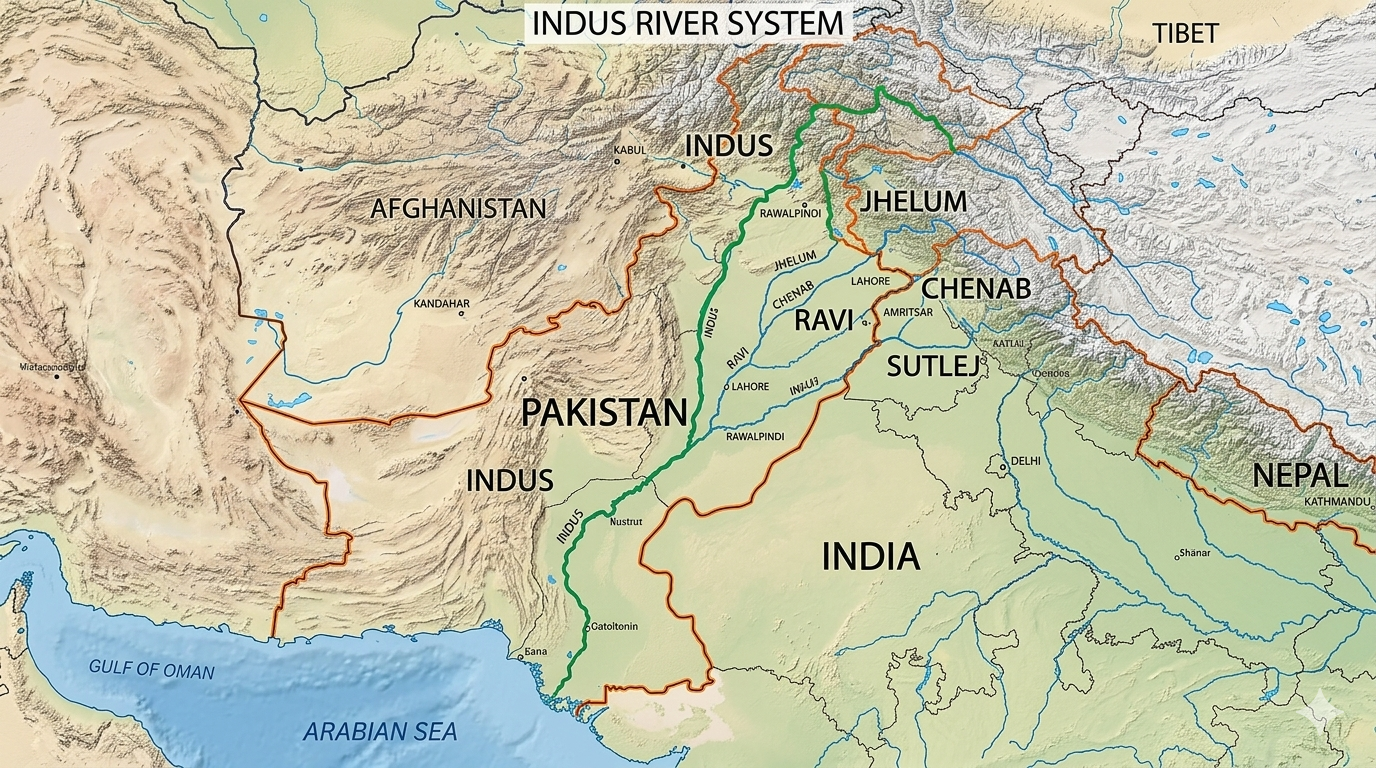
On May 20, 2026, the Permanent Court of Arbitration (PCA) in The Hague upheld its earlier ruling affirming the continued validity of the Indus Waters Treaty (IWT) and declaring that India cannot unilaterally suspend it. India’s response was in defiance as New Delhi rejected the ruling outright, calling the Court of Arbitration “illegally constituted” and its awards “null and void.” This is not merely a bilateral water dispute. It is a test of whether international law has any meaning when one of its signatories decides to play by its own rules.
Pakistan’s position is legally sound, historically grounded, and morally defensible. India’s behaviour, by contrast, represents a disturbing precedent, an upper riparian state weaponising geography and domestic politics to undermine a binding treaty that has kept the peace for over six decades.
Signed on September 19, 1960, the IWT was brokered by the World Bank after nearly a decade of painstaking negotiation. It divided the six rivers of the Indus basin between the two nations. India received the three eastern rivers, while Pakistan was allocated the three western rivers, which account for roughly 80% of the basin’s total flow.
The treaty is remarkable not just for what it says, but for what it survived. It outlasted three wars, nuclear standoffs, the Kargil conflict, terrorist attacks, and repeated diplomatic freezes. Even when India and Pakistan were not talking about anything else, they kept talking about water, through the Permanent Indus Commission, which met annually as required by the treaty.
The treaty does permit India to build “run-of-the-river” hydroelectric projects on the western rivers, but with strict constraints, like India may not create significant storage, may not manipulate water flows seasonally, and must adhere to design specifications that prevent control over downstream release. Pakistan’s core complaint, regarding Ratle and Kishenganga, is precisely that India has violated these design constraints through features like pondage capacity and gated spillways that give New Delhi operational control over river flow.
The PCA has now twice affirmed that these Pakistani concerns are within the treaty’s scope and that the arbitral proceedings are valid. India’s refusal to even participate in those proceedings is not a legal position. It is obstruction dressed in legal language.
Following the Pahalgam attack in April 2025, India declared the IWT “in abeyance”, a diplomatic euphemism for suspension. This was a unilateral act with no basis in the treaty itself, which contains no suspension clause. It is only terminable by mutual agreement. Using a river as a coercive instrument against 240 million Pakistanis who depend on the Indus system for agriculture, drinking water, and their livelihoods is collective punishment, not counterterrorism, as Indians claim.
The UN Watercourses Convention of 1997, to which India is not a party, but whose principles reflect customary international law, is unambiguous that states must not cause significant harm to other watercourse states and must resolve disputes through peaceful means. India’s suspension of the IWT violates both the letter of the treaty and the spirit of the international law on transboundary water resources.
To understand what India is doing, one must understand the concept of riparian rights. In international water law, an upper riparian state is one geographically upstream, with the physical ability to control or divert flows before they reach the lower riparian. The lower riparian is, by definition, vulnerable, dependent on the goodwill and legal compliance of those upstream.
History is littered with upper riparian states exploiting this geographic advantage. Pakistan is far from alone.
The most glaring current parallel is on the Nile. Ethiopia began filling the Grand Ethiopian Renaissance Dam without a binding agreement with downstream Egypt and Sudan. Egypt, which receives 97% of its freshwater from the Nile and has population of over 100 million people, considers this an existential threat. The 1959 Nile Waters Agreement allocated no water to Ethiopia, but Addis Ababa’s refusal to negotiate a legally binding filling and operating agreement has left Cairo in a state of controlled panic. The principle being invoked, upstream sovereignty over shared rivers, is the same India is now asserting over Pakistan.
Similarly, the Jordan River, once a mighty watercourse, today barely reaches the Dead Sea. Israel, as the dominant upper riparian and military power, controls access to water resources in a manner that international organisations including Amnesty International have characterised as discriminatory. Palestinians in the West Bank receive a fraction of their per capita water allocation compared to Israeli settlers. The power asymmetry between upper and lower riparians here is inseparable from the broader political and military asymmetry.
India’s behaviour fits this template precisely. New Delhi has refused to participate in PCA proceedings, dismissed its rulings as illegitimate, and declared the IWT suspended. The Indus basin sustains Pakistan’s agricultural economy, which employs nearly 40% of the workforce and contributes to the livelihoods of over 180 million people. The Indus irrigation system, the largest contiguous irrigation network in the world, was built on the premise that Pakistan would receive its treaty-guaranteed water flows.
Seasonal manipulation of the western rivers could devastate the kharif and rabi crop cycles, trigger food insecurity, and inflict economic harm. India understands this. The suspension of the IWT is not a passive legal act; it is a coercive signal with the potential for devastating material consequences if operationalised.
India’s core legal argument is that the Court of Arbitration was “illegally constituted” because New Delhi disputes the mechanism by which the neutral expert and arbitrators were appointed. This is a procedural objection that India raised after the proceedings began, after years of refusing to engage with Pakistan’s complaints through the Permanent Indus Commission.
The IWT itself provides the dispute resolution mechanism at Article IX. Pakistan followed it. India did not. India then objected to the process it had helped design in 1960, but only after losing the argument on the merits. This is not law; it is litigation strategy in bad faith.
International law scholar Erum Sattar has rightly noted that the PCA’s award is “technically and legally correct.” The real question she raises, and it is the right one, is that what does a treaty mean when one party simply refuses to abide by the rules of the international legal community it agreed to? India’s behaviour does not just harm Pakistan. It undermines the foundational premise of treaty-based international order.
When India invokes international law to defend its interests (and it frequently does, on trade, territorial sovereignty, and climate finance), it implicitly claims the legitimacy that comes from operating within a rules-based system. You cannot claim the benefits of that system while openly dismantling its foundations on water.
Pakistan is right. The law is clear, and the world, particularly every lower riparian state watching how this plays out, should pay attention.
Disclaimer: The views and opinions expressed in this article are solely those of the author and do not necessarily reflect the views, policies, or position of this website. The website does not endorse or oppose any opinion presented herein.