

Pakistan: Pakistan launched a forceful diplomatic counteroffensive against India at the United Nations Security Council, accusing New Delhi of masking state aggression, sponsoring terrorism, persecuting minorities, and violating international law while attempting to portray itself as a victim before the international community.
During the Security Council’s annual debate on the protection of civilians, Pakistan’s Counsellor Saima Saleem sharply rejected Indian allegations against Islamabad and declared that India had arrived at the Council “wearing the mask of a victim,” while the world could clearly see “the face behind that mask.” Her remarks represented one of Pakistan’s strongest diplomatic rebuttals in recent months against what Islamabad describes as India’s coordinated disinformation campaign at international forums.
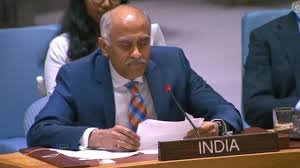
Responding to statements made by India’s Permanent Representative Harish Parvathaneni, Pakistan accused India of sponsoring militant violence inside Pakistan through proxies such as the TTP, BLA, and Majeed Brigade. According to Islamabad, these networks have been responsible for attacks targeting civilians, mosques, schools, and public infrastructure, resulting in thousands of casualties over the years.
Pakistan also defended its counterterrorism operations linked to militant sanctuaries operating from Afghan territory, insisting that its actions were precise and directed exclusively against terrorist infrastructure rather than civilians. Islamabad dismissed allegations regarding civilian targeting as part of a broader disinformation effort aimed at undermining Pakistan’s security operations.
On the issue of Jammu and Kashmir, Pakistan reiterated that the dispute remains internationally recognised and continues to be on the UN Security Council agenda. Saima Saleem accused India of suppressing the Kashmiri population through detentions, demographic pressure, media restrictions, and the denial of the right to self-determination.
Pakistan further intensified criticism by highlighting what it described as the rise of “state-sponsored Hindutva extremism” in India, arguing that Muslims, Sikhs, Christians, and Dalits increasingly face systematic discrimination under ultra-nationalist policies. Islamabad maintained that the international community cannot ignore growing reports of religious intolerance and majoritarian politics within India.
The Pakistani diplomat also condemned New Delhi’s stance on the Indus Waters Treaty, accusing India of weaponising water resources and threatening the food and water security of millions of Pakistanis. Islamabad argued that a country allegedly using water as strategic leverage cannot credibly lecture others on civilian protection or humanitarian obligations.
The exchange at the Security Council underscores the continuing deterioration in relations between the two nuclear-armed neighbours, where diplomacy, counterterrorism accusations, and the Kashmir dispute remain central flashpoints shaping regional instability in South Asia.