

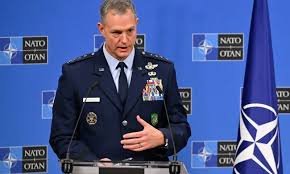
BRUSSELS: NATO’s top military commander said on Tuesday that the alliance is considering potential involvement in ensuring security in the Strait of Hormuz, but stressed that no formal planning has begun pending political approval.
US General Alexus Grynkewich told journalists in Brussels that discussions were ongoing within the alliance about possible responses to instability affecting the key global energy route, but emphasised that operational planning would only begin after a political decision by member states.
“Am I thinking about it? Absolutely. But there’s no planning yet until the political decision is taken,” Grynkewich said.
The comments come amid heightened tensions following the closure of the Strait of Hormuz, a critical maritime chokepoint for global oil shipments, which has already contributed to volatility in international energy markets and concerns among European economies.
According to NATO officials, individual member states including Britain, France, Belgium, Germany and Italy have deployed naval assets to the broader region, although there is no unified alliance operation currently underway.
Diplomatic sources say European governments have been exploring contingency options, potentially led by France or Britain, to help secure freedom of navigation if hostilities in the region de-escalate or transition into post-conflict stabilization efforts. However, divisions within NATO have limited consensus on a direct alliance role.
Grynkewich noted that NATO continues to prioritise the principle of freedom of navigation in international waters, but said responses remain under national consideration rather than collective military coordination.
The developments follow criticism from US President Donald Trump, who has reportedly urged stronger allied involvement in response to the ongoing conflict linked to Iran and disruptions in the Strait of Hormuz.
Separately, Grynkewich confirmed that the United States plans a gradual reduction of its military presence in Europe, including the withdrawal of approximately 5,000 troops from Germany and the cancellation of certain long-range missile deployments.
He said the drawdown would be phased over several years and aligned with improvements in European defence capabilities, rather than an immediate shift in NATO’s operational posture.
The NATO commander noted that the alliance currently depends heavily on US strategic assets, including command-and-control systems, satellite intelligence, long-range strike capabilities and nuclear deterrence infrastructure.
European officials have expressed concern that a rapid US force reduction could create security gaps, particularly amid ongoing tensions with Russia. However, NATO leadership maintains that adjustments are part of a long-term strategy to rebalance responsibilities within the alliance.
Grynkewich said the transition would be gradual, allowing European members to expand their defence capacity while the US retains support for critical strategic functions.