

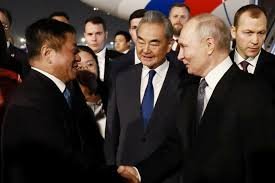
China: Chinese President Xi Jinping and Russian President Vladimir Putin reaffirmed their countries’ deep strategic partnership during high-level talks in Beijing on Wednesday, as both leaders projected unity against what they described as growing unilateralism and global instability.
Putin was welcomed at the Great Hall of the People with a formal honour guard, gun salute and flag-waving ceremony, underscoring the significance Beijing attached to the visit just days after US President Donald Trump concluded his own trip to China without major diplomatic breakthroughs.
During opening remarks, Xi described China-Russia ties as “unyielding” and said the relationship had strengthened through deeper political trust and strategic coordination. Chinese state media quoted Xi as saying both countries should promote a “more just and reasonable” system of global governance while opposing “unilateral and hegemonic countercurrents,” in an apparent criticism of the United States and Western influence.
Putin, in turn, praised bilateral relations as being at an “unprecedentedly high level” despite what he called unfavourable external conditions. He stressed that Russia remained a dependable energy supplier at a time when instability in the Middle East and disruption around the Strait of Hormuz threatened global oil and gas flows.
The two leaders also extended their treaty of “friendly cooperation” and held further private discussions over tea later in the day, a diplomatic gesture often viewed as a sign of close personal ties from Xi.
The meeting comes as Moscow seeks to deepen economic and energy cooperation with Beijing amid continued Western sanctions linked to Russia’s war in Ukraine. Analysts believe Putin is expected to push for progress on the long-delayed “Power of Siberia 2” gas pipeline project, which would expand Russian natural gas exports to China through Mongolia.
The talks also reflected shifting geopolitical alignments as countries increasingly reassess partnerships amid mounting global uncertainty. Russia and China have significantly expanded political, military and economic cooperation since Moscow launched its invasion of Ukraine in 2022, with Beijing emerging as a critical economic lifeline for the Kremlin.
Despite presenting itself as neutral in the Ukraine conflict, China has avoided condemning Russia’s military actions and has repeatedly called for negotiations instead of escalation.
The leaders also discussed the worsening conflict in the Middle East following the US-Israeli war on Iran. While Moscow has looked to benefit from rising global energy prices caused by instability in the region, Beijing signalled concern over prolonged disruption to international trade routes and energy supplies.
Xi reportedly told Putin that further escalation in the Middle East was “inadvisable” and stressed that a comprehensive ceasefire remained urgently necessary.