

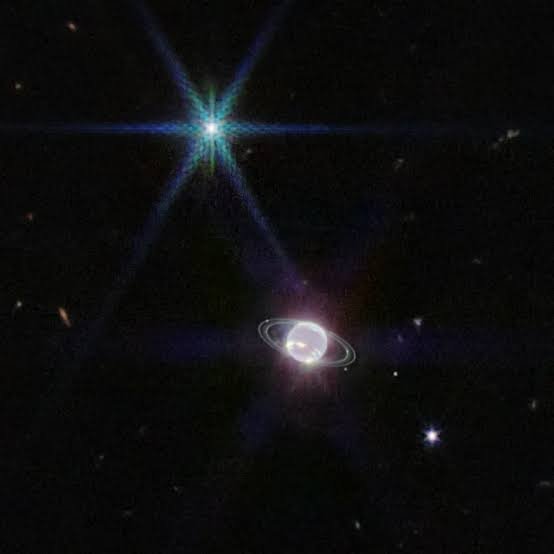
WASHINGTON: New observations from NASA’s James Webb Space Telescope (JWST) have uncovered evidence suggesting that Neptune’s inner moon system was reshaped by a massive collision billions of years ago, with scientists identifying the giant moon Triton as the most likely trigger.
The findings, published in the journal Science Advances, indicate that Neptune’s present-day inner moons and rings were formed from debris left behind after the planet’s original moons were destroyed during a violent gravitational upheaval early in the Solar System’s history.
Using JWST, researchers analysed the composition of Neptune’s small inner moons Proteus, Larissa, and Galatea, along with the planet’s dusty inner rings. They detected magnesium-rich clay minerals that typically form only after prolonged interaction between liquid water and rock, conditions impossible on these small, frozen moons.
According to lead author Ryleigh Davis, the minerals must have originated from the deep interiors of much larger ancient icy worlds that were later shattered, exposing material that eventually became incorporated into Neptune’s current moons and rings.
Researchers believe the destruction began after Neptune gravitationally captured Triton—a Pluto-sized object from the distant Kuiper Belt—within the first billion years of the Solar System’s formation about 4.5 billion years ago. Triton’s powerful gravitational influence is thought to have destabilised Neptune’s original moons, causing repeated collisions that destroyed most of them.
The debris from those impacts later reassembled into the smaller inner moons observed today.
Scientists note that Triton remains unique among the Solar System’s large moons because it orbits Neptune in the opposite direction of the planet’s rotation, reinforcing the theory that it was captured rather than formed alongside Neptune.
The study also suggests that Nereid, one of Neptune’s distant outer moons, may be the only surviving remnant of the planet’s original satellite system.
Researchers say the discovery provides one of the clearest pieces of evidence yet that the outer Solar System experienced catastrophic events capable of permanently reshaping entire planetary systems, offering new insight into the violent processes that shaped the early evolution of planets and their moons.