

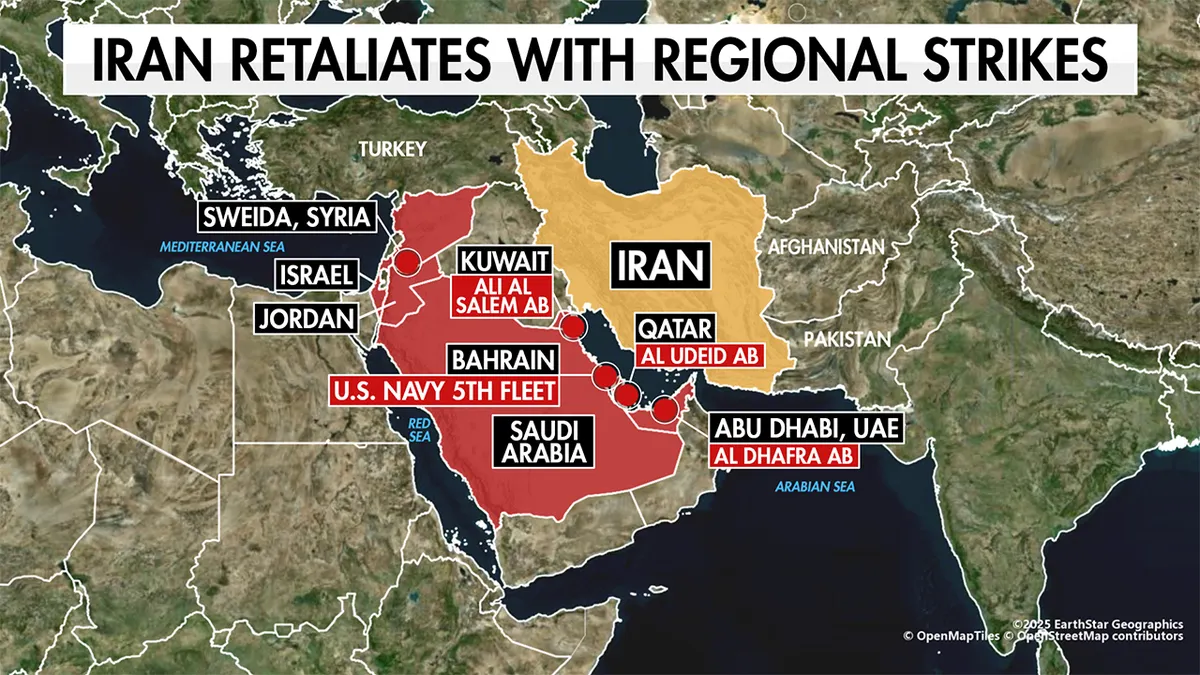
17 June 2026 — Day 108
A fragile but potentially historic agreement between the United States and Iran is moving toward formal signing, with a ceremony expected in Geneva on Friday. President Donald Trump announced the deal, describing it as a “great deal,” capping months of open conflict that began with joint US-Israeli strikes on Iranian military and government infrastructure in late February 2026.
The emerging memorandum of understanding would immediately reopen the Strait of Hormuz without tolls, lift the US blockade, extend the ceasefire for 60 days, including in Lebanon, and leave detailed nuclear negotiations for a second stage, according to multiple reports.
Pakistan’s Prime Minister Shehbaz Sharif confirmed in parliament that Pakistan will host the signing ceremony for the US-Iran agreement in Geneva, praising Field Marshal Asim Munir for guiding the negotiations through “ups and downs” and moments when talks appeared close to collapse.
US Vice President JD Vance said the administration could release the text of the memorandum as early as Wednesday, while describing it as a “political document” in which the underlying understandings matter more than the written terms. Officials said the framework includes commitments on sanctions relief, nuclear discussions, and unfreezing of assets, all tied to phased compliance.
A major uncertainty remains US intelligence assessments, which reportedly remain skeptical of Iran’s willingness to make meaningful nuclear concessions, raising doubts over long-term durability even as diplomatic momentum builds.
The Lebanon front remains the most volatile fault line. Iran’s Islamic Revolutionary Guard Corps accused Israel of violating the ceasefire in southern Lebanon “84 times in two days” and warned of a “harsh response” if operations continue. Israel, however, has refused any withdrawal, with Defense Minister Israel Katz stating the Israel Defense Forces will not pull back from areas seized in southern Lebanon, Syria, or Gaza under any deal.
Far-right National Security Minister Itamar Ben-Gvir said “Israel is not subordinate to the United States,” signaling internal political resistance to the framework. Prime Minister Benjamin Netanyahu has not yet issued a formal response.
The United States has also reportedly declined Israel’s request to review the MOU text, highlighting growing strain in US-Israel coordination.
On the ground in Lebanon, the Lebanese Armed Forces urged civilians not to return to southern areas due to continued danger, even as some displaced families began moving back after the announcement, prompting partial reopening of roads in Tyre and Bint Jbeil.
International maritime authorities welcomed the development, with the International Maritime Organization calling it an important step toward restoring safety in the Strait of Hormuz, while warning that evacuation and stabilization efforts will take time. The United Nations also reported a notable decline in border violence, describing the trend as linked to the diplomatic breakthrough.
Despite the momentum, the situation remains highly unstable. The outcome now hinges on whether the second-stage nuclear talks produce enforceable commitments, whether Israel adjusts its posture in Lebanon, and whether the planned signing ceremony proceeds amid escalating political pressure.
16 June 2026 — Day 107
An electronically signed US–Iran Memorandum of Understanding (MoU) marked the central development of this period, signaling a major step toward de-escalation after months of regional conflict.
The agreement, finalized through digital signatures by senior US and Iranian representatives, formalized a framework aimed at ending active hostilities, extending the ceasefire arrangement, and opening the way for broader negotiations on Iran’s nuclear programme, sanctions relief, and regional security issues. It also included provisions for the reopening of the Strait of Hormuz, along with phased steps toward restoring maritime stability and commercial shipping.
US leadership described the deal as a breakthrough toward regional stabilization and energy security, while Iran responded cautiously, welcoming diplomatic progress but maintaining that key issues—particularly sanctions and nuclear rights—remain unresolved. Pakistan was widely referenced in reporting as playing a facilitating diplomatic role, with its leadership supporting the outcome as a step toward regional calm.
At the same time, the situation was complicated by ongoing Israel–Hezbollah tensions in Lebanon, where Israeli operations continued following earlier strikes in Beirut’s southern districts. These actions, which resulted in reported casualties, were framed by Israel as responses to security threats and remained outside the scope of the US–Iran understanding.
Israeli officials also expressed reservations about the agreement, particularly its limited coverage of Iran’s regional influence and allied non-state actors. Washington, meanwhile, urged restraint from all sides to prevent escalation from undermining the emerging diplomatic framework.
Markets reacted positively, with reports of declining oil prices and improved global sentiment following expectations of reduced risk to maritime routes through the Strait of Hormuz. However, analysts emphasized that despite the diplomatic breakthrough, the broader regional situation remains fragile and uneven, with implementation still in early stages and parallel conflicts continuing in Lebanon.
Overall, the period reflects a formalized step toward US–Iran de-escalation through an electronically signed agreement, alongside persistent instability in adjacent conflict zones, keeping the regional security environment cautiously transitional.
15 June 2026 — Day 106
No large-scale direct US-Iran or Israel-Iran military escalation was reported during this period, as the regional situation shifted toward a fragile de-escalation framework following a US-Iran understanding to wind down active hostilities.
The key development was the announcement of a US-Iran Memorandum of Understanding (MoU) aimed at ending the ongoing conflict. The agreement, presented as a mediated breakthrough involving regional diplomatic support, outlined a temporary extension of the ceasefire, gradual steps toward restoring maritime stability in the Strait of Hormuz, and the resumption of broader negotiations on nuclear, sanctions, and regional security issues. A formal signing process was expected to follow, with both sides presenting differing interpretations of the scope and binding nature of the arrangement.
The United States described the agreement as a major step toward regional stabilization and energy security, while Iran expressed cautious acceptance, emphasizing that core disputes—particularly around nuclear enrichment and sanctions relief—remain unresolved. Pakistan was highlighted in some reporting as playing a facilitating diplomatic role, with its leadership publicly endorsing the ceasefire framework.
However, the diplomatic momentum was complicated by continued Israel–Hezbollah hostilities. Israeli airstrikes in Beirut targeted areas linked to Hezbollah infrastructure following reported cross-border fire toward northern Israel. The strikes resulted in limited but confirmed casualties, and triggered strong condemnation from Lebanese and Iranian officials. Israel maintained that its operations were self-defensive and ongoing, and stated it was not bound by the US-Iran understanding.
The Israeli leadership expressed reservations over the emerging arrangement, particularly its lack of firm provisions on Iran’s nuclear program and regional proxy networks. The development also generated visible political tension between Washington and Tel Aviv, with US officials urging restraint to avoid undermining the broader de-escalation effort.
Despite the announcement of a diplomatic breakthrough, the situation remained militarily fragmented, with the US-Iran front moving toward de-escalation while the Israel-Hezbollah theater continued to experience localized, intermittent exchanges.
Overall, the period reflected a partial and uneven de-escalation process, where diplomatic progress on one axis coexisted with continued instability on another, leaving the broader regional security environment uncertain but temporarily less volatile than earlier in the conflict cycle.
14 June 2026 — Day 105
Diplomatic efforts to finalize a US-Iran memorandum of understanding (MoU) have intensified, with Pakistan acting as a key mediator and reporting that both sides have reached agreement on a final draft text aimed at extending the ceasefire and easing regional tensions.
Prime Minister Shehbaz Sharif said the United States and Iran had agreed on the finalised wording of an interim deal, describing the process as nearing completion, with electronic signing expected soon and follow-up technical negotiations planned.
President Donald Trump announced that a deal was expected to be signed imminently, saying it would include provisions to reopen the Strait of Hormuz, enforce strict nuclear limitations on Iran, and establish inspections and controls over nuclear material. He also said the arrangement would involve no immediate financial transfers and a framework for broader enforcement measures.
Iranian officials, however, have pushed back on the proposed timeline, stating that while discussions are progressing, a signing is not confirmed for the suggested date. Tehran has highlighted unresolved issues related to sanctions relief, maritime control in the Strait of Hormuz, and verification mechanisms.
The proposed agreement is reported to include steps to extend the fragile ceasefire, gradually reopen critical shipping lanes, and initiate broader nuclear negotiations, though major differences remain over enforcement and long-term commitments.
At the same time, limited military activity continues, including US interceptions of Iranian drones near the Strait of Hormuz amid ongoing tensions surrounding maritime security.
The Strait of Hormuz remains a central point of concern due to its role as a key global energy corridor, with any disruption affecting international oil and gas flows.
While diplomatic momentum is building, both sides remain divided on core issues, and no formal signing has yet been confirmed.
13 June 2026 — Day 104
Diplomatic efforts to end the ongoing US-Iran conflict have accelerated, with Pakistan playing a mediating role and reporting that Washington and Tehran have reached agreement on the final draft of a potential peace deal, according to official statements.
Prime Minister Shehbaz Sharif said the two sides had agreed on the final wording of the agreement, with an electronic signing expected soon, followed by technical-level talks. He described the process as being closer than ever to a settlement.
US President Donald Trump separately said a memorandum of understanding (MOU) was expected to be signed soon, which would include provisions to stabilize the Strait of Hormuz, restart free navigation, and restrict Iran’s nuclear program. US officials have also expressed strong optimism about a near-term agreement, describing a high probability of an initial deal that could extend the ceasefire and launch broader negotiations.
Iranian officials have acknowledged ongoing talks but have pushed back on timelines, saying several core issues remain unresolved, particularly around nuclear restrictions and sanctions relief.
Despite diplomatic momentum, military tensions continue in the region. US forces have intercepted and destroyed multiple Iranian drones near the Strait of Hormuz, while earlier exchanges of strikes and accusations have kept the situation volatile.
The conflict has also disrupted global energy routes, with the Strait of Hormuz remaining a critical chokepoint for international oil and gas shipments. Negotiators are prioritizing reopening and securing maritime traffic as part of any interim agreement.
While talks continue, both sides remain divided on enforcement mechanisms, nuclear constraints, and regional security arrangements, leaving the outcome uncertain despite growing diplomatic activity.
12 June 2026 — Day 103
The US-Iran-Israel conflict saw renewed escalation and competing diplomatic claims as limited strikes, missile exchanges, and high-level political statements intensified uncertainty over a possible breakthrough agreement.
The broader war, which began with joint US-Israeli strikes on Iranian nuclear and military facilities, has continued through cycles of retaliation involving Iran, Israel, US forces, and regional allies, with the Strait of Hormuz remaining a key flashpoint and proxy fronts active across the Middle East.
In the latest phase of escalation, the United States carried out airstrikes on multiple Iranian targets, described as self-defence operations following reported incidents including the downing of a US Apache helicopter near the Strait of Hormuz. Targets included military installations, surveillance systems, and communications infrastructure, according to US defence sources.
Iran responded with missile and drone attacks on US-linked bases in Bahrain, Kuwait, and Jordan, while also warning over maritime security in the Strait of Hormuz and rejecting US justification for the strikes.
Amid the military exchanges, US President Donald Trump initially warned of further major escalation, including possible strikes on Iran’s energy infrastructure and strategic oil facilities. However, he later announced the cancellation of additional military operations, citing what he described as progress in negotiations and an emerging agreement framework with Iran.
Trump claimed that discussions had reached high-level approval within Iran’s leadership, and suggested that a formal agreement could be signed soon with participation from regional actors. He also stated that the conflict could move toward resolution and that several countries had been briefed on the draft understanding.
Iranian officials, however, rejected claims of a finalized deal, stating that while parts of a draft text were under review, no final agreement had been reached. Tehran reiterated that any settlement would require sanctions relief and economic guarantees, while continuing to deny US claims of internal approval for an agreement.
Israel, while not formally part of the reported US-Iran understanding, maintained that it expects any deal to include dismantling Iran’s enrichment capacity, missile restrictions, and limits on regional proxy activity. Israeli leadership also confirmed ongoing coordination discussions with Washington but signaled it remains prepared for further military developments.
Despite reports of diplomatic momentum, tensions across the region remain elevated, with continued risks tied to the Strait of Hormuz, ongoing proxy activity, and the absence of a formally confirmed agreement between Washington and Tehran.
11 June 2026 — Day 102
The United States and Iran carried out limited but intense military exchanges amid renewed tensions in the ongoing conflict, before US President Donald Trump announced a pause in planned strikes, citing progress toward a potential diplomatic agreement.
The escalation followed an incident near the Strait of Hormuz in which a US Apache helicopter was reportedly downed, an event Washington attributed to Iranian-linked forces.
In response, the US conducted airstrikes on multiple targets inside Iran, including facilities in southern regions and sites near the Strait of Hormuz. US Central Command described the strikes as “self-defence” operations, targeting surveillance systems, communications infrastructure, and air defence positions.
Iran subsequently launched missile and drone attacks targeting US-linked sites in Bahrain, Kuwait, and Jordan. Iranian authorities claimed responsibility for strikes on multiple regional targets and issued threats regarding maritime traffic through the Strait of Hormuz.
Amid the exchanges, US President Donald Trump initially warned of further military action, including potential strikes on Iran’s energy infrastructure. However, he later announced the cancellation of additional operations, stating that diplomatic discussions had advanced toward a possible agreement with Tehran.
Trump said discussions on a draft understanding had reached what he described as high-level approval in Iran, and suggested that the conflict could move toward resolution. No formal confirmation of such approval was issued by Iranian authorities.
Iranian officials acknowledged ongoing internal review of diplomatic proposals but maintained that no final decision had been reached. Tehran reiterated its position that any agreement must include sanctions relief and access to frozen assets, while rejecting claims of concessions on its nuclear programme.
The Strait of Hormuz, a critical global energy shipping route, remained central to the tensions, with both sides issuing warnings over maritime security and regional stability.
The brief but sharp escalation marked the latest flare-up in a conflict that has seen repeated exchanges of strikes, despite intermittent ceasefire arrangements and ongoing diplomatic efforts involving regional and international actors.
10 June 2026 — Day 101
The ongoing US–Iran–Israel conflict has escalated following a series of incidents involving a US military helicopter crash near the Strait of Hormuz, retaliatory strikes, and renewed cross-border attacks, despite an earlier fragile ceasefire.
Tensions increased after a US Army AH-64 Apache helicopter went down during a patrol near the Strait of Hormuz in waters close to Oman and Iran. US officials said both crew members were rescued safely by a US Navy unmanned vessel. Washington suggested the aircraft may have been struck or affected by hostile action, while Iran denied involvement and pointed to possible technical failure or operational accident amid heightened regional tensions.
Following the incident, US Central Command launched limited strikes on Iranian military infrastructure, targeting air defence systems, radar facilities, surveillance nodes, and command sites in southern Iran near the Strait of Hormuz, including areas in Hormozgan province. The US described the operation as defensive, aimed at reducing threats to its forces and maritime traffic through the strategic waterway.
In response, Iran’s Revolutionary Guards claimed coordinated drone and missile attacks on multiple US-linked targets across the Gulf region, including the US Fifth Fleet in Bahrain, bases in Kuwait, and the Al Azraq installation in Jordan. US and regional authorities said most incoming projectiles were intercepted and no major damage or confirmed casualties were reported in initial assessments.
At the same time, Israel carried out strikes in southern Lebanon against Hezbollah positions following cross-border activity. Israeli leadership indicated that direct strikes on Iran had been paused under diplomatic pressure but warned of further action if escalation continues, while Hezbollah remains a key regional flashpoint.
Casualty reports remain disputed, with Iran alleging civilian impact from US strikes, while Washington maintains its operations targeted only military sites. Independent verification of battlefield claims remains limited.
US officials have described their actions as proportionate self-defence, while Iran has condemned them as violations of sovereignty and warned of continued retaliation if attacks persist. Gulf states have expressed concern over rising instability, particularly due to risks to shipping through the Strait of Hormuz, a critical global energy corridor.
The situation remains highly volatile, with continued exchanges of air and missile strikes, conflicting claims from all sides, and ongoing diplomatic efforts to prevent further escalation.
9 June 2026 — Day 100
The US–Iran–Israel conflict saw a brief escalation followed by rapid de-escalation, as both sides stepped back from renewed confrontation after earlier strikes linked to tensions involving Hezbollah in Lebanon.
Israel carried out airstrikes on Iranian territory, targeting military installations, air defense systems in western and central Iran, including areas near Tehran, Isfahan, and Tabriz, as well as the Mahshahr (Karun) petrochemical complex in southwest Iran. The strikes caused explosions across multiple Iranian cities, and several airports were temporarily shut down.
In response, Iran launched additional ballistic missile waves toward Israel, firing approximately 30 missiles across the exchange cycle, targeting northern and central Israeli areas. Most missiles were intercepted by Israeli air defense systems, with limited damage reported and no major confirmed casualties on either side.
Both sides later moved toward de-escalation. Israel announced a pause in strikes, while warning of strong retaliation if further attacks occur. Iran stated that its retaliatory actions had ended, but warned of a “crushing response” if Israeli operations in Lebanon continued.
The United States played a key diplomatic role, with President Donald Trump intervening directly, holding multiple calls with Israeli leadership and urging an immediate halt to escalation. He reportedly warned that continued fighting could leave Israel without full US support and could undermine ongoing US–Iran diplomatic and nuclear negotiations. The White House remained on high alert to prevent further escalation.
After the pause, no new major strikes were reported, and the situation remained relatively calm into the following day, although tensions persisted. Trump expressed confidence that a US–Iran agreement could be reached within days, potentially addressing nuclear restrictions and broader regional security issues, including tensions around the Strait of Hormuz.
Israeli military operations against Hezbollah in Lebanon continued in parallel, including strikes and evacuation warnings, which Iran cited as part of its justification for earlier retaliation.
The exchange resulted in limited casualties and infrastructure damage, but triggered volatility in global markets, including oil price fluctuations and short-term stock instability. While contained, the incident highlighted the fragility of the April 2026 ceasefire framework and the risk of renewed escalation amid unresolved regional disputes.
8 June 2026 — Day 99
A brief escalation between Iran and Israel tested the fragile ceasefire established in April 2026, following months of heightened regional conflict that began earlier in the year with US-Israeli strikes on Iranian military and nuclear-linked infrastructure.
The latest flare-up began after Israeli airstrikes targeted Hezbollah positions in southern Beirut and surrounding areas in Lebanon, an Iran-aligned group. Iran responded by launching waves of ballistic missiles toward Israeli territory, including reported targets in northern Israel such as the Ramat David Airbase. The exchange marked the most direct Iran–Israel military confrontation since the ceasefire agreement.
Israel subsequently carried out retaliatory strikes on Iranian territory, hitting military installations, air defense systems in western and central regions, and industrial infrastructure including the Mahshahr petrochemical complex in southwestern Iran. Explosions were also reported in several major Iranian cities, including Tehran, Tabriz, and Isfahan. Iran responded with additional missile fire, while Israel reported intercepting multiple incoming projectiles and instructed civilians to seek shelter.
The exchanges prompted heightened diplomatic activity, with the United States intervening to prevent further escalation. The US administration urged both sides to exercise restraint and maintain the ceasefire framework, with direct communications reportedly taking place with Israeli leadership to limit the scope of retaliation. Washington emphasized efforts to preserve ongoing diplomatic and nuclear-related negotiations.
By the end of the exchange, both sides indicated a temporary pause in direct attacks, although statements from Israeli and Iranian officials underscored that further retaliation remained possible if provoked. Israel warned it would respond forcefully to any additional strikes, while Iran described its missile launches as a completed response to the earlier attacks in Lebanon.
The limited exchange caused volatility in global financial markets, with oil prices fluctuating amid concerns over potential wider regional disruption. Although contained, the incident highlighted the continuing fragility of the ceasefire and the risk of rapid re-escalation linked to wider regional conflicts involving Hezbollah and broader Iran-Israel tensions.
7 June 2026 — Day 98
A new wave of escalation continued in the ongoing US–Israel–Iran conflict as Iranian drone and missile activity targeted the Strait of Hormuz and US-linked sites in Kuwait and Bahrain, further straining the already fragile ceasefire framework. Iranian forces reportedly launched additional one-way attack drones toward the Strait of Hormuz, alongside renewed ballistic missile threats against Gulf targets, prompting heightened regional alerts.
The United States responded with multiple drone interceptions and defensive operations, with US Central Command confirming the downing of Iranian drones over the Strait of Hormuz and intercepting additional incoming threats aimed at Kuwait and Bahrain. In parallel, US forces conducted retaliatory strikes on Iranian radar and coastal defense infrastructure, including sites in Goruk and Qeshm Island, which Washington described as necessary actions to protect maritime traffic and allied security in the Gulf.
Although most incoming missiles and drones were intercepted, the broader exchange added to earlier damage in Kuwait, including strikes that had previously impacted Kuwait International Airport’s Terminal 1, resulting in at least one civilian death (an Indian national) and dozens of injuries. Gulf states activated air defenses and issued alerts as debris and interception effects caused minor localized damage, while Iran condemned the US response as a flagrant ceasefire violation and warned of further retaliation.
On the Israel–Lebanon front, fighting remained active despite ongoing diplomatic pressure for de-escalation. Israeli airstrikes across southern Lebanon, including areas such as Naqoura, Nabatieh, and Tyre, continued to cause casualties, with reports of both militant and military losses. In response, Hezbollah carried out rocket, drone, and anti-tank missile attacks against Israeli positions, sustaining a pattern of sustained cross-border conflict.
Hezbollah maintained its rejection of the US-brokered conditional ceasefire proposal, insisting that any agreement must include a full Israeli withdrawal from Lebanese territory. The breakdown of negotiations resulted in continued exchanges, with both sides blaming each other for escalation and undermining peace efforts.
Diplomatic efforts between the United States and Iran remained stalled, despite claims of incremental progress from Washington. Discussions reportedly centered on the Iranian nuclear program, frozen financial assets valued at tens of billions of dollars, and the reopening of the Strait of Hormuz, along with whether Lebanon should be linked to broader regional negotiations. Iran warned that continued US pressure could trigger wider escalation, while US officials accused Tehran of prolonging instability and operating with significantly reduced missile capacity.
Overall, the conflict remained in a highly volatile phase, with repeated ceasefire violations, intensified proxy warfare in Lebanon, and continued US–Iran military exchanges in the Gulf region, leaving the regional security situation extremely unstable and diplomatically unresolved.
6 June 2026 — Day 97
A significant escalation unfolded in the ongoing US–Israel–Iran conflict as Iran launched drone and missile attacks targeting the Strait of Hormuz, Kuwait, and Bahrain, intensifying pressure on the already fragile regional ceasefire. Iranian forces reportedly deployed multiple attack drones toward the Strait of Hormuz, followed by a barrage of ballistic missiles aimed at Kuwait and Bahrain, some of which were described as “warning strikes” near US naval activity in the Gulf of Oman.
The United States and allied forces responded with rapid interceptions, with US Central Command reporting the downing of all incoming drones and the interception of most ballistic missiles, while regional air defenses in Kuwait and Bahrain were activated amid widespread alerts. Despite the interceptions, some missiles caused limited infrastructure disruption, while earlier related strikes in Kuwait damaged Kuwait International Airport’s Terminal 1, resulting in at least one civilian death (an Indian national) and dozens of injuries across earlier incidents in the same escalation cycle.
In response, the United States carried out retaliatory strikes on Iranian military infrastructure, targeting coastal surveillance and radar facilities in Goruk and Qeshm Island, near the strategic Strait of Hormuz. Washington described these operations as defensive actions aimed at protecting maritime security and allied territory, while Iran condemned them as a flagrant violation of the ceasefire and warned that US bases in the region could become legitimate targets.
On the Israel–Lebanon front, the situation remained highly unstable despite a US-brokered ceasefire attempt, which quickly unraveled after Hezbollah rejected the proposed terms. The agreement called for Hezbollah withdrawal south of the Litani River and the establishment of security buffer zones, but Hezbollah argued it was one-sided and failed to require full Israeli withdrawal from Lebanese territory.
Following the breakdown, Israel intensified airstrikes across southern Lebanon, including areas such as Tyre, Nabatieh, and Naqoura, resulting in multiple casualties, including civilians and reports of UNIFIL-related fatalities in earlier cross-border incidents. In response, Hezbollah launched dozens of rocket, drone, and anti-tank attacks, targeting Israeli military positions and reportedly injuring IDF personnel, including soldiers from frontline units.
Diplomatic efforts continued in parallel, with US officials describing negotiations with Iran as ongoing but fragile, focusing on issues such as the Strait of Hormuz, Iran’s nuclear program, and frozen financial assets valued at tens of billions of dollars. Iran, however, linked broader progress to conditions in Lebanon and accused Washington of double standards, while US officials accused Tehran of a deliberate escalation strategy.
Meanwhile, political tensions within the US–Israel coordination framework reportedly surfaced, alongside continued regional condemnation from Gulf states, which labeled Iranian strikes as blatant aggression against sovereignty and civilian infrastructure. Oil markets and maritime shipping routes remained under pressure due to continued instability in the Gulf.
Overall, the situation remained in a highly volatile and fragile phase, with repeated ceasefire violations, proxy warfare in Lebanon, and direct US–Iran military exchanges undermining diplomatic efforts to stabilize the region.
5 June 2026 — Day 96
A new wave of escalation hit the ongoing US–Israel–Iran conflict as Iranian missile and drone attacks targeted Kuwait, Bahrain, and other Gulf-linked sites. In one major barrage, Iran launched multiple ballistic missiles toward Kuwait and Bahrain, most of which were intercepted, while some caused limited damage. Kuwait reported infrastructure damage, including earlier airport disruptions, along with one civilian death (an Indian national) and dozens of injuries. Bahrain activated emergency sirens and condemned the strikes as “blatant aggression.”
The United States responded through CENTCOM defensive and retaliatory operations, intercepting incoming Iranian drones and missiles, including activity near the Strait of Hormuz, and carrying out strikes on Iranian coastal radar and surveillance installations, including areas on Qeshm Island and nearby sites. Iran accused the US of violating the fragile ceasefire and justified its actions as self-defense, further escalating tensions in the Gulf maritime corridor.
On the Israel–Lebanon front, a US-brokered ceasefire agreement quickly collapsed after Hezbollah rejected its terms. The proposal required Hezbollah withdrawal south of the Litani River and the creation of security buffer zones, but Hezbollah argued the deal was unfair without a full Israeli withdrawal from Lebanon. Despite the announcement, fighting continued almost immediately.
Israeli airstrikes hit multiple areas in southern Lebanon, including Naqoura, Nabatieh, and Tyre, causing several casualties, including civilians and reports of a UN peacekeeper fatality (UNIFIL personnel). Hezbollah responded with rocket, drone, and anti-tank missile attacks, targeting Israeli military positions and reportedly killing an Israeli officer. The exchange marked a rapid return to sustained hostilities despite diplomatic efforts.
In the broader diplomatic context, US officials described ongoing negotiations with Iran as progressing cautiously, with discussions involving ceasefire stabilization, the Strait of Hormuz reopening, and Iran’s nuclear program. However, Iran tied any broader agreement to conditions in Lebanon and the release of frozen assets, while US officials accused Tehran of prolonging instability.
Overall, the conflict remained in a fragile and volatile phase, with repeated violations, proxy warfare, and maritime tensions undermining efforts to stabilize the region across the Gulf and Levant theaters.
4 June 2026 — Day 95
A major escalation occurred in the ongoing US–Israel–Iran conflict when Iranian drone and missile strikes targeted Kuwait International Airport and surrounding areas. The attack killed one person (an Indian national) and injured over sixty people, while causing severe damage to Terminal 1 and forcing a temporary shutdown of the airport. Kuwait condemned the strike as a “heinous act of aggression,” while Iran later claimed that some of the destruction may have been caused by a malfunctioning US Patriot missile system.
In parallel, Iran also attempted strikes on US-linked facilities across the Gulf, including sites in Bahrain and other strategic locations. These actions were seen as retaliation within the broader regional war following earlier US and Israeli strikes on Iranian territory. The United States responded through CENTCOM retaliatory operations, reporting interceptions of incoming threats and carrying out strikes on Iranian military assets, including radar and coastal command sites near the Strait of Hormuz. Washington described the action as defensive and protective for regional allies and shipping routes.
Meanwhile, a US-brokered Israel–Lebanon ceasefire agreement was announced as part of wider diplomatic efforts to contain the conflict. The deal called for a halt in hostilities and the withdrawal of Hezbollah fighters from southern Lebanon, along with proposed security arrangements along the border. However, the agreement quickly collapsed after Hezbollah rejected the terms, arguing it was unequal and did not require full Israeli withdrawal.
Following the breakdown, fighting intensified again. Israeli airstrikes in southern Lebanon caused casualties, while Hezbollah rocket and anti-tank attacks reportedly killed an Israeli soldier. The exchange marked a rapid return to active combat after the failed ceasefire attempt.
Overall, the situation reflects a fragile regional security environment, where ongoing diplomacy is repeatedly disrupted by retaliatory strikes, proxy warfare, and escalating tensions involving Iran, Israel, the United States, and allied groups.
3 June 2026 — Day 94
The regional security environment remained highly fragile as US-Iran relations held a temporary pause in direct military escalation, while diplomatic negotiations remained frozen on one side and publicly optimistic on the other. Meanwhile, the Israel-Hezbollah conflict in Lebanon continued despite claims of a ceasefire, raising doubts over the durability of any informal de-escalation efforts.
On the US-Iran front, no new major direct military strikes were reported between the two sides during this period. The situation remained focused on the aftermath of earlier exchanges involving US strikes on Iranian military infrastructure, including radar installations, drone command-and-control sites, and facilities in Bandar Abbas and Qeshm Island, alongside Iran’s retaliatory actions against US-linked regional military assets.
Despite the absence of fresh kinetic escalation, tensions in the Strait of Hormuz remained elevated. Iran continued to enforce restrictive measures over maritime traffic and reiterated threats to expand pressure to other strategic chokepoints, including the Bab al-Mandeb Strait, particularly if Israeli military operations in Lebanon continued. The United States maintained a strong military posture in the region, with senior defense officials reiterating readiness to respond if necessary while emphasizing a preference for diplomatic resolution.
Diplomatically, the situation remained deeply divided. Iran’s suspension of indirect negotiations with the United States remained in effect, with Iranian officials stating that talks would not resume unless Israeli operations in Lebanon were halted or significantly reduced. Iranian leadership, including Foreign Ministry figures and IRGC-linked statements, insisted that any ceasefire framework must apply across all regional fronts, not solely the Gulf theater.
In contrast, US messaging remained more optimistic. Former President Donald Trump rejected the notion that negotiations had stalled, insisting that discussions were “continuing rapidly” and could lead to a deal within a short timeframe. He claimed progress toward a draft Memorandum of Understanding, which would include a 60-day ceasefire extension, nuclear programme restrictions, sanctions relief mechanisms, and guarantees regarding maritime access through the Strait of Hormuz.
Trump also urged calm in public remarks, suggesting that the situation was stabilizing and encouraging observers to “sit back and relax,” while maintaining pressure for stricter limits on Iran’s highly enriched uranium stockpile.
Reports also indicated rising diplomatic friction between Trump and Israeli leadership, including a reportedly tense phone call with Prime Minister Benjamin Netanyahu, during which Trump urged restraint in Lebanon and emphasized that escalation could jeopardize broader US-Iran negotiations.
On the Israel-Hezbollah front in Lebanon, the situation remained volatile despite competing claims of a ceasefire.
Following earlier Israeli declarations of a truce agreement with Hezbollah, hostilities continued on the ground. Hezbollah launched additional rocket and drone attacks toward northern Israel, many of which were intercepted, though some caused property damage and continued disruption in border communities.
Israel, in turn, maintained military operations in southern Lebanon, including drone strikes and ground activity in contested areas. Reports indicated continued fighting near key zones such as Tyre and areas surrounding previously captured positions including Beaufort Castle, as well as ongoing Israeli presence in forward operational areas.
Casualty reports from Lebanese authorities indicated continued fatalities, including civilians, with at least eight deaths reported in Israeli strikes during this period alone. The broader death toll in Lebanon since the escalation of conflict earlier in the year reportedly exceeded 3,400, alongside widespread displacement and infrastructure damage.
The humanitarian situation in Lebanon deteriorated further, with ongoing evacuation orders and large-scale population displacement affecting a significant portion of the country. Northern Israel also remained under repeated alert conditions due to continued cross-border attacks.
International reactions intensified, with the United Nations and European states, including France, calling for urgent de-escalation and additional emergency discussions to prevent further regional destabilization.
Global energy markets remained sensitive to developments in the Gulf and Red Sea, with oil prices remaining elevated due to persistent uncertainty surrounding the Strait of Hormuz and potential spillover risks involving the Bab al-Mandeb Strait.
Overall, the period reflected a sharp diplomatic disconnect between US and Iranian positions, ongoing uncertainty over any ceasefire framework, and continued instability in Lebanon despite claimed de-escalation efforts. The situation remained highly volatile, with multiple overlapping conflicts threatening to undermine regional stability.
2 June 2026 — Day 93
The period saw renewed US-Iran military exchanges, escalating diplomatic contradictions, and a sharp intensification of the Israel-Hezbollah war in Lebanon, creating a multi-front regional crisis that further strained already fragile ceasefire arrangements.
On the military front, US Central Command (CENTCOM) carried out continued defensive strikes on Iranian military infrastructure in southern Iran. Targets included radar systems, air defense installations, drone command-and-control centers, and missile launch facilities in areas such as Goruk and Qeshm Island. A separate strike reportedly hit a drone ground-control station in Bandar Abbas, which was preparing additional unmanned aerial launches.
US officials described these operations as limited self-defense actions, conducted in response to perceived imminent threats to shipping lanes and US forces operating near the Strait of Hormuz.
The strikes followed Iranian actions, including the reported downing of a US MQ-1 Predator drone over international waters and ongoing threats to maritime traffic in the Gulf.
Iran responded with missile strikes targeting a US-linked military facility, with reports indicating impacts near installations in Kuwait or other regional US bases. US forces intercepted the missiles, preventing significant damage or confirmed casualties. Iran also deployed drones during the exchange, continuing a pattern of controlled but direct retaliation.
Although the exchanges remained limited in scale, they marked a renewed breakdown in the fragile de-escalation environment and reinforced fears of renewed escalation in the Gulf.
Diplomatically, tensions deepened as Iran announced the suspension of indirect negotiations with the United States, which had been mediated in Qatar. Iranian officials cited Israel’s military campaign in Lebanon as the primary reason, arguing that continued Israeli operations undermined the broader regional ceasefire framework linked to US-Iran diplomacy.
Iran also escalated its warnings over the Strait of Hormuz, threatening tighter control over maritime movement and suggesting the possibility of coordinated pressure on additional chokepoints such as the Bab al-Mandeb Strait, potentially involving allied regional actors.
US messaging, however, remained more optimistic. Former President Donald Trump rejected claims that negotiations had stalled, stating that discussions were “continuing rapidly” and remained active across multiple channels. He described the parties as close to a draft Memorandum of Understanding (MoU) involving a 60-day ceasefire extension, nuclear restrictions, sanctions relief mechanisms, and maritime security guarantees.
Trump emphasized strict conditions, particularly regarding Iran’s highly enriched uranium stockpile and regional behavior. Despite Iran’s suspension announcement, US officials continued to signal that diplomatic engagement had not fully collapsed.
Reports also indicated rising tensions between Trump and Israeli leadership, including a reportedly heated phone call with Prime Minister Benjamin Netanyahu, during which pressure was applied on Israel to moderate its military actions in Lebanon.
On the Israel-Hezbollah front, the conflict escalated sharply despite competing claims of ceasefire efforts.
Following Israel’s capture of the strategic Beaufort Castle near the Litani River, Israeli forces continued expanded ground operations deep into southern Lebanon. The site’s seizure was described by Israeli leadership as a major symbolic and strategic breakthrough, marking one of the deepest incursions into Lebanon in decades.
Israeli airstrikes intensified across southern Lebanon and Beirut’s southern suburbs, including the Dahiya district, targeting Hezbollah command centers, weapons depots, and logistical infrastructure. Ground forces maintained positions beyond previous lines of engagement, consolidating control in key southern areas.
In contrast, Donald Trump announced what he described as a ceasefire between Israel and Hezbollah, claiming that both sides had agreed—through intermediaries such as Nabih Berri—to halt hostilities. He stated that Israel would not strike Beirut and that a pause in fighting had been secured through high-level communications.
However, battlefield developments contradicted these claims. Hezbollah continued launching rockets and drones toward northern Israel, including border communities and military positions, while Israeli forces maintained operations in southern Lebanon. This indicated that any ceasefire understanding remained fragile, partial, or not fully implemented.
Casualties in Lebanon remained high due to ongoing Israeli air and ground operations, with continued civilian displacement across southern regions. Israel also faced continued security disruptions, though casualty levels were lower compared to earlier peak escalation periods.
The humanitarian situation in Lebanon worsened significantly, with large-scale displacement, infrastructure damage, and mounting civilian pressure. The United Nations Security Council held emergency discussions focused on the deteriorating conflict and the risk of wider regional escalation.
Global energy markets remained highly sensitive to developments in both the Gulf and the Levant, with oil prices rising amid fears of disruption to shipping routes through the Strait of Hormuz and potential instability extending toward the Bab al-Mandeb Strait.
Overall, the period reflected a deeply unstable regional environment marked by renewed US-Iran strikes, suspended diplomacy, contested ceasefire claims in Lebanon, and intensifying Israel-Hezbollah warfare, all contributing to heightened risk of broader multi-front escalation.
1 June 2026 — Day 92
The already fragile security environment between the United States and Iran deteriorated further as fresh limited military exchanges were reported alongside a major escalation in the Israel-Hezbollah conflict in Lebanon, culminating in Iran suspending indirect diplomatic talks and raising fears of broader regional destabilization.
On the US-Iran front, US forces conducted self-defense strikes targeting Iranian military infrastructure in southern Iran, including areas around Goruk and Qeshm Island. The strikes reportedly focused on radar installations, drone command-and-control centers, and launch facilities, as well as a drone ground-control station in Bandar Abbas that was allegedly preparing additional unmanned aerial operations.
US Central Command stated the strikes were carried out in response to Iranian actions, including the reported downing of a US MQ-1 Predator drone operating over international waters and continued perceived threats to commercial shipping routes in the region. Washington characterized the operations as limited and defensive, aimed at preventing further escalation in the Strait of Hormuz and surrounding waters.
Iran responded with retaliatory action against a US-linked air base, with reports indicating strikes directed at facilities in Kuwait or other regional US military locations. Iranian authorities claimed that the targeted sites were directly connected to American operations against Iranian assets, framing the response as justified retaliation.
Although the exchanges remained limited in scale, they marked a renewed breakdown in the fragile ceasefire framework and reinforced concerns that the region was sliding back toward sustained confrontation.
In a significant diplomatic setback, Iran suspended indirect negotiations with the United States, which had been taking place through mediators in Qatar. Iranian officials stated that talks would not resume unless Israel reduced its military operations in Lebanon, explicitly linking the diplomatic process to the regional conflict involving Hezbollah.
Iranian state media and the Islamic Revolutionary Guard Corps (IRGC) warned of broader escalation, including threats to intensify restrictions in the Strait of Hormuz, with indications that additional maritime chokepoints such as Bab el-Mandeb could also be affected. Iranian messaging further suggested the possibility of opening new regional fronts if pressure continued.
Meanwhile, US President Donald Trump delayed final approval of a proposed Memorandum of Understanding aimed at extending the ceasefire framework. Washington reportedly pushed for stricter conditions, particularly regarding Iran’s highly enriched uranium stockpile and guarantees over maritime access through the Strait of Hormuz. Trump also indicated ongoing high-level communications with regional actors, including Israeli leadership, regarding broader de-escalation efforts.
At the same time, the Israel-Hezbollah war in Lebanon escalated sharply, marked by one of the most significant territorial developments in the conflict.
Israeli forces captured the strategically important Beaufort Castle, a historic fortress overlooking the Litani River near Nabatieh. The site’s capture represented Israel’s deepest ground incursion into Lebanon in over two decades and was described by Israeli leadership as a major operational and symbolic breakthrough in the campaign against Hezbollah.
Prime Minister Benjamin Netanyahu characterized the advance as a “dramatic shift” in Israel’s military posture and signaled intentions to expand operations further north, including the possible establishment of a broader security zone inside Lebanese territory.
Israeli ground forces advanced beyond the Litani River while airstrikes intensified across southern Lebanon and Beirut’s southern suburbs, including the Dahiya district, a long-standing Hezbollah stronghold. Military targets included command centers, weapons storage facilities, and logistical infrastructure.
Hezbollah responded with sustained rocket and drone attacks against northern Israel, triggering continued cross-border exchanges and civilian disruptions in Israeli border communities. The fighting caused property damage in several Israeli towns and ongoing security alerts across the northern front.
Casualty reports indicated continued heavy losses in Lebanon, with dozens killed in recent strikes, including civilians, while Israeli forces reported additional casualties during operations in southern Lebanon. Earlier Israeli losses in the broader campaign included Staff Sergeant Mihael Chukin, killed in a Hezbollah drone strike, contributing to rising military fatalities since the escalation began.
Humanitarian conditions in Lebanon worsened significantly, with expanding displacement, evacuation orders, and infrastructure damage. France requested an emergency UN Security Council meeting, reflecting growing international concern over the scale of the conflict.
Oil markets reacted sharply to the combined escalation in both the Gulf and Lebanon, with prices rising amid renewed fears over disruption to energy flows through the Strait of Hormuz and wider regional instability.
Overall, the period marked a dangerous convergence of crises: renewed US-Iran military exchanges, Iran’s suspension of diplomacy, and Israel’s major territorial advance in Lebanon, all reinforcing the risk of a broader regional conflict and the collapse of remaining ceasefire frameworks.
31 May 2026 — Day 91
The United States and Iran experienced a period of relative calm in direct military confrontation as tensions in the Gulf stabilized following earlier tit-for-tat exchanges, even as indirect negotiations continued under pressure and the Israel-Hezbollah conflict in Lebanon escalated significantly, reshaping the regional security landscape.
On the US-Iran front, no major new kinetic exchanges were reported during this period, marking a temporary pause after earlier confrontations linked to the Strait of Hormuz and strikes near Bandar Abbas. The situation reflected a shift from active escalation toward cautious containment, though both sides remained on high alert.
Iran continued to assert its authority over the Strait of Hormuz, warning that foreign commercial and military vessels operating outside Iranian regulations could face enforcement actions. Iranian statements reinforced a posture of deterrence, even as Tehran remained engaged in ongoing indirect diplomacy.
The United States maintained a strong operational posture in the Gulf, with senior defense officials reiterating readiness to respond if required. US Defense Secretary Pete Hegseth stated that American forces were “more than capable” and fully prepared to resume combat operations if diplomatic efforts collapsed, emphasizing continued US strategic superiority and deterrence capacity.
Despite the military calm, indirect US-Iran negotiations continued through mediators in Qatar and other regional channels, focusing on a potential Memorandum of Understanding (MoU) aimed at extending the ceasefire framework for approximately 60 days.
Discussions reportedly included several major provisions: reopening the Strait of Hormuz to unrestricted commercial shipping, removal of Iranian naval mines within a defined timeline, restrictions on Iran’s highly enriched uranium stockpile, limits on its nuclear programme, sanctions relief mechanisms, and the structure of longer-term nuclear negotiations.
However, the talks remained fragile. While US officials indicated progress, including statements from Vice President JD Vance suggesting the parties were “very close” to an agreement, final approval had not yet been granted by US leadership. Former President Donald Trump was reviewing the draft proposal and reportedly weighing strict conditions, including nuclear restrictions and regional security guarantees.
Iran, meanwhile, remained cautious and did not confirm that a final agreement was close. Iranian officials and state media stressed that negotiations were still ongoing and that key disagreements remained unresolved, particularly regarding nuclear limits, sanctions relief, and strategic demands affecting Iranian autonomy.
On the Israel-Hezbollah front in Lebanon, the situation escalated sharply and became the dominant active conflict in the region.
Israel significantly expanded military operations across southern Lebanon, the Bekaa Valley, and parts of Beirut. The Israel Defense Forces conducted extensive airstrikes on more than 100–150 targets, including Hezbollah weapons depots, command centers, rocket launch sites, and logistical infrastructure.
Ground operations intensified, with Israeli forces pushing deeper into southern Lebanon, operating beyond the Litani River, and expanding activity around key strategic zones including Beaufort Castle and nearby high-ground positions. Israeli leadership described control or operational presence in Beaufort Castle as a symbolic and strategic achievement, marking a significant escalation in the ground campaign.
Evacuation warnings were broadened across multiple towns and villages, including areas near Tyre, Nabatieh, and surrounding southern regions, leading to large-scale civilian displacement and growing humanitarian pressure.
Hezbollah responded with sustained and intensified rocket, drone, and artillery attacks targeting northern Israel, including border towns such as Kiryat Shmona, Nahariya, and wider Galilee regions. Some strikes caused property damage, including a rocket impact on a closed shopping mall in Kiryat Shmona, while drone attacks targeted Israeli military positions in southern Lebanon.
Casualties mounted on both sides. On the Israeli side, Staff Sergeant Mihael Chukin (21, Givati Brigade) was killed by a Hezbollah drone strike, along with additional wounded personnel. This brought total Israeli military fatalities in Lebanon since the broader escalation to approximately 13 soldiers. On the Lebanese side, authorities reported dozens of deaths during this period alone, including civilians, with cumulative fatalities since earlier phases of the conflict exceeding 3,200 killed, alongside widespread destruction of infrastructure.
The humanitarian situation deteriorated further, with over one million people displaced in Lebanon, while northern Israel faced repeated security alerts, school closures, and emergency measures, including hospitals operating underground or relocating critical services.
The parallel conflicts reinforced a broader regional linkage dynamic, as Iran and Hezbollah continued to frame any wider diplomatic settlement as dependent on Israeli military restraint in Lebanon, complicating US-Iran negotiations.
Global energy markets remained sensitive to developments in the Strait of Hormuz, with oil prices fluctuating amid ongoing uncertainty over maritime security. However, no immediate major disruption to global shipping occurred during this period.
Overall, the period reflected a dual reality: stabilization in direct US-Iran military confrontation alongside fragile but continuing diplomacy, contrasted with rapid escalation of the Israel-Hezbollah war in Lebanon, which intensified humanitarian costs and increased the risk of wider regional spillover.
30 May 2026 — Day 90
The United States and Iran continued cautious diplomatic engagement as indirect negotiations made progress toward a potential framework agreement, even as broader regional instability deepened due to escalating fighting between Israel and Hezbollah in Lebanon.
No major new direct military exchanges were reported between US and Iranian forces during the latest period, marking a temporary lull following earlier confrontations in the Gulf. US officials reiterated that prior operations near Bandar Abbas and the Strait of Hormuz were limited defensive actions, aimed at countering perceived drone and maritime threats and ensuring the security of international shipping routes.
Diplomatic momentum continued through indirect talks in Qatar, where mediators reported ongoing progress toward a possible 60-day ceasefire extension between Washington and Tehran. Proposed elements under discussion include the reopening and securing of the Strait of Hormuz for commercial traffic, removal of naval mines within a defined timeframe, restrictions on Iran’s highly enriched uranium stockpile, and the establishment of a broader framework for long-term nuclear negotiations and sanctions relief.
US officials, including Vice President JD Vance, described the parties as being “very close” to a preliminary Memorandum of Understanding, although final approval from President Donald Trump remained pending. Trump reportedly emphasized strict conditions, particularly regarding Iran’s nuclear programme and regional behavior.
Iranian officials, however, remained cautious and did not confirm that an agreement was near completion. State media and government sources stressed that negotiations were still ongoing, with key disagreements unresolved, particularly over US demands related to Iran’s nuclear capabilities and strategic autonomy in the Gulf.
Tensions also persisted around the Strait of Hormuz, where Iran reiterated warnings regarding foreign vessels and asserted its security posture over the strategic waterway. US Central Command maintained heightened readiness in the region but reported no new major incidents during this period.
In contrast to the relative calm in US-Iran military activity, the Israel-Hezbollah conflict in Lebanon escalated significantly. Israeli forces expanded airstrikes across southern Lebanon, Beirut, and the Bekaa Valley, targeting what they described as Hezbollah infrastructure, including weapons depots and command centers.
Israeli ground operations reportedly advanced further into southern Lebanon, including areas around Beaufort Castle and other strategic positions near the Litani River. Evacuation orders were expanded, resulting in widespread displacement across multiple towns and villages.
Hezbollah responded with intensified rocket, drone, and artillery attacks on northern Israel, prompting civilian disruptions, including hospital relocations and school closures in affected regions. Lebanese authorities reported rising casualties, including civilians, while Israel confirmed additional military losses linked to Hezbollah attacks.
The escalating Lebanon front added further complexity to regional diplomacy, with Iran continuing to link broader negotiations to Israeli military operations against Hezbollah. Analysts warned that this interconnected escalation risked undermining progress in US-Iran talks despite emerging diplomatic momentum.
Oil markets remained volatile amid uncertainty over the security of the Strait of Hormuz, though signs of potential diplomatic agreement provided limited stabilization to investor sentiment.
Overall, the period reflected a rare pause in direct US-Iran military confrontation, coupled with continued diplomatic engagement, while the widening Israel-Hezbollah conflict underscored the fragility of the broader regional security environment.
29 May 2026 — Day 89
Tensions between the United States and Iran showed signs of easing after several days of direct military exchanges in the Gulf, as both sides shifted focus toward diplomacy amid efforts to stabilize a fragile ceasefire and prevent wider regional escalation.
Following earlier confrontations involving US defensive strikes near Bandar Abbas and Iranian missile and drone retaliation targeting a US-linked base in Kuwait, no new large-scale military strikes were reported in the latest period. US officials described previous operations as limited self-defense actions aimed at protecting shipping lanes in the Strait of Hormuz and countering imminent drone and maritime threats.
Iran continued to condemn earlier US strikes as a violation of the ceasefire, but refrained from launching additional retaliatory attacks during this phase. Iranian military officials, however, maintained strong rhetoric warning of further responses if diplomatic efforts failed or if US operations resumed.
Despite the absence of new kinetic escalation, both sides remained on high alert, with continued monitoring of naval and drone activity in the Gulf and sustained concerns over potential disruption to global shipping routes passing through the Strait of Hormuz.
In contrast to the de-escalation in direct US-Iran military activity, indirect diplomatic negotiations advanced in Qatar, where mediators reported significant progress toward a possible 60-day extension of the ceasefire framework. Discussions reportedly included proposals to reopen and secure commercial navigation through the Strait of Hormuz, the removal of naval mines within a defined timeframe, limits on Iran’s highly enriched uranium stockpile, and broader talks on sanctions relief and nuclear programme restrictions.
US officials, including Vice President JD Vance, indicated that a preliminary understanding was close to completion, while President Donald Trump was reviewing proposed terms and emphasizing the need for strict guarantees on Iran’s nuclear activities and regional behavior. Iranian officials, however, remained cautious, neither fully confirming nor rejecting claims of a near-final agreement, and reiterated opposition to several US demands.
At the same time, the Israel-Hezbollah conflict in Lebanon escalated sharply, overshadowing diplomatic progress in the Gulf. Israeli forces expanded air and ground operations across southern Lebanon, the Bekaa Valley, and parts of Beirut, targeting what they described as Hezbollah weapons depots, command centers, and military infrastructure.
Israeli ground operations reportedly advanced deeper into contested areas, including positions near the Litani River and strategic sites such as Beaufort Castle. The Israel Defense Forces also issued expanded evacuation warnings for multiple southern Lebanese towns and villages amid ongoing strikes.
Hezbollah responded with intensified rocket, drone, and artillery attacks on northern Israel, striking areas near the border and prompting continued military exchanges. Casualty reports from Lebanese authorities indicated a rising civilian toll from Israeli strikes, while Israel reported losses among its forces due to Hezbollah drone and rocket attacks.
The simultaneous escalation in Lebanon and cautious diplomatic progress in the Gulf highlighted the increasingly interconnected nature of regional conflicts. Analysts noted that Iran continued to link broader negotiations to Israeli military actions against Hezbollah, complicating efforts to secure a comprehensive regional settlement.
Oil markets remained sensitive to developments, with prices fluctuating amid uncertainty over the security of the Strait of Hormuz, though reports of diplomatic progress provided limited stabilization to investor sentiment.
While the absence of new US-Iran strikes marked a temporary pause in direct hostilities, officials and analysts warned that the situation remained highly fragile, with both diplomatic breakthroughs and renewed escalation still possible depending on developments in the coming days.
28 May 2026 — Day 88
The fragile ceasefire between the United States and Iran came under renewed pressure as both sides engaged in fresh military exchanges in the Gulf, while escalating hostilities between Israel and Hezbollah further complicated efforts to secure a broader regional settlement.
According to US officials, CENTCOM carried out additional defensive strikes against Iranian targets in and around Bandar Abbas, targeting what Washington described as immediate threats to international shipping and US military assets operating near the Strait of Hormuz.
US forces reportedly intercepted several Iranian one-way attack drones and conducted a strike against an Iranian ground control station that officials said was preparing another drone launch. American authorities maintained that the operations were limited in scope and intended solely to counter threats posed by Iranian drones and maritime activities that could disrupt commercial traffic through the strategic waterway.
Iran strongly condemned the attacks, accusing Washington of violating the ceasefire and engaging in aggression despite ongoing diplomatic negotiations. Iranian officials argued that the strikes undermined confidence-building efforts and demonstrated bad faith during a sensitive phase of talks.
In response, Iran launched a ballistic missile attack targeting the Ali Al Salem Air Base in Kuwait, a facility linked to US military operations in the region. Kuwaiti air defenses successfully intercepted the missile before impact, preventing major casualties. However, falling debris and shrapnel reportedly caused minor injuries to several American personnel, including military members and contractors. Some reports also indicated limited damage to US equipment stationed at the base.
The Islamic Revolutionary Guard Corps (IRGC) claimed responsibility for the retaliation, describing the strike as a direct response to American military actions near Bandar Abbas. Iranian officials warned that further responses could follow if US operations continued.
The military exchanges unfolded as indirect US-Iran negotiations remained underway through regional mediators in Qatar. Diplomats were reportedly discussing a potential 60-day extension of the ceasefire, alongside broader negotiations covering sanctions relief, Iran’s nuclear programme, restrictions on highly enriched uranium, and guarantees for freedom of navigation through the Strait of Hormuz.
Despite the rising tensions, US President Donald Trump signaled that diplomatic channels remained open. While downplaying the significance of the latest incidents, Trump maintained that any future agreement would require strict conditions, including limitations on Iran’s nuclear activities and assurances regarding maritime security in the Gulf.
At the same time, conflict intensified on the Israel-Lebanon front, adding further uncertainty to the regional landscape. Israeli forces significantly expanded operations against Hezbollah, carrying out widespread air strikes targeting weapons depots, command centers, military infrastructure, and other strategic sites across southern Lebanon.
Israeli ground operations and raids also reportedly expanded deeper into contested areas, while evacuation warnings were issued for multiple towns and villages in southern Lebanon. Israeli officials said the operations were aimed at degrading Hezbollah’s military capabilities and preventing further attacks on northern Israel.
Hezbollah responded with an increased wave of rocket and drone attacks against Israeli territory, targeting military positions and communities near the border. The exchanges contributed to a growing humanitarian toll, with Lebanese authorities reporting dozens of fatalities, including civilian casualties, from Israeli strikes. Israel also reported military losses resulting from Hezbollah drone attacks.
The latest developments fueled concerns about the stability of the wider ceasefire environment and raised fears that continued escalation could undermine diplomatic progress. Analysts noted that the repeated exchanges between Washington and Tehran, combined with the expanding Israel-Hezbollah conflict, highlighted the persistent risk of a broader regional confrontation.
Financial markets reacted cautiously to the tensions, with oil prices rising amid fears that further instability around the Strait of Hormuz could disrupt global energy supplies. The broader conflict, which has already inflicted substantial human and economic costs across the region, continues to pose significant challenges to peace efforts despite ongoing diplomatic engagement.
While neither side appeared willing to return immediately to full-scale war, the latest cycle of military actions demonstrated how quickly localized incidents could threaten the fragile balance sustaining current negotiations and ceasefire arrangements.
27 May 2026 — Day 87
The fragile ceasefire between the United States and Iran faced a serious challenge after a series of military exchanges in the Gulf heightened concerns over regional stability and threatened ongoing diplomatic efforts aimed at securing a broader peace agreement.
The latest tensions began when the US military’s Central Command (CENTCOM) carried out what American officials described as limited self-defense strikes against Iranian targets in southern Iran. According to US officials, the operation targeted missile launch sites along the southern Gulf coast near the Strait of Hormuz, as well as Islamic Revolutionary Guard Corps (IRGC) vessels that were allegedly attempting to deploy naval mines or pose a threat to commercial shipping and US forces operating in the region.
US forces also intercepted several Iranian one-way attack drones that officials said posed an imminent threat. In a separate strike, American forces targeted a ground control station in Bandar Abbas that was reportedly preparing to launch another drone. Washington insisted that the actions were defensive, restrained and necessary to protect US personnel, international shipping routes and the broader ceasefire arrangement.
Iran strongly condemned the attacks, describing them as a serious violation of the ceasefire and accusing Washington of acting in bad faith while diplomatic negotiations remained underway. Iranian officials argued that the strikes undermined efforts to reduce tensions and reach a long-term settlement.
The IRGC subsequently threatened retaliation, and Iran responded by launching a ballistic missile at the US-linked Ali Al Salem Air Base in Kuwait. Kuwaiti air defenses successfully intercepted the missile before impact, though reports indicated that falling debris caused minor injuries. Iranian forces also launched additional drones during the operation. The IRGC claimed the attack was a direct response to the American strikes near Bandar Abbas.
The military exchanges occurred against the backdrop of ongoing indirect negotiations between Washington and Tehran, facilitated by regional mediators. The talks have focused on several contentious issues, including freedom of navigation through the Strait of Hormuz, sanctions relief, Iran’s nuclear programme, the future of highly enriched uranium stockpiles, and wider regional security arrangements.
US President Donald Trump continued to advocate for a broader agreement while downplaying the urgency of the negotiations. He reiterated that no single country should be allowed to control the Strait of Hormuz, one of the world’s most important energy transit corridors. However, the latest military incidents fueled concerns that the diplomatic process could unravel if tensions continue to escalate.
Complicating matters further, Israel intensified operations against Hezbollah in southern Lebanon, carrying out additional strikes and ground actions amid continuing drone threats against northern Israel. Israeli Prime Minister Benjamin Netanyahu reportedly ordered deeper military operations against Hezbollah positions, adding another layer of tension to an already volatile regional environment.
The Israel-Hezbollah confrontation has become increasingly intertwined with US-Iran diplomacy. Iranian officials have reportedly linked progress in negotiations to a reduction in Israeli military operations against Hezbollah, Tehran’s long-standing regional ally.
Although the latest exchanges resulted in relatively limited casualties, they underscored the fragile nature of the ceasefire and the continuing risk of broader conflict. The wider war that erupted earlier in the year has already inflicted thousands of casualties, significant economic damage, disruptions to global energy markets, and widespread regional instability, particularly because of concerns surrounding the Strait of Hormuz.
Despite the flare-up, diplomatic channels remain open, and mediators continue efforts to prevent a return to full-scale conflict. Analysts warn, however, that continued military incidents in the Gulf or along the Israel-Lebanon front could jeopardize negotiations and increase the risk of a wider regional confrontation.
26 May 2026 — Day 86
President Donald Trump is pushing for a “great and meaningful” agreement with Iran or no deal at all, directing US negotiators not to rush a settlement. A draft Memorandum of Understanding is under discussion that includes a possible 60-day extension of the ceasefire, reopening of the Strait of Hormuz, and renewed talks on Iran’s nuclear program and enriched uranium stockpiles. Trump has also called for expansion of the Abraham Accords, involving Saudi Arabia and other regional states.
The US Central Command carried out self-defense strikes in southern Iran, targeting missile facilities and Iranian boats suspected of preparing to lay mines near key shipping routes. US officials said the ceasefire remains in effect despite the operations.
Israel has expressed growing concern over the emerging US–Iran diplomatic framework. Prime Minister Benjamin Netanyahu has insisted that any agreement must require Iran to fully dismantle its nuclear infrastructure and remove enriched uranium stockpiles. Israel was reportedly excluded from direct negotiations and is receiving updates through indirect channels, while the US has reaffirmed Israel’s right to self-defense.
Clashes continue in southern Lebanon between Israel and Hezbollah, including drone strikes and Israeli military operations, as the wider regional conflict remains in a fragile ceasefire phase with intermittent violations. Diplomatic engagement between the US and Iran remains active but uncertain, while limited military operations continue in parallel. Israel remains uneasy over being sidelined, and no major breakthrough or breakdown in negotiations has been reported, leaving the situation fluid and unstable.
25 May 2026 — Day 85
Recent developments involving the United States, Iran, and Israel indicate a tentative diplomatic opening, although key disagreements remain unresolved and regional tensions continue to shape the process. Former US President Donald Trump stated that a potential US–Iran agreement was “largely negotiated” and could be announced soon. The emerging framework is reported to include a 60-day ceasefire extension, along with discussions on reopening the Strait of Hormuz, including a temporary suspension of tolls and Iranian clearance of naval mines to ensure maritime flow.
Trump later softened expectations, directing negotiators not to rush the process, while US officials suggested that final approval could still take several days depending on Iran’s internal decision-making. The draft elements under discussion reportedly include possible sanctions relief, easing of maritime restrictions, and the reopening of the Strait of Hormuz for commercial shipping. Iran may also consider reducing or transferring parts of its highly enriched uranium stockpile, although broader nuclear negotiations have been deferred to a later stage. At the same time, Iran has emphasized that lifting sanctions and maritime restrictions remains a priority before committing to major nuclear concessions.
Israel has expressed serious concern over the emerging framework, arguing that it may not sufficiently dismantle Iran’s nuclear capabilities. US assurances to Israeli leadership reportedly stress that any final agreement would require the full removal of enriched uranium and strict limits on Iran’s nuclear programme. Despite diplomatic activity, Israel continues independent security operations, particularly in southern Lebanon, where strikes against Hezbollah-linked positions have persisted.
No major direct military escalation among the United States, Iran, or Israel was reported, but regional instability remains evident through ongoing proxy tensions. Israeli military activity in southern Lebanon has continued, including strikes that have resulted in Hezbollah casualties, while an Israeli soldier was reportedly killed in a drone attack near the border. Iran also carried out the execution of an individual accused of espionage for the United States and Israel during earlier phases of conflict.
The emerging situation has drawn mixed international reactions. In the United States, some lawmakers have expressed skepticism about the proposed terms, warning that Iran could gain strategic advantage in the process. Global markets are also closely monitoring the potential reopening of the Strait of Hormuz, given its significance for global oil supply chains and maritime trade routes.
Overall, the situation remains fluid and uncertain. While diplomatic engagement has increased and a preliminary de-escalation framework appears to be taking shape, no final agreement has been reached. The process reflects an early-stage attempt at stabilization rather than a comprehensive settlement, with nuclear issues, sanctions, and regional security dynamics still unresolved.
24 May 2026 — Day 84
Recent developments in the US–Iran–Israel situation point to ongoing intensified diplomatic engagement, alongside continued regional instability driven by proxy conflicts. No new direct US or Israeli strikes on Iranian territory were reported, but violence involving allied and proxy forces persisted, particularly in Lebanon and Gaza.
Former US President Donald Trump stated that a US–Iran understanding had been “largely negotiated”, describing it as a developing memorandum framework. The emerging proposal reportedly includes the reopening of the Strait of Hormuz, initial suspension of tolls, Iranian clearance of naval mines, and a 60-day ceasefire extension. Additional elements under discussion include possible limited sanctions relief, lifting of restrictions on Iranian oil exports, and potential handling or reduction of Iran’s highly enriched uranium stockpile, while broader nuclear negotiations are expected to be postponed to a later phase.
Trump later adopted a more cautious tone, emphasizing that negotiators should proceed without urgency and that “time is on our side.” He also indicated that the US naval blockade would remain in place until any agreement is formally finalized and verified, reinforcing that the process remains conditional and reversible.
Iranian officials, working through intermediaries including Pakistan and Qatar, have reportedly acknowledged progress on several issues but continue to resist immediate surrender of enriched uranium, describing it as a potential “deal-breaking demand.” Tehran has prioritized sanctions relief and maritime access arrangements, particularly regarding the Strait of Hormuz, before committing to deeper nuclear concessions.
Israel has expressed strong concern over the emerging framework, warning that it may not sufficiently eliminate Iran’s nuclear capabilities. Israeli leadership, including Prime Minister Benjamin Netanyahu, has reiterated that any final agreement must ensure the complete dismantling of enrichment capacity and removal of enriched material. Despite diplomatic engagement, Israel continues to emphasize its operational freedom in regional theatres, particularly Lebanon, where military activity against Hezbollah positions remains ongoing.
On the ground, Israeli operations in southern Lebanon have continued, with airstrikes reported in multiple locations resulting in casualties among Hezbollah-linked personnel as well as civilians and medical workers. Hezbollah has also carried out drone and cross-border attacks targeting Israeli positions, with at least one Israeli soldier reported killed in recent incidents. In Gaza, Israeli strikes have continued at a lower but persistent intensity, with reports of injuries and ongoing targeting of militant infrastructure.
In the United States, political debate continues over the scope and implications of the negotiations, with some lawmakers expressing skepticism over the proposed terms. Global markets remain highly sensitive to developments involving the Strait of Hormuz, given its central role in global oil transit and energy security.
Overall, the situation remains fluid and highly conditional, characterized by parallel tracks of diplomacy and proxy conflict. While discussions between Washington and Tehran show partial convergence on a temporary de-escalation framework, core disputes over nuclear capabilities, sanctions relief, and regional security architecture remain unresolved, leaving the risk of escalation intact.
23 May 2026 — Day 83
The period between May 22 and May 23, 2026 was dominated by intensified diplomatic activity between the United States and Iran, alongside continued regional instability involving Israel and Hezbollah. No direct US or Israeli strikes on Iranian territory were reported, but proxy-level violence in Lebanon continued alongside negotiations aimed at de-escalation.
Former US President Donald Trump made multiple public statements indicating that a potential US–Iran agreement was “largely negotiated.” He suggested the conflict could end soon and reiterated that Iran would not be allowed to obtain a nuclear weapon. According to his posts and remarks, the emerging framework includes a 60-day ceasefire extension, potential reopening of the Strait of Hormuz with an initial suspension of tolls, and provisions allowing Iran to resume oil exports. The proposal also reportedly includes discussions on Iran reducing or transferring its highly enriched uranium stockpile, while broader nuclear negotiations are expected to be deferred.
Trump later clarified that negotiations should proceed cautiously, stating that “time is on our side,” and indicated that the US naval blockade would remain in place until any agreement is formally finalized. He described the situation as evenly balanced between a diplomatic breakthrough and possible renewed escalation.
Iranian officials reportedly engaged in indirect discussions through mediators, including Qatar and Pakistan, but maintained resistance to full uranium handover, describing it as a potential “deal-breaker.” Tehran has emphasized that sanctions relief and easing of maritime restrictions in the Strait of Hormuz are key priorities before accepting deeper nuclear concessions.
Israel has expressed strong concern over the evolving framework, warning that it may fail to fully dismantle Iran’s nuclear capabilities. Israeli leadership, including Prime Minister Benjamin Netanyahu, reiterated demands for strict limitations on Iran’s nuclear programme and maintained Israel’s operational freedom in regional theatres such as Lebanon. Recent discussions between US and Israeli leadership were described as cautious and at times tense, particularly over the balance between diplomacy and military pressure.
On the military front, Israeli operations continued in southern Lebanon. Airstrikes in areas including Tyre, Nabatieh, and Deir Qanoun en-Nahr resulted in significant casualties, including Hezbollah operatives as well as reported civilian and medical personnel deaths. Hezbollah also claimed responsibility for drone attacks targeting Israeli positions, including an incident that reportedly killed an Israeli soldier near the Biranit military camp.
In the United States, legislative discussions on restricting presidential war powers were delayed, reflecting ongoing political divisions over the scope of executive authority in the Iran situation. International markets remained highly sensitive to developments involving the Strait of Hormuz due to its strategic importance for global oil transportation, while allied naval actors reportedly prepared contingency measures for maritime security.
Overall, the situation remains fluid and uncertain, with diplomatic momentum visible but no finalized agreement. Key unresolved issues include Iran’s nuclear enrichment capacity, sanctions relief, maritime access through the Strait of Hormuz, and broader regional security dynamics involving Israel and its proxy conflict environment.
22 May 2026 — Day 82
Diplomatic efforts between the United States and Iran remain underway amid a fragile ceasefire following months of conflict involving the US, Israel, and Iran, with major disagreements persisting over Tehran’s nuclear programme and control of the Strait of Hormuz.
The conflict began after large-scale US and Israeli strikes targeted Iranian nuclear facilities, military infrastructure, air defence systems, and senior leadership positions. The military campaign caused significant destruction across Iran and led to heavy civilian casualties, according to regional reports.
A ceasefire brokered through Pakistani mediation later halted most direct hostilities, though tensions remain high across the region. The United States continues a naval blockade around Iranian ports, while Iran has asserted greater control over parts of the Strait of Hormuz, one of the world’s most critical oil shipping routes.
Diplomatic negotiations have since focused on several unresolved issues, including the future of Iran’s highly enriched uranium stockpile, restrictions on Tehran’s nuclear activities, sanctions relief, and maritime access through Hormuz.
US President Donald Trump said Washington remains prepared for military action if negotiations fail, while emphasizing that Iran must never be allowed to acquire a nuclear weapon. American officials have described recent diplomatic exchanges as constructive in some areas, though disagreements remain over uranium removal and Iran’s demands regarding the Strait of Hormuz.
Iranian officials, including members of the Islamic Revolutionary Guard Corps (IRGC), have warned that any renewed military action would trigger a broader regional response. Tehran maintains that its role in the Strait of Hormuz is tied to national sovereignty and regional security.
Israeli leadership has also maintained a hardline stance, with reports indicating continued military preparedness for possible future operations against Iranian nuclear facilities. Israeli officials are said to remain dissatisfied with the outcomes achieved under the ceasefire arrangement.
Meanwhile, low-level clashes between Israel and Hezbollah have continued along the Lebanon border, raising concerns that the conflict could widen if diplomacy collapses.
Military deployments across the region remain elevated. The United States has maintained a significant naval and aerial presence under CENTCOM operations, while Iranian naval activity in Hormuz has increased. Intelligence assessments cited by regional media suggest Iran has continued efforts to rebuild missile and drone capabilities during the ceasefire period.
The ongoing standoff has also affected global markets, with oil prices remaining volatile amid fears of disruptions to energy supplies and commercial shipping through the Gulf.
Regional powers, including Gulf states, have continued urging restraint and a negotiated settlement to avoid further escalation across the Middle East.
21 May 2026 — Day 81
The US–Israel–Iran conflict remains in a volatile phase marked by continued diplomatic engagement, military deterrence, and regional spillover, despite the absence of confirmed large-scale new airstrikes. Washington has maintained strong pressure on Tehran, with White House Deputy Chief of Staff Stephen Miller warning of “unprecedented military consequences” if Iran fails to reach an agreement. US President Donald Trump said Washington is prepared to act militarily but may allow “a few days” for negotiations, describing the talks as being “on the borderline” between a deal and renewed strikes. He reiterated that Iran must not obtain nuclear weapons and suggested that the United States could “finish the job” if diplomacy collapses, while also indicating willingness to wait briefly for a settlement.
Iran has confirmed it has received a new US proposal and is reviewing it, stating that exchanges with Washington are continuing through Pakistani mediation, with Interior Minister Mohsin Naqvi playing a facilitation role. Iranian officials say discussions include sanctions relief, access to frozen assets, and maritime security arrangements in the Strait of Hormuz. Tehran insists that its core demands remain the lifting of US sanctions and recognition of its rights under international agreements.
Military and maritime tensions remain elevated in the Gulf. The United States has continued enforcement operations linked to its naval posture in the region, including boarding and releasing an Iranian-flagged tanker in the Gulf of Oman. US Central Command figures indicate that around 90 to 94 commercial vessels have been redirected or disrupted under enforcement measures, while Iran reports coordinated transit of ships through the Strait of Hormuz under IRGC oversight. The UN has warned that continued instability in the Strait could threaten global energy and food supply chains.
The wider region also remains unstable, particularly along the Lebanon–Israel front, where Hezbollah has intensified low-level attacks involving drones, rockets, and mortars against Israeli positions. Israeli forces have responded with air and artillery strikes on southern Lebanon, targeting infrastructure and towns, while casualties have included senior Israeli officers and at least one reservist. Lebanese authorities report thousands of deaths and injuries since March amid continuing hostilities.
Global economic impact is also being felt, with oil prices falling by more than 5 percent amid cautious optimism over diplomacy. However, analysts warn that the Strait of Hormuz remains a critical chokepoint for global energy flows. The United Arab Emirates has advanced construction of an alternative pipeline bypassing the Strait, which is now around 50 percent complete, as part of contingency planning.
Diplomatic responses remain divided. Saudi Arabia has welcomed continued mediation efforts led by the United States and regional actors. Türkiye, China, and Russia have separately called for restraint and renewed negotiations. The United Nations has urged the restoration of maritime security and an end to ceasefire violations across the region.
Pakistan has reiterated at the UN Security Council its position calling for dialogue, restraint, and adherence to international law, while continuing to facilitate indirect communication between Washington and Tehran. Iran maintains it will not accept coercion, warning that any renewed strikes would trigger wider regional escalation. In Washington, the US Senate has advanced a resolution aimed at limiting presidential authority over further military action against Iran, highlighting growing political divisions over the war strategy.
20 May 2026 — Day 80
A fragile and extended ceasefire between the United States, Israel, and Iran remains in place, but tensions continue to escalate through military posturing, proxy warfare, maritime pressure, and ongoing diplomacy.
US President Donald Trump reportedly delayed authorisation of a major strike on Iran, despite being prepared for military action, following appeals from Gulf mediators including Saudi Arabia, the UAE, and Qatar. The pause reflects efforts to allow diplomatic negotiations more time, even as Washington maintains that all options remain on the table.
Diplomatic talks between the US and Iran continue with regional involvement, focusing on Iran’s nuclear programme, sanctions relief, and frozen assets, but both sides remain sharply divided on key issues.
At the same time, the United States continues economic and maritime pressure operations, including enforcement actions around the Strait of Hormuz, with several vessels reportedly intercepted or redirected.
In Israel, Prime Minister Benjamin Netanyahu has held repeated security meetings, with officials warning of a high risk of renewed war if negotiations collapse.
The Lebanese front remains active despite a ceasefire extension, with Hezbollah continuing low-intensity drone and rocket attacks, while Israeli forces respond with strikes on Hezbollah infrastructure.
Maritime tensions in the Strait of Hormuz continue to disrupt shipping routes, adding pressure to global energy security and trade stability.
Cumulatively, the conflict has caused heavy casualties and regional instability, with thousands affected across Iran, Israel, and surrounding states.
Analysts warn the situation remains highly volatile, with diplomacy and escalation risks running in parallel, and any breakdown in talks could trigger renewed large-scale military action.
19 May 2026 — Day 79
In a significant escalation-management move in the Middle East crisis, U.S. President Donald Trump has postponed a scheduled military strike on Iran that was reportedly set for May 19–20, citing ongoing diplomatic efforts and pressure from key Gulf allies.
According to reports from Washington and investigative journalist Barak Ravid, Trump halted preparations after direct engagement with leaders of Qatar, Saudi Arabia, and the United Arab Emirates, who urged restraint and warned of severe regional fallout. Gulf officials reportedly stressed that any strike could trigger retaliation against oil and energy infrastructure across the region and widen the conflict beyond Iran.
One U.S. official described a “unified message” from Doha, Riyadh, and Abu Dhabi encouraging Washington to allow negotiations with Tehran to continue. Another source said Trump later told allies that concerns had been raised over potential Iranian retaliation targeting Gulf energy facilities.
Trump also stated that there remains a “very good chance” of reaching a nuclear-related agreement with Iran, while confirming that U.S. military forces have been instructed to pause active strike planning but remain on standby for a possible “large-scale assault” if diplomacy fails.
The decision comes amid indirect diplomatic exchanges between Washington and Tehran, reportedly facilitated through regional intermediaries, including Pakistan. Iran is said to have submitted a revised proposal addressing nuclear restrictions, sanctions relief, and maritime access through the Strait of Hormuz.
U.S. officials, however, have described Tehran’s latest proposal as insufficient, particularly regarding nuclear verification and compliance mechanisms, indicating significant gaps remain despite ongoing dialogue.
Meanwhile, regional tensions continue to intensify. Hezbollah claimed drone attacks on Israeli positions in southern Lebanon, while Israel issued fresh evacuation warnings in border areas amid continued cross-border strikes and rising displacement. Iranian authorities also reported interception of suspected hostile micro-drones near Qeshm Island, underscoring ongoing security risks around critical maritime routes.
Global markets reacted quickly to the developments, with oil prices falling more than 2% following reports of the strike postponement, reflecting eased immediate fears of supply disruption through the Strait of Hormuz.
Despite the temporary diplomatic pause, military readiness remains high across the region, with all sides signaling preparedness for rapid escalation if negotiations collapse.
18 May 2026 — Day 78
Tensions between Iran, the United States, and Israel have intensified sharply amid renewed warnings from Washington, heightened military preparations, and a series of regional security incidents, despite an ongoing fragile ceasefire framework.
The US President issued strong public warnings to Iran through social media, stating that time was running out for Tehran to reach an agreement, and suggesting severe consequences if diplomatic progress is not achieved quickly. The remarks followed high-level consultations with national security advisers in Washington and discussions with Israeli leadership, amid reports of growing frustration over stalled negotiations.
Security sources indicate that the United States and Israel are engaged in advanced contingency planning for the possibility of renewed large-scale military operations against Iran. These preparations reportedly include operational readiness and rearmament measures, reflecting concerns over the breakdown of diplomatic momentum.
Iran, meanwhile, is assessed to have significantly rebuilt portions of its missile and launch capabilities during the ceasefire period, maintaining a substantial portion of its pre-conflict military stockpile. Analysts suggest this has contributed to the current strategic standoff and heightened deterrence dynamics.
In parallel, multiple regional incidents have further increased tensions. A drone strike caused a fire near a power generation facility outside the perimeter of a nuclear plant in the United Arab Emirates, though authorities confirmed there were no casualties or radiation leaks and that core operations remained unaffected. Regional allies reported intercepting additional drones approaching sensitive infrastructure from western directions.
Israeli military activity has also continued in other theatres, with strikes reported against targets linked to armed groups, including the killing of a senior commander of a Palestinian faction in the region, underscoring the continued volatility across multiple fronts.
Diplomatic efforts remain stalled through indirect channels involving regional mediators, with key disagreements persisting over nuclear restrictions, sanctions relief, and strategic maritime routes. Both sides continue to reject core proposals, and no breakthrough has been achieved despite ongoing backchannel engagement.
Global energy markets have responded to the heightened uncertainty, with oil prices rising amid fears of renewed escalation. The broader conflict environment continues to be shaped by earlier large-scale military confrontations, subsequent ceasefire arrangements, and ongoing proxy engagements across the region, leaving the situation highly unstable with a persistent risk of rapid escalation.
17 May 2026 — Day 77
The fragile ceasefire between the United States, Israel, and Iran remained in place without major new strikes inside Iran, but escalating military preparations, maritime tensions, and stalled nuclear negotiations pushed the region closer to renewed conflict.
International media described the truce as being “on life support” amid growing brinkmanship between Tehran and the US-Israeli alliance.
According to reports widely circulated through international outlets, the United States and Israel have begun their most intense military preparations since the April ceasefire, amid fears diplomacy could collapse within days.
Military planners are reportedly considering several options, including expanded bombing campaigns, special operations raids aimed at seizing nuclear material, and strikes targeting Iran’s strategic oil infrastructure, including facilities on Kharg Island.
The preparations reportedly followed stalled Pakistan-mediated negotiations centred on Iran’s enriched uranium stockpiles, sanctions relief, and access through the Strait of Hormuz.
Iran simultaneously escalated pressure over maritime traffic in the Gulf.
Senior Iranian lawmaker Ebrahim Azizi announced that Tehran would soon unveil a new “toll mechanism” requiring commercial vessels passing through the Strait of Hormuz to pay transit fees.
Reports suggested the charges for large oil tankers could reach millions of dollars, intensifying concerns throughout global energy markets.
Live reporting from the Strait of Hormuz showed severe shipping congestion, with large numbers of oil tankers delayed amid heightened tensions, rising insurance costs, and fears of further escalation.
Shipping industry sources indicated that several major energy companies had already started rerouting tankers around the Cape of Good Hope to avoid possible fees, delays, and security risks in the Gulf.
Iranian Foreign Minister Abbas Araghchi reiterated Tehran’s readiness to resume direct military confrontation if negotiations fail to deliver what Iran considers acceptable terms.
Araghchi also expressed continued skepticism regarding Washington’s seriousness in negotiations while highlighting the economic consequences the earlier conflict and shipping disruptions had imposed on American households and global markets.
Meanwhile, US President Donald Trump intensified pressure on Tehran following his summit in Beijing with Chinese President Xi Jinping.
After returning from China, Trump warned that the “decimation” of Iran’s military capabilities could continue unless Tehran provides what he described as “real guarantees” regarding its nuclear programme.
The president’s remarks further fuelled speculation that Washington and Israel could launch another round of military operations if talks remain deadlocked.
Iranian officials and state media later responded to reports of US-Israeli preparations by dismissing the threats and warning of a “crushing response” to any future aggression.
Despite the rhetoric, no immediate changes to Iran’s official military alert status were publicly announced.
Regional tensions also persisted along the Lebanon-Israel front.
The US-brokered 45-day ceasefire extension between Israel and Hezbollah remained in effect, although both sides accused each other of minor violations, including Israeli drone overflights and Hezbollah rocket alerts.
No major casualties were reported from the incidents.
The White House and US State Department avoided direct public comment regarding reports of renewed strike preparations or Iran’s Hormuz toll framework, instead continuing to stress the importance of “serious negotiations.”
International coverage highlighted that although large-scale combat had paused, the combination of Iranian economic countermeasures, stalled nuclear diplomacy, and US-Israeli military readiness had again pushed the region to the edge of escalation.
Analysts warned that continued uncertainty surrounding the Strait of Hormuz and Iran’s nuclear programme could further destabilise global oil markets and rapidly trigger another phase of conflict across the Middle East.
16 May 2026 — Day 76
The fragile ceasefire between the United States, Israel, and Iran remains under severe strain as diplomatic negotiations stall and both sides intensify military and political pressure over Iran’s nuclear programme, sanctions, and control of the Strait of Hormuz.
International coverage focused on growing brinkmanship and preparations for possible renewed fighting, although no major new US or Israeli strikes inside Iran were officially reported.
CNN correspondent Matthew Chance was granted rare access inside Iran, where he reported from the heavily damaged Karaj B1 Bridge, one of the country’s major infrastructure sites hit during earlier US airstrikes.
Iranian officials said reconstruction efforts remained a priority despite fears of another military escalation and renewed bombing campaigns.
Authorities in Tehran vowed to rebuild damaged infrastructure while maintaining military readiness.
Meanwhile, US President Donald Trump concluded high-level talks in Beijing with Chinese President Xi Jinping, where Iran, maritime security, and nuclear tensions dominated discussions alongside trade and Taiwan.
Trump stated that both leaders shared similar views on Iran, insisting Tehran “cannot have nuclear weapons” and that the war should end through diplomacy while ensuring the reopening of the Strait of Hormuz.
The US president also claimed Xi had offered to help broker peace and pledged that China would not provide weapons to Iran.
Despite the summit, no concrete breakthrough or formal agreement regarding Iran was announced.
Regional tensions also persisted along the Lebanon-Israel front.
US-mediated negotiations secured a 45-day extension of the fragile ceasefire between Israel and Hezbollah, although Israeli strikes targeting Hezbollah positions in southern Lebanon continued, including attacks near Tyre following evacuation warnings.
US military officials meanwhile defended the effectiveness of earlier operations against Iran.
CENTCOM commander Admiral Brad Cooper testified that joint US-Israeli strikes had “severely degraded” Iran’s military and defence capabilities.
In Washington, the US House of Representatives narrowly rejected another War Powers Resolution aimed at limiting Trump’s authority to conduct military operations against Iran, reflecting continued divisions within American politics over the conflict.
At a BRICS meeting in New Delhi, Iranian Foreign Minister Abbas Araghchi expressed doubt about Washington’s seriousness in ongoing negotiations and confirmed that talks remained deadlocked over Iran’s enriched uranium stockpile.
Araghchi said Tehran remained open to possible assistance from Russia or China regarding uranium storage and accused the United Arab Emirates of blocking a joint BRICS statement while allegedly colluding with US-Israeli positions.
Iran also signalled a tougher stance regarding Gulf shipping routes.
A senior Iranian politician announced that Tehran would soon introduce a new “toll mechanism” for ships passing through the Strait of Hormuz as part of plans to regulate maritime traffic and security.
The proposal has raised concerns internationally because the strait remains one of the world’s most critical oil transit corridors.
Araghchi also warned that Iran remained prepared to resume direct military confrontation if negotiations failed to produce acceptable outcomes.
Iranian officials intensified domestic messaging focused on wartime mobilisation and highlighted the economic consequences of the conflict for American households and global markets.
The foreign minister said distrust remained the main obstacle in negotiations, despite receiving messages from the Trump administration signalling openness to further talks.
At the same time, reports widely circulated through international media indicated that the United States and Israel are conducting their most intense military preparations since the ceasefire took effect.
According to reports, military planners are discussing options including expanded bombing campaigns, special operations targeting nuclear facilities and enriched uranium sites, and possible strikes against critical Iranian oil infrastructure such as Kharg Island if diplomacy collapses.
The preparations reportedly follow stalled Pakistan-mediated negotiations involving disputes over enriched uranium, sanctions, and access to the Strait of Hormuz.
Following his return from China, Trump hinted that the “decimation” of Iran’s military capabilities could continue and signalled openness to a long-term suspension of Iran’s uranium enrichment programme if Tehran provided what he described as “real guarantees.”
Major international outlets described the ceasefire as being “on life support” amid increasing military pressure, diplomatic deadlock, and regional instability.
Tehran’s municipal authorities also released updated figures on damage caused by earlier strikes, reporting hundreds of impact incidents across the capital along with more than 1,260 deaths and over 2,800 injuries.
Although active large-scale combat has paused, analysts warn that ongoing military mobilisation, nuclear tensions, oil route disputes, and proxy conflicts continue to place the region at high risk of renewed war.
15 May 2026 — Day 75
The fragile ceasefire between the United States, Israel, and Iran remains under intense pressure as diplomatic tensions and military preparations continue across the Middle East despite the absence of major new strikes inside Iran.
At a meeting of BRICS foreign ministers in New Delhi, Iranian Foreign Minister Abbas Araghchi urged member states to explicitly condemn what he described as US and Israeli aggression and violations of international law during the conflict.
Araghchi criticised the United Arab Emirates over its alleged role during the war and said divisions among BRICS members prevented the bloc from issuing a joint statement on the crisis.
India reportedly emphasised the importance of open maritime trade routes and raised concerns over sanctions and instability affecting global markets.
Meanwhile, Israeli Prime Minister Benjamin Netanyahu became the centre of controversy after his office claimed he secretly visited the UAE during the conflict for talks with UAE President Mohammed bin Zayed Al Nahyan.
Israeli officials described the alleged meeting as a historic security breakthrough, including discussions related to regional defence cooperation.
However, the UAE Foreign Ministry strongly denied the visit ever took place and rejected reports of unofficial arrangements with Israel.
Iran condemned any alleged coordination between Israel and Gulf states as “unforgivable.”
At the same time, US President Donald Trump held high-level talks in Beijing with Chinese President Xi Jinping, where the Iran conflict, the Strait of Hormuz, and nuclear tensions dominated discussions alongside trade and Taiwan.
Trump later stated that both leaders agreed Iran “cannot have a nuclear weapon” and said Xi had offered to help broker peace efforts while assuring Washington that China would not provide weapons to Tehran.
Xi warned against policies that could lead to “clashes and even conflicts” internationally.
Despite the summit, no major diplomatic breakthrough on Iran was announced.
Inside Iran, international media crews were granted rare access to areas damaged during earlier US air operations.
CNN correspondent Matthew Chance visited the heavily damaged Karaj B1 Bridge, where Iranian officials said reconstruction efforts remain a national priority despite fears of renewed attacks.
Iranian authorities stressed resilience and rebuilding while maintaining military readiness.
In Washington, the US Senate narrowly rejected another War Powers Resolution seeking to limit Trump’s authority regarding military action against Iran, highlighting continuing divisions inside the United States over the conflict.
Regional tensions also continued along the Lebanon-Israel front.
US-mediated negotiations resulted in a 45-day extension of the Israel-Lebanon ceasefire, although Israeli strikes targeting Hezbollah positions in southern Lebanon were still reported following a Hezbollah drone attack that injured Israeli civilians.
Meanwhile, CENTCOM commander Admiral Brad Cooper stated that joint US-Israeli operations had “severely degraded” Iran’s military and defence capabilities.
Reports from multiple international outlets also indicated that the United States and Israel are conducting intense military preparations for possible renewed strikes if negotiations collapse.
Military planners are reportedly discussing scenarios involving renewed bombing campaigns, special operations targeting nuclear facilities, and possible strikes against critical Iranian oil infrastructure.
Pakistan-mediated negotiations between Washington and Tehran remain stalled over sanctions, trust issues, and disagreements surrounding Iran’s enriched uranium stockpile.
Although the ceasefire continues to hold inside Iran, diplomats and analysts warn that military brinkmanship, economic instability, and regional proxy tensions continue to threaten renewed escalation across the Middle East.
14 May 2026 — Day 74
The US–Iran–Israel conflict, which escalated into open warfare earlier in the year following joint US–Israeli strikes on Iranian nuclear and military facilities under what Washington described as Operation Epic Fury, remained in a tense but relatively low-kinetic phase during the reporting period. The fragile ceasefire, brokered earlier in April through regional mediation channels, continues to hold formally but is widely described by officials on all sides as unstable, with persistent military alertness and diplomatic deadlock.
Diplomatic activity dominated developments, with US President Donald Trump arriving in Beijing for high-level talks with Chinese President Xi Jinping. Discussions reportedly centered on the Iran conflict, with Washington seeking greater Chinese involvement in pressuring Tehran toward a settlement framework covering nuclear limitations, maritime access through the Strait of Hormuz, and broader regional security arrangements. While US officials signaled confidence in American leverage, they also indicated interest in coordinated diplomatic pressure through Beijing. No immediate breakthrough was announced following the meetings.
Ahead of and during the visit, President Trump reiterated that the United States would complete its objectives regarding Iran “peacefully or otherwise” if a negotiated settlement fails. US messaging continued to emphasize prevention of Iranian nuclear weapon capability as a non-negotiable position. Senior US officials, including the Vice President and Secretary of State, indicated that diplomatic channels involving intermediaries and regional actors remain active, while also noting that Iranian proposals under review have not yet met US conditions. Washington also urged China to use its influence over Tehran to support de-escalation efforts.
Iran, for its part, continued to engage indirectly through mediating channels, including reported exchanges facilitated by regional interlocutors. Tehran maintained that it remains open to a broader regional settlement framework but insisted on sanctions relief and an end to maritime pressure operations as preconditions for any durable agreement. Iranian officials also warned that the country remains prepared for renewed escalation if targeted militarily, while continuing to adjust its negotiating positions in response to US proposals.
On the security front, no major new confirmed large-scale strikes between US/Israeli forces and Iran were reported during the period. However, the ceasefire environment remained highly sensitive, particularly in and around the Strait of Hormuz. Maritime activity in the region continued to operate under elevated threat conditions following earlier disruptions, with shipping routes affected by previous attacks, counter-operations, and military deterrence deployments. Although no fresh confirmed incidents were recorded during the reporting window, the situation remained militarized, with continued risk of escalation.
Parallel tensions persisted in the wider regional theatre, particularly along the Israel–Lebanon axis, where intermittent Israeli strikes and cross-border hostilities have continued to strain earlier ceasefire arrangements. US-mediated diplomatic contacts involving regional actors also continued in an effort to prevent broader spillover. Security officials across the region have warned that the multi-front environment remains interconnected, with developments in one theatre affecting stability across others.
The economic and humanitarian impact of the conflict remains significant. The war has contributed to sustained pressure on global energy markets, with elevated oil prices and continued volatility in shipping and insurance costs linked to maritime insecurity. The United States has incurred substantial operational expenditures since the start of the conflict, while Iran’s economy continues to experience severe disruption due to sustained military pressure, infrastructure damage, and financial isolation. Broader regional economies have also been affected through trade disruptions and energy market instability.
Overall, the reporting period reflects a phase of active diplomatic maneuvering under conditions of strategic stalemate. While large-scale kinetic escalation was not reported during the window, the ceasefire remains fragile, and core disagreements over Iran’s nuclear programme, missile capabilities, and regional posture remain unresolved. Analysts continue to characterize the situation as highly volatile, with diplomatic efforts, particularly involving the United States, China, and regional intermediaries—seen as critical in preventing renewed escalation.
13 May 2026 — Day 73
The fragile ceasefire between the United States, Israel, and Iran has come under renewed strain after President Donald Trump sharply rejected Tehran’s latest nuclear proposal, warning that Iran would face “devastating consequences” without a deal.
Trump described the Iranian proposal as “totally unacceptable” and signalled that Washington remains committed to demanding major nuclear concessions, including the removal of highly enriched uranium.
Iran, meanwhile, defended its proposal as necessary for a “sustainable agreement,” insisting on sanctions relief, reparations, and guarantees against future military action. Iranian officials accused Washington of seeking “surrender” rather than diplomacy.
Tensions also remained high in the Strait of Hormuz, where naval incidents and fears over shipping security continue to threaten global energy markets. Gulf states have accused Iran of aggressive maritime activity, while Western allies are considering expanded naval coordination in the region.
Israeli Prime Minister Benjamin Netanyahu said the conflict “is not over,” stressing that Iran’s nuclear infrastructure and enriched uranium stockpiles must still be dismantled.
Meanwhile, Israeli strikes in southern Lebanon continued despite a separate ceasefire, with Lebanese authorities reporting further casualties linked to ongoing cross-border violence involving Hezbollah.
US defence officials also warned Congress that the conflict could “escalate further” if diplomacy collapses, as negotiations remain deadlocked over nuclear restrictions, sanctions, and regional security demands.
12 May 2026 — Day 72
The fragile ceasefire between the United States and Iran is facing severe strain as diplomatic efforts stall and both sides exchange sharp accusations over a proposed settlement framework.
US President Donald Trump has rejected Iran’s counterproposal to a US-brokered peace plan, calling it “totally unacceptable” and dismissing it in strong terms. The ceasefire, already described by Washington as being on “life support,” remains unstable amid widening disagreements.
Iran submitted its response through Pakistani mediators, calling for an end to regional hostilities, lifting of the US naval blockade, reopening of the Strait of Hormuz, and the release of frozen assets. While Tehran indicated limited nuclear flexibility, including potential transfer of enriched uranium abroad, it firmly rejected demands to fully dismantle its enrichment programme.
Iranian officials described US conditions as “unreasonable,” insisting that any agreement must include a permanent end to hostilities and meaningful sanctions relief. The two sides remain sharply divided on key issues, including nuclear restrictions, missile capabilities, and regional proxy networks.
Israeli Prime Minister Benjamin Netanyahu has stated that the conflict “is not over,” citing concerns over Iran’s remaining nuclear capabilities, missile stockpiles, and allied groups in the region. Israel continues to signal readiness for further military action if perceived threats persist.
The conflict has resulted in significant casualties and economic disruption. US military sources report 13 service members killed and over 400 wounded, while independent monitoring groups estimate thousands of Iranian fatalities and widespread infrastructural damage. Iran’s economy has also suffered severe losses, with major job cuts and disruption across key sectors.
Tensions escalated following the outbreak of direct hostilities earlier this year, marked by large-scale strikes, retaliatory missile attacks, and heightened instability in the Strait of Hormuz, a critical global energy route that has seen repeated disruptions.
Despite intermittent ceasefire arrangements, sporadic clashes and drone attacks continue across multiple fronts, including spillover violence involving regional allies and proxy forces. The situation remains volatile, with diplomatic engagement stalled and the risk of renewed escalation persisting across the Middle East.
11 May 2026 — Day 71
Tensions escalated across the Middle East and Eastern Europe as diplomatic efforts surrounding the Iran conflict faltered and accusations of ceasefire violations mounted in the Russia–Ukraine war.
In the ongoing Iran conflict, Tehran formally responded to the latest United States peace proposal through Pakistani mediators, demanding a permanent end to hostilities across all fronts, including Lebanon, along with security guarantees and the reopening of the Strait of Hormuz.
US President Donald Trump swiftly rejected the Iranian proposal, calling it “totally unacceptable” and stating that both sides remained “far apart” on key issues.
Despite the fragile regional ceasefire brokered earlier this year, Israeli airstrikes intensified in southern Lebanon, targeting more than 10 towns. Lebanese sources reported at least 24 fatalities, including civilians and medical workers, while some estimates placed the toll significantly higher. Israel stated the strikes targeted Hezbollah positions and security threats, while Lebanese officials condemned the attacks as violations of the truce.
Fresh security concerns also emerged in the Gulf region. The United Arab Emirates reportedly intercepted two Iranian drones headed toward its territory, while Kuwait confirmed hostile drone activity in its airspace. Separately, a commercial vessel near Qatar caught fire after being struck in what officials described as a limited attack. No casualties were reported.
Israeli Prime Minister Benjamin Netanyahu declared that the war with Iran “is not over” until Tehran’s enriched uranium stockpiles are removed and its nuclear infrastructure dismantled.
Although no major strikes have resumed on Iranian mainland territory, analysts warn the ceasefire remains on the brink of collapse. Reports also indicate Russia is quietly assisting Iran in replenishing drone and missile capabilities during the lull in fighting.
The instability has once again pushed global oil prices upward, with several Asian economies experiencing renewed fuel shortages and inflationary pressure.
Meanwhile, in Eastern Europe, the Russia–Ukraine conflict entered the final phase of a three-day ceasefire brokered by Washington.
Ukrainian President Volodymyr Zelenskyy accused Russian forces of continuing assault operations along the frontline despite the temporary truce, saying Moscow was “not even really trying” to honor the agreement. Russian officials, in turn, accused Ukraine of violating the ceasefire, though no major independent confirmations have emerged.
Russian President Vladimir Putin said the war was “heading toward an end” and signaled openness to direct negotiations involving Ukraine and European stakeholders. Putin also suggested former German Chancellor Gerhard Schröder as a potential mediator.
Russia’s annual Victory Day parade in Moscow proceeded in a scaled-down format without major military announcements, while frontline activity remained limited compared to previous weeks.
The ceasefire is expected to expire soon, with uncertainty surrounding whether it could evolve into broader peace negotiations.
Elsewhere, the ceasefire between Israel and Hamas in Gaza remains technically intact, although tensions continue to simmer amid Israeli warnings of renewed military action if Hamas refuses to disarm. No major strikes were reported in Gaza during the latest reporting period.
10 May 2026 — Day 70
Tensions in the Strait of Hormuz remained high but relatively contained as the United States and Iran avoided new direct military clashes while continuing diplomatic engagement and naval pressure operations under the fragile regional ceasefire.
Iran signaled that it was still reviewing the latest US-backed proposal aimed at extending the ceasefire and launching a new round of nuclear negotiations. Iranian officials stated that Tehran would respond to the proposal “at the appropriate time,” while accusing Washington of undermining diplomacy through continued maritime blockade measures and tanker interdictions in the Gulf region.
At the same time, the Islamic Revolutionary Guard Corps (IRGC) Navy issued a strong warning against any further American action targeting Iranian commercial shipping. Iranian military officials declared that any future attack on Iranian oil tankers or merchant vessels would trigger a “heavy assault” on American military assets and naval forces operating in the region.
Despite the escalating rhetoric, no new naval confrontations or airstrikes were reported during the period. There were no additional incidents involving US warships, Iranian drones, or tanker seizures following the earlier clashes in the Strait of Hormuz. Commercial shipping activity through the strategic waterway remained heavily restricted, with US naval forces continuing enforcement patrols linked to the ongoing blockade of Iranian ports.
US President Donald Trump continued to express optimism regarding negotiations with Tehran, stating that a diplomatic agreement could be reached “very quickly.” Trump maintained that the ceasefire was still holding despite recent tensions and indicated that Washington remained prepared to intensify pressure if talks collapsed.
US Secretary of State Marco Rubio also reiterated that the United States remained committed to diplomacy while preserving its military posture in the Gulf. American officials confirmed that the naval escort mission known as Project Freedom remained paused, though contingency plans for a larger regional maritime operation reportedly remained under consideration.
Meanwhile, regional tensions linked to the broader Iran-Israel confrontation persisted in Lebanon, where Israeli forces continued limited operations against Hezbollah-linked positions in southern Lebanon. Hezbollah also launched a small number of rockets toward northern Israel, though no major casualties or significant damage were reported.
Mediation efforts involving Pakistan, Qatar, and China continued quietly behind the scenes as all sides attempted to prevent a return to the large-scale warfare witnessed earlier in the conflict. China, Russia, and Gulf states again called for restraint and emphasized the importance of maintaining secure maritime trade routes through the Gulf region.
Global energy markets remained sensitive to developments in Hormuz, with oil prices and fuel costs continuing to fluctuate amid uncertainty over regional stability and the future of the ceasefire.
Although the broader Iran war did not witness a return to major missile or bombing campaigns during the period, military posturing, naval enforcement operations, and escalating warnings from both Washington and Tehran underscored the fragile and uncertain nature of the ongoing ceasefire.
09 May 2026 — Day 69
Tensions in the Strait of Hormuz remained high as the United States and Iran continued naval pressure tactics despite the fragile ceasefire that has largely prevented a return to full-scale war in the region.
The United States intensified enforcement of its maritime blockade against Iranian oil exports after US Navy F/A-18 Super Hornets operating from the USS George H.W. Bush carrier strike group disabled two Iranian-flagged oil tankers in the Gulf of Oman. According to US Central Command (CENTCOM), the vessels — M/T Sea Star III and M/T Sevda — ignored repeated warnings while attempting to approach restricted maritime routes linked to Iranian ports. American aircraft reportedly targeted the tankers’ smokestack and steering systems to disable movement without sinking the vessels.
US officials described the operation as part of the continuing Project Freedom maritime enforcement mission, stating that dozens of commercial vessels had already been redirected since the blockade began.
Iran responded by seizing the Barbados-flagged tanker Ocean Koi in what Tehran described as a countermeasure against American interference in regional oil exports. The Islamic Revolutionary Guard Corps (IRGC) accused the vessel of involvement in sanctioned oil transport operations and redirected it toward Iran’s southern coast.
Despite the ongoing naval confrontation, no major missile exchanges or direct US airstrikes on mainland Iranian military facilities were reported during the period. Iranian officials, however, accused Washington of repeated ceasefire violations and warned that continued military pressure could undermine ongoing diplomatic negotiations.
US President Donald Trump maintained that negotiations with Tehran were progressing and insisted the ceasefire remained intact. Trump warned that failure to reach an agreement could lead to renewed military action, but also expressed optimism that a diplomatic breakthrough could be achieved quickly.
US Secretary of State Marco Rubio continued consultations with European and Gulf allies regarding maritime security and the reopening of safe commercial shipping routes through the Strait of Hormuz.
Iranian officials confirmed they were still reviewing a US-backed proposal aimed at extending the ceasefire and initiating a new round of nuclear negotiations. Mediation efforts involving Qatar, Pakistan, and China reportedly continued behind the scenes as regional powers pushed for de-escalation.
Meanwhile, tensions linked to the broader Iran-Israel confrontation continued in Lebanon. Israeli airstrikes targeted multiple areas in southern Lebanon and near Beirut, with reports indicating several casualties, including suspected Hezbollah-linked operatives. Hezbollah responded with limited rocket fire toward northern Israel, though no major casualties were reported.
On the following day, the naval front witnessed a period of relative calm, with no new direct clashes between US and Iranian military forces reported. Both sides appeared to avoid further escalation while maintaining strong rhetoric and military readiness in the Gulf region.
Iran reiterated that it would respond firmly to any future attacks, while Washington continued to describe the ceasefire as “holding” despite recent confrontations. Reports also emerged that a Qatari LNG tanker had been permitted safe passage through the Strait of Hormuz, a move viewed by analysts as a possible confidence-building gesture linked to ongoing mediation efforts.
Global powers, including China and Russia, urged restraint and called for uninterrupted maritime trade through the Gulf. Oil prices remained volatile amid concerns over the security of one of the world’s most critical energy corridors.
Although the broader Iran war did not return to the large-scale bombing campaigns seen earlier in the conflict, the continuing tanker seizures, blockade enforcement operations, and regional proxy tensions highlighted the fragile and uncertain nature of the ceasefire.
08 May 2026 — Day 68
Tensions in the Strait of Hormuz remained dangerously high as the United States and Iran continued military and naval confrontations despite the fragile ceasefire that has largely prevented a return to full-scale war in the region.
The most significant escalation came when Iran launched a coordinated multi-domain attack targeting three US Navy Arleigh Burke-class destroyers transiting the Strait of Hormuz. According to US Central Command (CENTCOM), anti-ship missiles, drones, and swarms of fast attack boats were used against USS Truxtun, USS Rafael Peralta, and USS Mason. American officials stated that all incoming threats were intercepted successfully, with no US casualties or damage reported.
In response, the United States carried out retaliatory airstrikes on Iranian military infrastructure in southern Iran. The strikes targeted missile and drone launch sites, intelligence nodes, and command-and-control facilities allegedly linked to the Hormuz attack. Areas reportedly hit included Bandar Abbas, Qeshm Island, Bandar Khamir, Sirik, Minab, and limited sites near western Tehran.
Iran condemned the strikes as a violation of the ceasefire, accusing Washington of targeting civilian infrastructure and oil tankers. Tehran also released footage claiming missile launches against US naval assets and the downing of an American drone over Hormuz. Despite the confrontation, Iranian officials stated they were still reviewing a US-backed diplomatic proposal aimed at extending the ceasefire and reopening negotiations.
US President Donald Trump described the American response as a “love tap,” insisting that the ceasefire remained intact and claiming US forces had inflicted “great damage” on Iranian military assets without sustaining losses. Trump also reiterated that a diplomatic agreement with Tehran could be reached “very quickly.”
The following day, the naval standoff continued as US fighter jets reportedly disabled two Iranian-flagged oil tankers attempting to breach the American-led maritime blockade in the Strait of Hormuz. According to CENTCOM, the vessels ignored warnings before their rudders and smokestack systems were targeted by F/A-18 aircraft to prevent further movement.
Iran responded by seizing the tanker Ocean Koi, a vessel accused by Tehran of involvement in sanctioned oil transport activities. Iranian authorities stated the ship had been detained for attempting to disrupt Iranian oil exports.
Unlike the previous day’s escalation, no major missile exchanges or direct US strikes on mainland Iranian targets were reported during the later phase of the standoff. However, tensions remained elevated as Iranian state media reported air defense activity near Tehran, while American officials continued enforcement operations linked to the Hormuz blockade.
Diplomatic contacts continued in parallel with the military confrontation. US Secretary of State Marco Rubio held consultations with European allies regarding maritime security in the Gulf, while Iranian officials signaled continued interest in discussions surrounding a proposed temporary ceasefire extension and nuclear negotiations reportedly backed by Chinese and Pakistani mediation efforts.
Global powers including China and Russia called for restraint and warned against further escalation in the Gulf. Meanwhile, uncertainty surrounding Hormuz shipping routes continued to impact global energy markets, with oil prices remaining volatile amid fears of supply disruptions.
Although the broader Iran war did not return to the intense air and missile campaigns seen earlier in the conflict, the continued naval tit-for-tat in the Strait of Hormuz underscored the fragile nature of the ceasefire and the persistent risk of a wider regional escalation.
07 May 2026 — Day 67
Tensions in the Gulf region sharply escalated as the fragile ceasefire between the United States, Iran, and Israel came under renewed strain following naval confrontations in the Strait of Hormuz and retaliatory military strikes across southern Iran.
The most serious escalation occurred when Iran launched a coordinated attack targeting three US Navy Arleigh Burke-class destroyers transiting the Strait of Hormuz. According to US Central Command (CENTCOM), the assault involved anti-ship missiles, drones, and swarms of fast attack boats aimed at USS Truxtun, USS Rafael Peralta, and USS Mason. US officials stated that all incoming threats were intercepted successfully and no American casualties or damage to the warships were reported.
In response, the United States carried out retaliatory airstrikes against multiple Iranian military installations in southern Iran. The strikes reportedly targeted missile launch facilities, drone infrastructure, command-and-control centers, and intelligence sites linked to the Hormuz attack. Areas hit included Bandar Abbas, Qeshm Island, Bandar Khamir, Sirik, and locations near Minab. Limited strikes were also reported near western Tehran, allegedly targeting air defense infrastructure.
Iran condemned the attacks as a violation of the ceasefire agreement and accused Washington of targeting civilian infrastructure, including coastal facilities and Iranian oil tankers. Tehran also claimed to have shot down a US drone over the Strait of Hormuz and vowed to continue what it described as “defensive operations” while still reviewing ongoing diplomatic proposals presented by Washington.
US President Donald Trump downplayed the confrontation, describing the American response as a “love tap” and insisting that the broader ceasefire remained intact. Trump stated that US forces had inflicted “great damage” on Iranian military assets while sustaining no losses. He also reiterated that negotiations with Tehran were progressing and that a potential agreement could be reached within days.
The naval confrontation followed rising tensions surrounding the US-led maritime blockade of Iranian shipping routes. Earlier, a US Navy F/A-18 fighter jet disabled the rudder of an Iranian-flagged tanker in the Gulf of Oman after the vessel allegedly ignored warnings and attempted to breach the blockade. CENTCOM reported that dozens of commercial vessels had already been diverted since the enforcement measures began.
Meanwhile, Israel carried out airstrikes in Beirut’s southern suburbs targeting a senior Hezbollah Radwan Force commander. Israeli officials said the operation was aimed at preventing further drone and rocket attacks against Israeli territory. The strike marked the first major Israeli attack in Beirut since the earlier Lebanon ceasefire and was reportedly coordinated with Washington.
Diplomatic activity continued alongside the military escalation. Iranian Foreign Minister Abbas Araghchi traveled to Beijing for talks with Chinese officials, while reports indicated that Tehran was reviewing a US-backed proposal for extending the ceasefire and initiating a new round of nuclear negotiations. China and Russia criticized American military actions and called for restraint from all parties.
Despite the latest flare-up, no full-scale resumption of the broader Iran war was reported. However, continued military exchanges in the Strait of Hormuz and ongoing Israeli-Hezbollah tensions highlighted the fragility of the ceasefire and the risk of renewed regional escalation.
06 May 2026 — Day 66
The fragile ceasefire between the United States, Iran, and Israel remains in place but is under mounting strain following renewed clashes in the Gulf and escalating tensions around the Strait of Hormuz, a critical maritime route for global energy supplies.
Despite the absence of full-scale hostilities, the situation has intensified due to naval confrontations and missile activity involving regional actors, particularly near key shipping lanes and Gulf states.
The United States launched a defensive naval escort mission aimed at securing commercial shipping routes in the Gulf without entering Iranian territorial waters. The operation involves naval vessels, air support, and thousands of personnel tasked with guiding merchant ships through the contested region.
US forces engaged Iranian Revolutionary Guard Corps (IRGC) fast-attack boats attempting to target escorted vessels. According to US officials, multiple Iranian boats were destroyed, and incoming drones and missiles aimed at commercial shipping were intercepted. Several merchant vessels were successfully escorted, although minor damage was reported to at least one container ship.
Iran, however, claimed it targeted US naval vessels to prevent their entry into the area, asserting continued control over the Strait of Hormuz. US authorities denied these claims, stating that no American warships were hit.
Tensions further escalated following missile and drone activity targeting the United Arab Emirates. Air defence systems intercepted multiple ballistic missiles, cruise missiles, and drones, with explosions reported near key port infrastructure.
Earlier strikes had caused damage to an oil facility, resulting in a fire and injuries to foreign workers. The UAE condemned the attacks as a serious escalation and warned of potential retaliation, while Iran denied direct involvement.
US officials maintained that the ceasefire remains intact and that recent actions are defensive in nature. The Pentagon emphasised that operations in the Gulf are aimed at protecting maritime security and ensuring the free flow of commerce, without escalating into broader conflict.
Washington has also reaffirmed that its naval blockade of Iranian ports remains in place, while stressing that it is not seeking direct confrontation. Diplomatic efforts are ongoing, with US leadership indicating progress toward a potential agreement aimed at stabilising the situation.
Israel has remained on heightened alert, closely monitoring developments in the Gulf. Military officials have indicated readiness to respond to any escalation, including the potential deployment of extensive air capabilities if required.
While limited hostilities involving Hezbollah in southern Lebanon have continued, the broader ceasefire framework between Israel and Iran has largely held, with no direct exchanges reported.
Diplomatic engagement continues, with mediation efforts focused on preserving the ceasefire and preventing further escalation. The situation remains fluid, with both sides accusing each other of violations while simultaneously signalling a willingness to avoid a return to full-scale conflict.
The crisis has significantly disrupted global shipping and energy markets. The Strait of Hormuz, through which a substantial portion of the world’s oil supply passes, remains partially constrained, contributing to elevated oil and gas prices and broader economic uncertainty.
The current phase of the conflict is characterised by limited military engagements and proxy tensions rather than direct large-scale warfare. However, the situation remains volatile, with the potential for escalation if clashes intensify or diplomatic efforts fail.
Both the United States and Iran continue to balance military posturing with diplomatic signalling, as regional and global stakeholders monitor developments closely.
05 May 2026 — Day 65
Military tensions sharply escalated in and around the Strait of Hormuz on May 4–5, 2026, as the United States launched a large-scale maritime operation and Iran issued warnings of retaliation, raising fears that the already fragile ceasefire framework in the wider US–Israel–Iran conflict could collapse.
The United States initiated what it termed “Project Freedom” on May 4, deploying naval destroyers, surveillance aircraft, and additional personnel to escort commercial shipping through the Strait of Hormuz. The operation was designed to assist hundreds of vessels—reportedly over 800 ships carrying approximately 20,000 crew members—left stranded following earlier disruptions and partial blockade conditions attributed to Iranian actions in the waterway. US officials described the mission as a limited security and humanitarian intervention aimed at restoring critical global shipping flows through one of the world’s most important energy corridors.
Iran strongly condemned the US naval deployment, warning that any military entry into the strait would constitute a violation of the ceasefire framework. Iranian officials characterized the operation as “provocative escalation” and signaled that US forces could be targeted if they advanced further into contested waters. State-linked Iranian media reported that missiles struck a US Navy vessel after it allegedly ignored warnings to withdraw. The United States denied that any warship had been hit but confirmed that armed exchanges occurred at sea, including engagements that resulted in the destruction of multiple Iranian small boats. US sources estimated between six and seven Iranian vessels were neutralized.
Simultaneously, the United Arab Emirates reported missile and drone activity near its coastal infrastructure, including the Fujairah oil port, where fires and limited injuries among workers were confirmed. Some incoming projectiles were reportedly intercepted by regional air defense systems, with unverified reports suggesting coordinated defensive support from allied systems in the region. Separately, multiple civilian vessels operating near the strait were reported damaged over the weekend, further intensifying concerns over maritime security in the Gulf.
Diplomatic channels remain active but under severe pressure. Iran has reportedly submitted a 14-point peace proposal, which is under review by US leadership. Former US President Donald Trump, commenting on the proposal, expressed skepticism over its terms and warned that continued attacks on US assets could trigger overwhelming military retaliation. Despite heightened rhetoric, both sides continue to signal that indirect negotiations remain possible. However, no new formal round of talks has been scheduled, and the ceasefire—initially announced in April 2026—appears increasingly unstable.
The current escalation follows months of sustained conflict that began on February 28, 2026, when US and Israeli forces carried out coordinated strikes on Iranian military and nuclear-related infrastructure. Iran subsequently responded with missile and drone attacks across the region, significantly expanding the conflict footprint. Casualty figures remain disputed, though Iranian military and infrastructure losses are widely reported to be substantial, while US and Israeli losses have been comparatively limited according to official statements.
Energy markets reacted sharply to the renewed tensions. Oil prices surged amid fears of prolonged disruption to Gulf shipping routes, while fuel prices in the United States reportedly climbed to approximately $4.45 per gallon in some regions.
With armed encounters at sea, active missile exchanges in adjacent waters, and collapsing diplomatic momentum, the Strait of Hormuz has emerged as the central flashpoint in a conflict that now carries heightened risk of regional expansion and global economic disruption.
04 May 2026 — Day 64
Tensions between the United States and Iran escalated over the Strait of Hormuz on Sunday, despite a fragile ceasefire that has largely halted large-scale fighting since early April in the ongoing 2026 Iran war.
U.S. President Donald Trump announced the launch of “Project Freedom,” a military-backed initiative to escort stranded commercial vessels out of the strategic waterway beginning May 4. The operation involves U.S. Navy guided-missile destroyers, more than 100 aircraft, and approximately 15,000 personnel, aimed at securing passage for ships from what he described as “neutral and innocent” countries.
Trump characterized the mission as humanitarian and economically necessary, citing ongoing disruptions to global shipping. He added that the United States would respond forcefully to any interference with the operation.
Iranian officials condemned the move, warning it would constitute a violation of the ceasefire. State media reported that Iranian forces fired missiles toward a U.S. Navy destroyer after issuing warnings, claiming the vessel was forced to change course and retreat.
The U.S. military, however, denied the claims. U.S. Central Command (United States Central Command) said no American warship had been hit or damaged, and there were no reported casualties linked to the incident.
The exchange comes as the Strait of Hormuz — a chokepoint for roughly 20% of global oil shipments — remains under heightened strain. Iran has restricted maritime traffic, while the United States has imposed a counter-blockade on Iranian ports, contributing to ongoing disruptions.
Separate incidents over the past two days included reports of small boat attacks, as well as explosions and fires on commercial vessels, including a South Korean ship. A tanker was also reportedly struck near the strait, though details remain unconfirmed.
The developments highlight the continued volatility following a ceasefire reached around April 8. Iran has proposed terms including the reopening of the Strait of Hormuz in exchange for sanctions relief and an end to U.S. restrictions, but Washington has rejected the proposal as insufficient, particularly over nuclear concerns.
While direct large-scale strikes between Iran, the U.S., and Israel have paused, tensions remain high across multiple fronts. Clashes involving Hezbollah in Lebanon, including rocket and drone exchanges with Israel, have continued despite separate ceasefire understandings.
The conflict has had significant economic repercussions, with oil markets fluctuating and shipping costs rising sharply due to security risks in the region.
Independent verification of battlefield and maritime incidents remains limited, with both sides issuing competing claims amid restricted access and ongoing information warfare
03 May 2026 — Day 63
The ceasefire between the United States, Israel and Iran remains extremely fragile, with no new military activity reported, as diplomatic efforts continue amid widening gaps over a proposed agreement.
Iran has submitted a revised 14-point peace proposal through intermediaries, outlining measures related to its nuclear programme, missile capabilities and regional activities. However, US officials said the proposal remains insufficient, particularly on verification and enforcement mechanisms.
US President Donald Trump said he is still reviewing the plan but signalled scepticism over its viability. He warned that military action could resume “in minutes” if Iran fails to meet key demands, while stressing that sanctions and the naval blockade would remain in place.
The United States has reinforced its position by warning global shipping companies against engaging with Iranian demands in the Strait of Hormuz, where traffic remains significantly reduced due to ongoing restrictions.
Despite the tense standoff, no missile launches, airstrikes or proxy attacks were reported, with Iran-backed groups across the region largely adhering to the broader ceasefire.
Officials said the situation remains tense but stable, with back-channel diplomacy, including mediation efforts, continuing without a breakthrough.
Analysts note that major disagreements over Iran’s nuclear programme, missile limits and regional influence continue to hinder progress, keeping the risk of renewed escalation on the table.
02 May 2026 — Day 62
The fragile ceasefire between the United States, Israel and Iran remains in place, with no fresh military strikes reported, as diplomatic efforts intensify amid deep divisions over a proposed agreement.
Iran has submitted a new peace proposal through intermediaries, describing it as a comprehensive plan aimed at long-term de-escalation. However, US officials said the offer falls short on key issues, particularly verification measures and enforcement mechanisms.
US President Donald Trump said he was “not satisfied” with the proposal and warned that military action could resume if a deal is not reached. He reiterated that the ceasefire is not permanent and could be reversed if Iran fails to meet core demands.
In a parallel move, the US administration formally notified Congress that active hostilities have ceased, complying with legal requirements, while stressing that sanctions and the naval blockade of Iran remain fully in place.
The United States and its allies continue to enforce restrictions on maritime activity, with shipping through the Strait of Hormuz significantly reduced, contributing to sustained pressure on global energy markets.
US authorities also warned international shipping firms against engaging with Iranian demands in the region, reaffirming that enforcement measures will continue until a comprehensive agreement is achieved.
Iranian officials, meanwhile, maintained a defiant stance, saying the country is using the pause to rebuild and stabilise while defending its strategic interests.
Despite the diplomatic engagement, analysts say major gaps remain between the two sides, with disagreements over Iran’s nuclear programme, missile capabilities and regional influence continuing to hinder progress.
With no immediate breakthrough in sight, the situation remains tense but stable, with the risk of renewed escalation still present.
01 May 2026 — Day 61
The US–Iran–Israel conflict remains in a fragile ceasefire phase with no confirmed large-scale direct strikes between US and Iranian forces, but tensions continue across multiple active fronts, particularly the Strait of Hormuz and southern Lebanon. Iran’s leadership issued a defiant statement declaring a “new chapter” in the Persian Gulf, asserting that it will impose new legal frameworks for control of shipping through the Strait of Hormuz and reaffirming that its nuclear and missile programs are non-negotiable national assets. Iranian officials have blamed the US military presence for regional instability and warned of severe retaliation if strikes resume.
The United States continues to enforce a naval blockade on Iranian ports, severely restricting oil exports and disrupting tanker movement through the Strait of Hormuz. Dozens of vessels have reportedly been redirected, with Iranian oil shipments significantly reduced and the economy facing multi-billion-dollar losses. At the same time, US leadership has been reviewing contingency plans for possible limited strikes on Iranian infrastructure, including energy and nuclear-related targets, if diplomatic efforts fail. Washington continues to frame the blockade as economic pressure aimed at forcing Tehran into a nuclear agreement while managing escalation risks.
In Lebanon and northern Israel, hostilities between Israel and Hezbollah continue at a low but persistent level despite the broader ceasefire environment. Hezbollah has increased its use of FPV drones, including fiber-optic guided systems resistant to electronic jamming, which have struck Israeli military positions and caused casualties as well as equipment damage. One major incident included an attack inside northern Israel that resulted in multiple wounded soldiers and secondary explosions. Israel has responded with repeated airstrikes in southern Lebanon, targeting Hezbollah positions and infrastructure under self-defense claims, while warning that broader operations could resume if diplomatic talks collapse.
Global oil markets remain volatile due to instability in the Strait of Hormuz, with prices fluctuating on fears of supply disruption. Shipping activity in the region has declined significantly, and insurance costs have risen as commercial operators classify the Gulf as a high-risk zone. The United States has also used strategic reserves to stabilize energy markets.
Diplomatic activity continues behind the scenes, with reports of Iranian efforts to explore revised proposals through intermediaries while the United States maintains its demand for nuclear concessions as a condition for easing pressure. Israel remains closely aligned with US strategic positioning but is primarily focused on the northern front with Hezbollah, where tensions remain active.
Overall, the situation remains a strategic stalemate marked by economic warfare, proxy clashes, and military posturing without direct superpower engagement. The ceasefire technically holds, but it remains highly fragile, with significant risks of escalation if negotiations collapse or if any major incident occurs in the Gulf or Lebanon fronts.
30 April 2026 — Day 60
A fragile ceasefire in the US–Iran–Israel conflict continues to hold, but tensions remain extremely high across multiple fronts, particularly in the Strait of Hormuz, Lebanon, and the wider Gulf region.
The United States has maintained a naval blockade around Iranian ports, significantly restricting Tehran’s oil exports. US Central Command reports that dozens of vessels attempting to breach the blockade have been redirected. The disruption has sharply reduced Iranian oil shipments and is estimated to have cost Tehran billions of dollars in lost revenue. Tanker traffic through the Strait of Hormuz has dropped to minimal levels, creating sustained pressure on Iran’s energy sector and global oil markets.
Iran has responded by exploring alternative export routes, including overland and Caspian Sea corridors with support from regional partners. Iranian-linked media and officials have also signaled possible countermeasures, including maritime seizures and asymmetric actions against US and allied shipping interests. Despite this, no major breakthrough in breaking the blockade has been reported.
Iran’s leadership has strongly condemned the US naval presence in the Gulf, calling it an extension of military aggression and asserting that regional waterways will be managed under new Iranian-led frameworks. Tehran continues to insist that its nuclear and missile programs remain non-negotiable national assets, while warning of severe retaliation if strikes resume.
The United States, under the current administration, has maintained pressure on Iran through the blockade strategy while simultaneously signaling readiness for further military action if diplomatic efforts fail. US officials have also focused on preventing wider regional escalation, particularly along the Lebanon–Israel front.
In Lebanon, hostilities between Israel and Hezbollah remain active despite the broader ceasefire environment. Israeli forces have conducted repeated air operations in southern Lebanon, targeting Hezbollah infrastructure under self-defense claims. In response, Hezbollah has increased the use of advanced FPV drone strikes against Israeli military positions, including attacks that have caused casualties and equipment damage inside northern Israel and along the border zone. The escalation marks a shift in the group’s tactical capabilities, particularly in drone warfare.
Israel continues limited military operations while warning of possible expansion if diplomatic efforts collapse. At the same time, the United States has reportedly urged restraint, seeking to avoid a full-scale regional war while reinforcing Lebanese security institutions as a potential stabilizing force.
Iranian officials have issued repeated warnings that any renewed strikes on its territory or strategic assets would trigger broader retaliation against US and regional targets. Brief air defense activations have been reported in Iran, though no confirmed damage or large-scale attacks have occurred during this period.
Economically, global oil markets remain volatile due to sustained tensions around Hormuz. Prices have surged intermittently amid fears of supply disruption, while the United States has taken steps to stabilize reserves.
Overall, the situation remains a strategic stalemate: the United States is applying sustained economic and maritime pressure, Iran is resisting concessions and signaling asymmetric retaliation capabilities, and the Israel–Hezbollah front continues low-intensity but deadly exchanges under a fragile ceasefire framework. No full-scale direct war escalation has resumed, but the risk of wider conflict remains high.
29 April 2026 — Day 59
The United States–Iran–Israel conflict remained in a phase of strategic stalemate and intensifying regional spillover, with no major direct US–Iran strikes but continued escalation across diplomatic, economic, and proxy fronts.
Israeli forces expanded military operations in southern Lebanon, carrying out pre-dawn air strikes on Hanine that destroyed multiple homes, alongside overnight bombardment in Naqoura and Khiam and continued drone and artillery attacks in surrounding areas. Casualties mounted as strikes in Majdal Zoun reportedly killed civilians, including paramedics, while Lebanese soldiers were also wounded during rescue operations. The Israeli military said two of its own soldiers were injured in clashes with fighters, as Hezbollah claimed it had targeted Israeli armour, including a Merkava tank strike. Lebanon’s health ministry said the overall death toll from Israeli attacks since early March has risen above 2,500, underscoring the scale of ongoing violence.
At the United Nations, Israeli envoy Danny Danon argued that Lebanon cannot claim sovereignty while Hezbollah operates freely, urging the Security Council to link international support to concrete action against the group’s weapons and infrastructure. In response, Iran’s UN ambassador Amir Saeid Iravani called on the Council to compel Israel to halt attacks, withdraw forces, and protect civilians, reflecting deepening diplomatic confrontation over the Lebanon theatre.
Israel maintained that it has “no territorial ambitions” in Lebanon, even as it issued mass evacuation warnings for multiple southern towns, signaling the likelihood of further operations. At the same time, Lebanon indicated a potential diplomatic track, with its foreign minister stating readiness for direct negotiations aimed at a permanent ceasefire, though conditions on the ground remain volatile.
The crisis continued to reverberate across the Gulf and wider region. Leaders of the Gulf Cooperation Council, meeting in Saudi Arabia, stressed unity and coordinated response, rejected any closure of the Strait of Hormuz, and warned that collective security would be enforced in case of further escalation. Meanwhile, the United Arab Emirates announced its withdrawal from OPEC and OPEC+, a significant move reflecting shifting energy and geopolitical calculations amid the crisis.
Iran signaled it remains in a “war situation”, warning that any further action by adversaries would be met with new methods and escalation tools, while also asserting its right to control maritime activity in Hormuz. Russian officials echoed this stance at the UN, arguing that a state under attack may restrict navigation for security reasons, adding to divisions among major powers.
In Washington, US President Donald Trump moved toward a prolonged economic pressure strategy, instructing aides to prepare for an extended blockade of Iran and expanding sanctions targeting Tehran’s financial networks. US Treasury Secretary Scott Bessent warned global institutions against engaging with Iran’s “shadow banking system,” as sanctions were imposed on dozens of entities accused of facilitating illicit financial flows.
At the same time, diplomatic efforts persisted. European powers, including France, reiterated that preventing Iran from acquiring a nuclear weapon must be achieved “through diplomacy,” while the European Union and ASEAN jointly urged both Washington and Tehran to end the war peacefully and maintain freedom of navigation. The United Nations also praised Pakistan for its ongoing mediation efforts, with Secretary-General Antonio Guterres expressing support for Islamabad’s role in facilitating dialogue.
The conflict’s global economic impact deepened, with oil prices remaining elevated amid expectations of prolonged supply disruption, and energy markets experiencing sustained volatility. Inflationary pressures spread worldwide: Australia reported a sharp CPI surge, the eurozone saw rising inflation expectations, and the United States recorded gasoline prices near a four-year high. Governments in Europe, including Italy under Prime Minister Giorgia Meloni, moved to contain rising energy costs, while countries like Sweden warned of potential fuel shortages.
Shipping and trade routes also faced disruption, with vessels rerouting via alternative corridors such as the Panama Canal, while limited transit through Hormuz resumed in isolated cases. Iran partially reopened airspace, restoring operations at several airports, signaling fragile stabilization in some sectors despite the broader crisis.
The situation remains highly volatile, marked by ongoing Israeli military operations in Lebanon, sustained US economic pressure on Iran, and intensifying geopolitical divisions, with no clear breakthrough in sight and the risk of further escalation continuing to loom.
28 April 2026 — Day 58
The United States–Iran–Israel conflict remained in a phase of strategic stalemate and diplomatic maneuvering, with no major direct military strikes reported between the principal actors during this period.
Iran submitted a revised proposal to Washington through intermediaries, including Pakistan, offering to reopen the Strait of Hormuz to full commercial shipping in exchange for the lifting of the US naval blockade on its ports. The proposal notably suggested delaying negotiations on the nuclear program, including enrichment levels and highly enriched uranium, to a later stage. Iranian Foreign Minister Abbas Araghchi led the diplomatic outreach, shuttling between Islamabad and Oman before traveling onward to Russia, as multiple regional actors quietly facilitated the process.
US President Donald Trump described the proposal as “better but not enough,” signaling continued gaps between the two sides. Planned talks in Pakistan involving envoys Steve Witkoff and Jared Kushner were canceled, underscoring Washington’s dissatisfaction. US officials maintained that any agreement must address Iran’s nuclear program and ensure freedom of navigation through the strait, a route critical to global energy flows.
Meanwhile, Araghchi met Russian President Vladimir Putin in St. Petersburg, where Moscow expressed support for Iran and signaled willingness to assist in de-escalation efforts, while also discussing broader strategic coordination amid the ongoing crisis.
Despite a ceasefire arrangement, violence persisted in Lebanon, where Israeli strikes in the Beqaa Valley reportedly killed at least 14 people, including two children, and wounded dozens. Hezbollah claimed retaliatory attacks on Israeli forces inside Lebanese territory, with reports of one Israeli soldier killed and several injured, while evacuation orders were issued for multiple areas north of the Litani River. Lebanese authorities indicated that cumulative casualties from Israeli strikes since early March had exceeded 2,500, highlighting continued instability on that front.
At the same time, the US naval blockade continued to place severe economic pressure on Iran, particularly its oil sector, with reports indicating unsold crude being stored in deteriorating facilities in provinces such as Khuzestan and Bushehr, reflecting mounting logistical strain.
President Donald Trump held internal consultations with senior officials, including Secretary of State Marco Rubio, to review Iran’s latest offer. Trump publicly claimed Iran was in a “state of collapse” and seeking urgent reopening of the Strait of Hormuz, though Iranian officials did not confirm this characterization. The situation was widely described as a “no war, no peace” deadlock, with the United States maintaining its naval presence and blockade, while Iran continued restrictions on maritime transit, effectively creating a dual pressure environment in the Gulf.
Regionally, leaders meeting in Saudi Arabia condemned Iran’s earlier actions, while Yemen’s Houthi movement voiced support for Iran and criticized US operations. International actors, including the United Nations and European states, warned of widening economic fallout, particularly rising fuel and food prices with global implications.
The conflict, which began on February 28, 2026, following large-scale US-Israeli strikes on Iran, remains unresolved despite a Pakistan-brokered ceasefire earlier in April that continues to hold only fragilely. Core disputes over the Strait of Hormuz, the US blockade, and Iran’s nuclear program persist, with no breakthrough reported and limited independent verification of ongoing diplomatic exchanges.
27 April 2026 — Day 57
The fragile ceasefire between the United States and Iran remained under strain as diplomacy stalled and tensions persisted around the Strait of Hormuz, despite no major new military strikes between the two sides.
Diplomatic activity intensified as Iran’s foreign minister, Abbas Araghchi, traveled through regional capitals in an effort to sustain mediation efforts. After a brief stop in Islamabad, he continued to Oman for talks focused on Hormuz security and broader efforts to end the conflict. He is expected to travel onward to Russia for meetings with Vladimir Putin.
Meanwhile, President Donald Trump confirmed he had canceled a planned visit by US envoys to Pakistan, citing a lack of progress and divisions within Iran’s leadership. Trump said negotiations could proceed remotely, adding that the United States holds “all the cards” and that the war could end “very soon.”
Reports indicated Iran had floated a new proposal via mediators to reopen the Strait of Hormuz and de-escalate the conflict, potentially postponing disputes over its nuclear program. However, US officials reportedly viewed the offer as insufficient, particularly regarding Iran’s uranium enrichment and stockpile.
Despite diplomatic exchanges, the United States continued naval operations, including mine-clearing and enforcement of its blockade on Iranian ports. The dual blockade — Iran’s restrictions on the strait and US countermeasures — remained unresolved.
Talks showed no signs of breakthrough. Araghchi continued his diplomatic outreach, while Pakistan maintained mediation efforts without securing direct US-Iran engagement. Trump reiterated that discussions could occur by phone, while Iran signaled it would not negotiate under ongoing military pressure.
The Hormuz standoff remained central, with continued concerns over global oil supply and shipping disruptions. Analysts described the ceasefire as “tenuous”, with economic pressure mounting on both sides.
At the same time, regional instability increased as Israel escalated strikes against Hezbollah targets in southern Lebanon. At least 14 people, including civilians, were reported killed in attacks. Israeli officials said operations would continue “forcefully” in response to alleged militant activity, raising concerns about spillover effects on the broader conflict.
While large-scale hostilities between the US and Iran did not resume during this period, the situation remained high-risk and fluid. Diplomatic outreach by Iran — involving Pakistan, Oman, and Russia — contrasted with continued US military and economic pressure.
Core disputes, including the reopening of the Strait of Hormuz, the US blockade, Iran’s nuclear and missile programs, and linked tensions in Lebanon, remained unresolved — leaving the ceasefire increasingly fragile.
26 April 2026 — Day 56
Efforts to revive diplomacy between the United States and Iran faltered over the weekend, as a fragile ceasefire held but tensions remained high, particularly around the strategically vital Strait of Hormuz.
Planned talks in Islamabad collapsed before they began on April 25 after Iran’s foreign minister, Abbas Araghchi, departed Pakistan ahead of the arrival of a US delegation. President Donald Trump subsequently called off the American visit, stating negotiations could proceed remotely. Iranian officials signaled openness to continued engagement through Pakistani mediation but reported no progress.
Despite the ceasefire, the United States continued naval operations in the Strait of Hormuz, including mine-clearing and enforcement of a blockade on Iranian ports. Trump said US forces had been instructed to target any vessels suspected of laying mines, underscoring Washington’s hardline stance.
Iran responded with strong warnings, accusing the US of “naval piracy” and cautioning that continued blockade measures could provoke a decisive military response. Tehran has maintained restrictions on traffic through the strait, a critical global oil route.
On April 26, the standoff in Hormuz persisted with no visible de-escalation. Analysts noted ongoing disruptions to global shipping and pressure on Iranian oil exports, while emphasizing that clearing mines could take months even under ceasefire conditions.
Diplomatic efforts remained limited to indirect communication. Trump reiterated that talks could continue by phone, while Iranian officials restated demands for an end to US military and economic pressure, including the blockade. Key disputes — Iran’s nuclear and missile programs and the reopening of the strait — remained unresolved.
Regional tensions also intensified. Israel resumed strikes against Hezbollah targets in Lebanon following the breakdown of talks, raising concerns about broader escalation linked to the Iran conflict.
The conflict, which began on February 28 with US and Israeli strikes on Iranian targets, has already had significant global economic consequences, including volatility in oil markets. While large-scale hostilities did not resume during the April 25–26 period, the ceasefire appeared increasingly fragile amid stalled diplomacy and continued military posturing.
25 April 2026 — Day 55
The 2026 conflict involving Iran, the United States, and Israel remained in a fragile extended ceasefire phase, with no new large-scale airstrikes or ground operations reported, while diplomatic engagement continued in Pakistan.
US defence officials confirmed continued enforcement of a dual naval blockade on Iranian ports and maintained authorization for lethal action against Iranian fast boats suspected of targeting commercial shipping in the Strait of Hormuz. No new strikes were reported during the period.
Diplomatic activity intensified in Islamabad, where Iranian Foreign Minister Abbas Araghchi held closed-door meetings with Pakistani leadership. Iranian officials reiterated that Tehran would not enter direct negotiations with the US unless the naval blockade is lifted, describing the situation as a ceasefire under pressure.
The United States also dispatched special envoys Steve Witkoff and Jared Kushner to Pakistan for indirect negotiations, while Vice President JD Vance remained on standby pending progress in talks mediated by Pakistan.
Iran reported intercepting small unidentified drones near Tehran, though no casualties or significant damage were confirmed. The United States and Israel denied involvement. Israeli officials separately reiterated warnings that military operations against Iran could resume if authorized.
No new ship seizures were reported following earlier incidents in the Strait of Hormuz, but maritime tensions remained high due to ongoing blockade operations and disruption to global shipping routes.
The Israel–Lebanon front remained relatively contained under a recently extended ceasefire, with only minor exchanges reported.
Global oil prices stayed above $106 per barrel amid continued uncertainty over energy flows through the Strait of Hormuz.
Overall, the situation remained tense but stable, with diplomacy ongoing but no breakthrough achieved and core disputes still unresolved.
24 April 2026 — Day 54
Naval tensions in the Strait of Hormuz remained critically high as the United States ordered forces to take lethal action against any Iranian boats suspected of laying mines or threatening shipping, while the fragile ceasefire with Iran continued under strain.
Former US President Donald Trump directed American naval forces to “shoot and kill” Iranian small craft involved in disrupting maritime traffic, as the US maintained its naval blockade of Iranian ports and continued enforcement operations in international waters.
The escalation followed earlier incidents in which Iran’s Islamic Revolutionary Guard Corps seized two commercial vessels and fired on a third in the Strait of Hormuz, actions Tehran described as enforcement of its maritime sovereignty amid ongoing sanctions and blockade conditions.
No new ship seizures or direct military clashes were reported in the latest period, but both US and Iranian forces maintained aggressive naval postures, keeping global energy markets on edge over possible supply disruptions.
Separately, Israel and Lebanon extended their ceasefire by three weeks, with Israeli officials signaling readiness for further operations against Iran if authorized by Washington. However, no new airstrikes were reported during this phase.
Diplomatic sources in Pakistan said Islamabad continues back-channel mediation efforts, urging both sides to avoid further escalation and return to negotiations. Pakistan, which played a role in brokering and extending the ceasefire, warned that continued instability in the Strait of Hormuz could severely impact regional economies and global oil supplies.
The broader conflict between the United States, Israel, and Iran erupted earlier in the year following large-scale airstrikes on Iranian targets, with Iran responding through missile and drone attacks before a temporary ceasefire was reached and later extended.
Officials continue to describe the situation as tense but contained, with diplomacy ongoing but maritime confrontation remaining the primary risk factor for renewed escalation.
23 April 2026 — Day 53
Tensions in the Strait of Hormuz escalated after the Islamic Revolutionary Guard Corps seized two international cargo vessels and fired on a third, raising fresh concerns over maritime security amid the fragile ceasefire between the United States and Iran.
The incidents involved the Liberian-flagged, Greek-owned vessel Epaminondas and the Panamanian-flagged MSC Francesca, both of which were taken into Iranian territorial waters after being damaged. A third ship, the Euphoria, continued transit despite coming under fire.
Iran described the actions as enforcement of its maritime sovereignty, linking them to ongoing tensions in the region and restrictions on its ports.
On the same day, former US President Donald Trump announced an extension of the US-Iran ceasefire, allowing additional time for Tehran to submit proposals aimed at ending the conflict. However, US officials confirmed that naval restrictions on Iranian ports remain in place.
The following day, US forces were ordered to respond forcefully to any Iranian small craft suspected of mining or threatening shipping routes in the Gulf, according to statements from US authorities.
The naval developments come amid wider regional instability following the escalation of conflict earlier this year between the United States, Israel and Iran, which included airstrikes on Iranian targets and retaliatory missile attacks across the region. A temporary ceasefire was brokered earlier this month with international mediation efforts, including facilitation by Pakistan.
Diplomatic sources in Islamabad said Pakistan continues to urge restraint from all parties and is engaged in back-channel efforts to support de-escalation, citing concerns over global energy security and regional economic stability.
No major air or ground engagements were reported during the latest period, but maritime tensions in the Gulf remain elevated, with international shipping operations continuing under heightened risk conditions.
22 April 2026 — Day 52
The 2026 conflict involving Iran, the United States, and Israel remained in a fragile ceasefire phase during April 21–22, with no major airstrikes or ground operations reported, but rising tensions in the maritime domain.
On April 21, former US President Donald Trump announced an indefinite extension of the ceasefire, stating that military action would be paused to allow Tehran to present a unified proposal to end the conflict. The decision reportedly followed diplomatic engagement involving Pakistani leadership, including mediation efforts by Pakistan.
US officials confirmed that the naval blockade of Iranian ports and enforcement operations in the Strait of Hormuz would remain in place. Plans for high-level talks in Islamabad were also postponed, with Washington citing the need for further clarity from Tehran.
Iranian officials did not issue an immediate unified response, while domestic political divisions reportedly deepened between hardline and moderate factions.
On April 22, the situation escalated at sea after the Islamic Revolutionary Guard Corps attacked and seized two commercial vessels in the Strait of Hormuz, while firing on a third. The seized ships were redirected into Iranian-controlled waters, while a third vessel continued its transit despite being targeted.
In response, US authorities announced a more aggressive maritime posture, authorizing military action against Iranian small boats suspected of laying mines or disrupting shipping lanes. Pentagon sources also confirmed contingency planning for potential strikes in the region if the ceasefire collapses.
The developments came amid ongoing disruption to global shipping and energy flows, with both US enforcement operations and Iranian maritime actions contributing to heightened instability.
Despite rising tensions, no new large-scale air or ground attacks were reported during this period, and diplomatic channels remain active, with Pakistan continuing to play a facilitation role in indirect negotiations.
21 April 2026 — Day 51
A sharp escalation unfolded in the North Arabian Sea as the United States Navy seized an Iranian-flagged cargo vessel, triggering strong reactions from Tehran and casting uncertainty over a fragile ceasefire ahead of critical talks in Pakistan.
On April 19, the guided-missile destroyer USS Spruance intercepted the cargo ship M/V Touska in waters between the Gulf of Oman and the Arabian Sea. According to US Central Command, the vessel was attempting to reach Bandar Abbas while allegedly violating a US naval blockade.
After a six-hour standoff and more than 50 warnings, US forces fired limited disabling shots targeting the vessel’s engine room. No casualties were reported. Marines from the 31st Marine Expeditionary Unit, deployed aboard the amphibious assault ship USS Tripoli, subsequently boarded and secured the vessel. CENTCOM released operational footage on April 20, confirming the seizure.
US President Donald Trump defended the operation, describing it as lawful enforcement of maritime restrictions. Officials indicated the ship may have been transporting dual-use cargo, though details remain unverified.
Iran swiftly condemned the incident. Statements from the Khatam al-Anbiya Central Headquarters labeled the seizure “armed piracy” and a violation of the ceasefire. Iranian authorities warned of a “swift and decisive response,” while emphasizing that ensuring the safety of the vessel’s crew remains a priority.
Signals from Tehran have also raised concerns over the Strait of Hormuz, with officials suggesting continued pressure or possible disruption if the blockade persists.
The incident comes as diplomatic efforts intensify. A senior US delegation, including Vice President JD Vance and advisor Jared Kushner, has arrived in Islamabad for a new round of negotiations aimed at extending the ceasefire set to expire on April 22.
However, Iran has so far withheld firm confirmation of participation, citing the ongoing blockade, the ship seizure, and what it described as “excessive demands.”
Meanwhile, global energy markets reacted sharply. Oil prices surged by over six percent in some sessions amid fears of disruption in Gulf shipping routes. Despite heightened tensions, no major kinetic strikes were reported between April 20 and early April 21.
With the ceasefire deadline approaching, the next 24–48 hours are critical, as the maritime incident adds pressure to an already volatile diplomatic process.
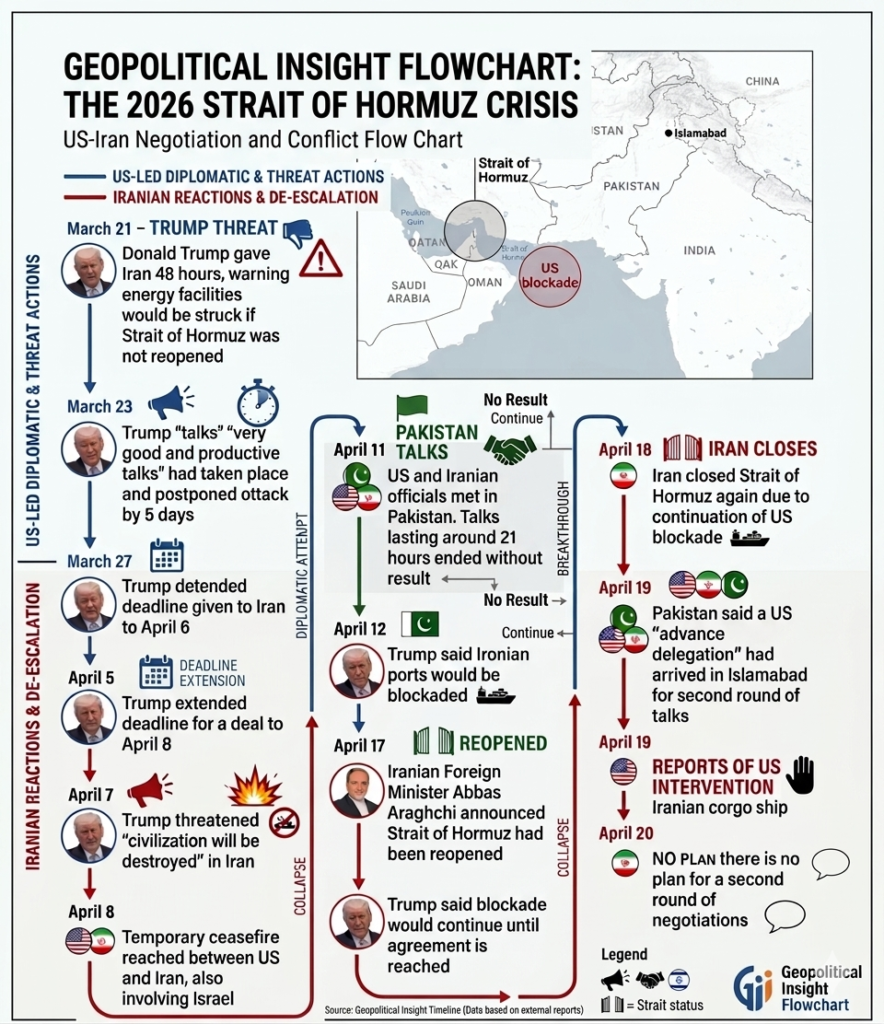
20 April 2026 — Day 50
A fragile ceasefire between the United States and Iran came under renewed strain over the weekend after US naval forces seized an Iranian-flagged cargo vessel near the Strait of Hormuz, while conflicting signals emerged over planned diplomatic talks in Pakistan.
The two-week ceasefire, brokered on April 8, is set to expire on April 22, with tensions rising sharply in the final days.
On April 19, US naval forces intercepted and disabled an Iranian-linked cargo ship near the Strait of Hormuz, citing an attempt to breach a US naval blockade on Iranian ports. The vessel was fired upon, immobilised, and later boarded by US personnel in what officials described as an enforcement action.
Iran condemned the incident as a “clear violation” of the ceasefire and labelled it “maritime piracy,” warning of a “swift response.” Iranian naval units increased their presence in the area, raising concerns of a potential naval confrontation.
Despite the escalation, no direct US-Iran strikes were reported on mainland targets, and the ceasefire technically remained in effect.
Diplomatic uncertainty also deepened. US President Donald Trump announced that American negotiators would travel to Islamabad on April 20 for a second round of talks with Iranian representatives, warning that failure to reach an agreement could result in expanded military action targeting infrastructure.
However, Iranian officials quickly denied that any such talks had been confirmed, stating there were “no plans to participate” under current conditions, particularly while the US blockade remained in place.
Meanwhile, the Strait of Hormuz remained effectively restricted following Iran’s decision on April 18 to reimpose controls in response to the blockade. Shipping traffic dropped significantly, with reports of vessels diverting or halting transit amid rising security risks.
The disruption has already impacted global energy markets, with oil prices rising and shipping and insurance costs increasing due to uncertainty in one of the world’s most critical energy corridors.
Elsewhere, a separate ceasefire between Israel and Hezbollah in Lebanon has largely held, with only minor violations reported.
As the ceasefire deadline approaches, analysts warn that the combination of military escalation, blocked shipping routes, and uncertain diplomacy could push the conflict toward renewed hostilities if no agreement is reached in the coming days.
19 April 2026 — Day 49
Tensions between the United States and Iran escalated sharply over the weekend as Tehran reimposed restrictions on the Strait of Hormuz and US forces seized an Iranian-flagged vessel, raising concerns over the fragile ceasefire set to expire later this week.
The two-week ceasefire, brokered on April 8 with mediation from Pakistan, is due to end around April 22. While large-scale hostilities have not resumed, developments on April 18–19 have significantly strained the truce.
On April 18, Iran announced it was placing the Strait of Hormuz under “intense control,” effectively restricting maritime traffic. The move came a day after a brief reopening of the strategic waterway, which handles nearly a fifth of global oil and gas shipments. Iranian officials said the decision was in response to the continued US naval blockade on Iranian ports, which Tehran described as a violation of the ceasefire.
Shipping activity in the strait dropped sharply following the announcement, with several oil tankers reportedly turning back amid rising security risks.
The situation escalated further on April 19 when US naval forces intercepted and seized an Iranian-flagged cargo vessel near the Strait of Hormuz. According to US officials, the ship was attempting to bypass the blockade. The vessel was disabled before being boarded by US personnel.
Iran condemned the action as a “clear violation” of the ceasefire and warned of a “swift response.” Iranian naval units also reportedly issued warnings to vessels, heightening fears of a broader maritime confrontation.
Despite the rising tensions, diplomatic efforts appear to be ongoing. US President Donald Trump said that American negotiators were expected to travel to Islamabad for a new round of talks with Iranian representatives. However, Iranian officials denied that any meeting had been formally scheduled, adding uncertainty to the negotiation process.
The renewed standoff has already impacted global markets, with oil prices rising amid fears of supply disruptions. Shipping and insurance costs for the region have also surged.
Elsewhere in the region, a separate ceasefire between Israel and Hezbollah in Lebanon has largely held, despite minor reported violations.
With only days remaining before the ceasefire deadline, the situation remains highly volatile. Observers warn that failure to reach an agreement could lead to a renewed escalation of conflict in an already unstable region.
18 April 2026 — Day 48
Iran briefly reopened the Strait of Hormuz to commercial shipping on April 17 before reimposing restrictions a day later, citing the continued United States naval blockade on Iranian ports as a violation of the ongoing ceasefire.
The temporary reopening followed a separate Israel-Hezbollah ceasefire in Lebanon, with Iranian Foreign Minister Abbas Araqchi indicating that maritime traffic would be allowed during the truce period. However, Tehran warned that any continuation of US pressure would lead to renewed restrictions.
On April 18, Iran reversed its decision, placing the strategic waterway under what officials described as “intense control.” The Supreme National Security Council said unrestricted access would not resume unless US actions against Iranian ports ceased.
No direct US-Iran airstrikes were reported during the two-day period, and the ceasefire — brokered on April 8 — remained technically in place, though increasingly fragile.
Naval tensions persisted in the Gulf, with reports of Iranian gunboats issuing warnings to vessels near the strait. The United States maintained its blockade operations, further escalating the standoff.
The Strait of Hormuz, a critical chokepoint for nearly 20% of global oil shipments, saw limited vessel movement during the brief reopening, followed by renewed disruption after restrictions were reinstated.
Global energy markets reacted with volatility, as oil prices fluctuated amid uncertainty over shipping routes. Maritime insurance costs and freight risks also increased.
US President Donald Trump initially welcomed the reopening, describing ongoing contacts with Iran as “positive,” but later accused Tehran of attempting to exert pressure through control of the waterway. Iranian officials, in turn, reiterated that maritime access would remain conditional on US actions.
Pakistan continued diplomatic efforts to sustain the ceasefire and facilitate further talks, while regional and international actors expressed concern over the stability of global energy supplies.
Despite the absence of major military escalation, the developments underscored the fragile nature of the ceasefire, with the April 22 deadline approaching and no clear agreement in place.
17 April 2026 — Day 47
The United States has continued and expanded its naval blockade of Iranian ports, tightening restrictions on maritime traffic amid ongoing tensions in the region, according to reports in major Pakistani media outlets.
The blockade has been widened to include suspected shipments of weapons, ammunition, nuclear-related materials, and key industrial goods such as oil products and metals. US forces are reportedly authorised to visit, board, search and seize vessels suspected of heading to Iran, with thousands of troops, naval ships, and aircraft deployed for enforcement. Several vessels are reported to have turned back, though no ship boardings have been confirmed.
US President Donald J Trump said Washington maintained a “very good relationship” with Iranian leadership and suggested the sides were “very close to a deal,” adding that Iran had agreed in principle not to pursue nuclear weapons and to transfer enriched uranium stockpiles. He also warned that failure to reach an agreement could lead to a resumption of fighting, while indicating that new rounds of talks could take place soon, potentially in Pakistan.
Israeli Defence Minister Israel Katz said Iranian “strategic targets and capabilities” had been significantly damaged in previous strikes and warned that further action could follow if necessary.
Despite heightened rhetoric, no new airstrikes or direct clashes between the United States, Iran, or Israel were reported during this period. The fragile ceasefire agreement reached earlier in April remained in place but under strain due to continued maritime restrictions.
Separately, a 10-day ceasefire between Israel and Lebanon came into effect, following an announcement attributed to US mediation. The truce, involving Israel and Hezbollah, was described as a temporary de-escalation measure, with expectations of further diplomatic engagement.
Trump said the broader regional situation was progressing positively and suggested developments were “going swimmingly,” while expressing optimism that the conflict could be nearing resolution.
The United Nations Secretary-General called for the US-Iran ceasefire to be preserved and extended, amid concerns over escalating tensions and economic disruption.
Oil markets responded positively to expectations of renewed diplomatic engagement, with prices easing on hopes of reduced regional risk.
Pakistani diplomatic efforts continued in the background, with Islamabad remaining involved in facilitating dialogue, though no new date has been confirmed for the next round of US-Iran talks.
16 April 2026 — Day 46
The United States continued to enforce and intensify a naval blockade on Iranian ports, raising tensions despite an ongoing but fragile ceasefire between the two sides, according to verified international and Pakistani media reports.
US forces maintained restrictions across key waterways, including the Persian Gulf, Gulf of Oman, and the Strait of Hormuz, effectively halting most maritime trade linked to Iran. US Central Command said the measures were being applied broadly, while allowing neutral vessels to transit international routes not connected to Iranian ports.
Iran strongly condemned the blockade, calling it illegal and “akin to piracy,” and warned that it risked undermining the ceasefire. Iranian officials signaled that continued enforcement could escalate the situation further.
US President Donald J. Trump said Iranian naval capabilities had been severely degraded, claiming only a limited number of vessels remained operational. He warned that any attempt by Iranian ships to challenge the blockade would be met with immediate force. Trump also indicated that while the conflict could be nearing an end, negotiations had stalled over nuclear-related disagreements.
Iranian officials responded with sharp warnings. Senior commanders from the Islamic Revolutionary Guard Corps described the blockade as a potential violation of the ceasefire and cautioned that Iran could retaliate by restricting maritime activity across the broader region. Tehran maintained that it seeks a complete end to the war and sanctions relief, while reiterating its stance on civilian nuclear energy.
Diplomatic efforts continued alongside rising tensions. A high-level Pakistani delegation, including Field Marshal Asim Munir and Interior Minister Mohsin Naqvi, arrived in Tehran to facilitate renewed dialogue. US officials signaled that talks could resume soon, potentially involving Vice President JD Vance.
Meanwhile, Chinese Foreign Minister Wang Yi described the ceasefire as “very fragile” and urged restraint, while France announced plans for a multinational defensive initiative aimed at ensuring safe navigation through the Strait of Hormuz.
Despite heightened rhetoric and enforcement actions, no new airstrikes, ground clashes, or confirmed battlefield casualties were reported during this period. The conflict remains in a phase defined by economic pressure and diplomatic maneuvering rather than active large-scale combat.
15 April 2026 — Day 45
The United States continued to enforce a naval blockade on Iranian ports, significantly disrupting maritime trade and raising tensions despite an ongoing but fragile ceasefire, according to reports from major Pakistani and international media.
US forces maintained strict control over key waterways, including the Persian Gulf, Gulf of Oman, and Strait of Hormuz, turning back vessels attempting to enter or exit Iranian ports. Officials said the blockade had begun to impact regional trade and oil flows, with broader implications for global markets.
Recent US-Iran talks in Islamabad ended without a breakthrough, particularly over disputes surrounding Iran’s nuclear programme. However, diplomatic efforts remained active, with indications that a second round of talks could resume soon, potentially again in Pakistan.
US Central Command declared the blockade “fully implemented,” stating that within the initial phase, sea trade to and from Iran had been effectively halted. The US also asserted maritime dominance in the region.
Iran strongly condemned the move, calling the blockade “illegal” and “provocative,” and warning it could undermine the ceasefire. Iranian officials signaled potential retaliatory measures, including possible disruption of shipping routes in the Persian Gulf, Sea of Oman, and Red Sea. Tehran reiterated that it would not compromise on its nuclear rights.
US President Donald J. Trump described the conflict as “very close to over” and suggested that Iran was open to negotiations, though no agreement had yet been reached. He indicated that talks could resume in the coming days, with no new large-scale military action anticipated.
Diplomatic engagement continued, with a Pakistani delegation involved in mediation efforts and regional players, including Wang Yi, urging restraint to preserve the ceasefire.
Despite heightened tensions and strong rhetoric, there were no reports of new airstrikes, ground clashes, or battlefield casualties. The situation remained in a phase defined by economic pressure and diplomacy, rather than active large-scale conflict.
14 April 2026 — Day 44
A major escalation has been reported in the US-Iran-Israel conflict, with the United States military imposing a naval blockade on all Iranian ports and coastal areas. The move is aimed at restricting maritime movement and increasing pressure on Iran over the Strait of Hormuz, a critical global oil shipping route.
The blockade reportedly restricts all vessels entering and leaving Iranian harbors. US officials have warned that any Iranian naval approach toward enforcing or challenging the blockade would be met with a swift military response. President Donald Trump has stated that Iranian officials have reached out seeking negotiations, adding that talks could proceed if Tehran agrees to broader terms.
Iran has strongly condemned the blockade, calling it an act of “piracy” and warning of retaliatory measures. Iranian authorities have also held public demonstrations, while state media has signaled potential responses targeting regional maritime routes if pressure continues.
Diplomatic efforts preceding the escalation collapsed after negotiations hosted in Pakistan failed to produce an agreement. Iran rejected US demands related to its nuclear program and maritime access, while Washington continued to insist on the reopening of the Strait of Hormuz and wider security concessions.
The United Nations has urged restraint and called for freedom of navigation in international waters, while several regional powers have expressed concern over rising energy and shipping risks. Saudi Arabia has reportedly warned of economic consequences, and Russia has offered mediation to de-escalate tensions.
The wider conflict, which began with large-scale US-Israeli strikes on Iranian military and nuclear infrastructure, has already resulted in significant regional instability, including retaliatory attacks, regional spillover into Lebanon, and disruptions to global energy markets.
Despite the escalation, no new large-scale airstrikes or direct naval clashes have been confirmed in the latest phase, though military posturing and rhetoric from all sides remain highly confrontational.
13 April 2026 — Day 43
Diplomatic efforts between the United States and Iran collapsed early on April 12 after nearly 21 hours of high-level talks in Islamabad, intensifying tensions as Washington moved to impose a naval blockade on Iranian waters.
The negotiations, which began on April 11 and marked rare direct engagement between the two countries, ended without agreement. US Vice President JD Vance, who led the American delegation, said, “We have not reached an agreement,” adding that Iran rejected what he described as the US’s “final and best offer.”
Key disagreements centred on Iran’s nuclear programme and sanctions relief. The United States demanded that Tehran abandon nuclear weapons ambitions and allow inspections, while Iran rejected the terms as excessive, seeking sanctions relief and assurances regarding the Strait of Hormuz. Iranian officials also accused Washington of failing to build trust during the negotiations. Both delegations departed Islamabad on April 12 following the breakdown.
Within hours of the talks collapsing, US President Donald Trump announced a naval blockade targeting Iranian ports and traffic linked to the Strait of Hormuz. The move was confirmed by US Central Command (CENTCOM), which said the operation would begin on April 13 at 10 a.m. EDT.
In a statement, Trump warned that the US Navy would “blockade any and all ships” linked to Iran and issued a strong warning against any attack on US forces. He also acknowledged that the move could drive global oil prices higher.
Despite the escalation, a fragile two-week ceasefire agreed earlier in April remained in place as of April 12, with Trump describing it as “holding well.” No major missile or drone strikes were reported during this period, as developments were dominated by diplomatic fallout and military positioning ahead of the blockade.
Global energy markets reacted sharply, with oil prices surging on fears of supply disruptions through the strategically vital Strait of Hormuz. US crude rose nearly 8% to above $104 per barrel, while Brent crude climbed over 7% to around $102–103 per barrel.
The collapse of talks and the impending blockade have significantly heightened tensions, raising concerns over a potential escalation in the ongoing conflict, even as direct military confrontation remained limited during the 24-hour period.
12 April 2026 — Day 42
High-level negotiations between the United States and Iran ended without an agreement on Sunday after nearly 21 hours of talks in Islamabad, marking the first direct engagement between the two countries in decades.
The talks, mediated by Pakistan, brought together senior officials from both sides at a hotel in the capital. The US delegation was led by Vice President JD Vance, joined by Steve Witkoff and Jared Kushner, while Iran was represented by Parliamentary Speaker Mohammad Baqer Qalibaf and Foreign Minister Abbas Araqchi.
Despite prolonged discussions across multiple sessions, key differences remained unresolved. Speaking after the talks, Vance said no agreement was reached, adding that Iran had rejected what he described as Washington’s “final and best offer.”
The main sticking points included Iran’s nuclear programme and sanctions relief. The United States demanded that Tehran abandon nuclear weapons ambitions and allow inspections, while Iran rejected the terms as excessive, calling instead for sanctions relief, broader guarantees, and clarity on the Strait of Hormuz.
Following the collapse of talks, US President Donald Trump announced a naval blockade targeting Iranian ports and the strategic Strait of Hormuz, set to begin on April 13. The move was confirmed by US Central Command.
In a statement, Trump warned the US Navy would “blockade any and all ships” entering or leaving Iranian waters and said US forces were “locked and loaded” for further action if required. He also cautioned that global oil prices could rise due to the escalation.
The failure of the talks has cast uncertainty over a fragile two-week ceasefire agreed earlier in April. While the truce remained in place during negotiations, its future is now uncertain amid rising tensions.
Markets reacted immediately, with oil prices climbing on fears of supply disruption in the Strait of Hormuz, a key global energy route.
No major military strikes were reported during the 48-hour negotiation period, but the breakdown has significantly heightened diplomatic tensions, raising concerns of a potential escalation in the ongoing conflict.
11 April 2026 — Day 41
The 2026 Iran conflict, which began on February 28 with US-Israeli strikes that killed Iranian Supreme Leader Ali Khamenei and triggered widespread Iranian retaliation across the region, remains in a fragile ceasefire phase following a Pakistan-brokered truce. The agreement, reached after intense backchannel diplomacy, has paused major hostilities but continues to face serious challenges over its implementation and scope.
Under the ceasefire framework, the United States and Israel halted direct strikes on Iran, while Tehran agreed in principle to reopen the Strait of Hormuz and engage on a broader 10-point proposal covering nuclear restrictions, missile capabilities, sanctions relief, and regional security arrangements. However, major disputes persist, particularly over Lebanon, where fighting has escalated sharply despite the wider ceasefire.
In Lebanon, Israeli airstrikes targeting Hezbollah positions have continued, with heavy bombardment reported across southern areas and the Bekaa Valley. Civilian infrastructure, including roads and residential zones, has been severely affected, leading to mass displacement and rising casualties. Iran and Hezbollah view these strikes as a direct violation of the ceasefire spirit, while Israel maintains that its operations in Lebanon are defensive and not covered under the US-Iran truce. The ongoing violence in Lebanon is now seen as the most serious threat to the stability of the broader agreement.
Despite the truce, tensions remain high in the Strait of Hormuz, where shipping traffic has not fully normalized. Reports indicate restricted movement of vessels, increased Iranian oversight of maritime routes, and additional charges imposed on transit, contributing to ongoing disruptions in global oil supply chains.
At the center of diplomatic efforts, Pakistan is hosting high-level negotiations between the United States and Iran in Islamabad. The US delegation, led by Vice President JD Vance along with senior officials including Special Envoy Steve Witkoff and Secretary of State Marco Rubio, has engaged in talks aimed at advancing a framework for a broader settlement. Vance has expressed cautious optimism while warning against any breakdown in commitments.
The Iranian delegation, led by senior officials including Parliament Speaker Mohammad Bagher Ghalibaf and Foreign Minister Abbas Araghchi, has pressed for guarantees on sanctions relief and a broader ceasefire that includes Lebanon and maritime security assurances in the Strait of Hormuz. Tehran has also reiterated that continued Israeli military operations in Lebanon undermine the negotiation process.
Pakistan has described the talks as a critical opportunity for de-escalation, emphasizing that failure would risk renewed conflict. Officials from Islamabad have highlighted the country’s role as a neutral facilitator, leveraging its diplomatic ties with Washington, Tehran, and regional partners to bring both sides to the negotiating table.
International reactions remain mixed but largely supportive of diplomatic engagement. While several countries have welcomed Pakistan’s mediation efforts, concerns persist that unresolved disputes, particularly the situation in Lebanon, could collapse the fragile truce. Global energy markets remain volatile due to uncertainty surrounding the Strait of Hormuz, with oil supply disruptions continuing to affect prices and trade routes.
The conflict has resulted in significant casualties and widespread infrastructure damage across Iran, Lebanon, and other parts of the region, along with large-scale displacement. In the United States, political debate continues over the extent of military involvement and the future direction of negotiations.
While talks are ongoing, the situation remains highly unstable, with analysts warning that the coming days will be decisive in determining whether the ceasefire holds or collapses back into open conflict.
10 April 2026 — Day 40
As of April 10, 2026, the US-brokered two-week ceasefire between Iran and Israel remains formally in place, with no confirmed large-scale direct strikes or missile exchanges reported between the two sides over the past 24–48 hours. However, the overall situation remains highly fragile due to intensifying developments in Lebanon involving Israel and Hezbollah.
No new direct Iranian attacks on Israel or Israeli strikes inside Iran have been reported during this period, marking a continued pause on the core Iran-Israel front. Both sides remain on high military alert, but direct confrontation has not resumed since the ceasefire announcement on April 8.
Tensions have, however, escalated on the Lebanon front. On April 9, Hezbollah launched rockets toward northern Israel, including areas near the kibbutz of Manara along the border. It was the group’s first attack since the ceasefire came into effect, which it said was in response to Israeli military operations in Lebanon. No immediate Israeli casualties were confirmed.
Lebanon continues to face severe humanitarian impact following massive Israeli strikes on April 8, which reportedly hit more than 100 locations in a short span, including parts of Beirut and surrounding areas. Lebanese authorities estimate 182–254 people killed and over 1,100 injured in what has been described as one of the deadliest days in the ongoing conflict.
Iran has strongly condemned the escalation, accusing Israel and the United States of undermining the ceasefire framework by continuing military action in Lebanon through indirect channels. Iranian officials have also reiterated concerns over earlier regional tensions, including brief disruptions linked to the Strait of Hormuz, which was reopened shortly after.
The United States and Israel maintain that the ceasefire strictly applies to direct Iran-Israel hostilities, and does not include operations against Hezbollah in Lebanon. Israeli leadership has stated that military action against Hezbollah will continue despite the truce with Iran.
International reactions have grown increasingly critical, with UN officials describing recent Israeli strikes in Lebanon as “horrific” and warning of further regional destabilization. Several countries, including Pakistan in its mediating role, have called for restraint to preserve the ceasefire and support ongoing diplomatic engagement.
Diplomatic sources indicate that the next phase of negotiations under the reported Islamabad Accord framework is expected to begin this week in Islamabad, with US participation anticipated.
The direct Iran-Israel conflict remains paused under the ceasefire, but escalating violence in Lebanon continues to strain the agreement and raise fears of a wider regional spillover.
9 April 2026 — Day 39
The two-week ceasefire between the United States and Iran, announced on April 8, remains technically in place, halting direct hostilities involving Israel. However, the truce is under growing pressure as Israeli military operations in Lebanon intensify, raising fears of a broader escalation.
In the past 24–36 hours, no major direct strikes have been reported between Iran and Israel. Instead, tensions have shifted to Lebanon, where Israeli actions against Hezbollah are testing the limits of the ceasefire.
The situation escalated early April 9 when Hezbollah launched rockets toward northern Israel, targeting areas near the border, including Manara. The group described the attack as a response to Israeli strikes in Lebanon, marking its first such action since the ceasefire began. No immediate casualties were reported, and Israel has yet to issue a formal response.
Lebanon, meanwhile, is reeling from the aftermath of large-scale Israeli strikes carried out on April 8. More than 100 targets were hit within minutes, including sites in central Beirut. Officials report between 182 and 254 fatalities, with over 1,100 injured, making it one of the deadliest days in the ongoing Israel-Hezbollah conflict. A national day of mourning has been declared.
Iranian officials, including senior leadership figures, have accused Washington and Tel Aviv of undermining the ceasefire by allowing continued attacks on Hezbollah, a key Iranian ally. Tehran briefly moved to shut the Strait of Hormuz in protest before reopening it under the terms of the truce.
The United States and Israel, however, maintain that the ceasefire applies strictly to direct US-Iran hostilities and does not extend to Lebanon. Israeli leadership has reiterated that operations against Hezbollah will continue, while Washington has echoed this position, emphasizing that the agreement does not cover the Lebanon front.
International concern is mounting. United Nations officials have condemned the scale of the strikes, while Pakistan and other regional actors are urging restraint to preserve the fragile agreement ahead of planned diplomatic talks.
On the core Iran-Israel front, the situation remains relatively contained. No new missile or drone attacks have been reported, and both sides appear to be observing the ceasefire terms, though military readiness remains high.
Attention is now turning to upcoming negotiations under the “Islamabad Accord,” expected to take place in Islamabad within days. These talks are seen as critical in determining whether the current pause can evolve into a more durable arrangement.
While direct conflict between Iran and Israel has paused, escalating violence in Lebanon is placing the entire ceasefire at risk, leaving the region in a precarious and uncertain state.
8 April 2026 — Day 38
A fragile two-week ceasefire between the United States and Iran is holding for now, as diplomatic efforts intensify and new developments emerge across the region, ranging from economic measures in key waterways to pauses in militia activity and mixed global reactions.
The truce, welcomed by Pakistan and expected to be followed by talks in Islamabad, has opened a narrow window for de-escalation after weeks of escalating conflict across the Middle East.
In a significant economic move, Iran and Oman are set to impose transit fees on vessels passing through the strategically vital Strait of Hormuz, according to reports citing Associated Press. A regional official involved in the negotiations said Tehran intends to use the revenue to fund post-war reconstruction, while the purpose of Oman’s fee collection remains unclear. The waterway is one of the world’s most critical oil routes, handling a large share of global shipments.
On the security front, the Iran-backed coalition known as Islamic Resistance in Iraq announced it would suspend operations for two weeks, aligning with the ceasefire timeline. The move signals a broader, though temporary, cooling of hostilities across multiple fronts.
In Washington, US President Donald Trump described the ceasefire as a “total and complete victory,” claiming that pressure from the United States, and possibly influence from China, helped bring Iran to the negotiating table. The White House reinforced that position, with Press Secretary Karoline Leavitt calling the agreement a result of strong military leverage that created space for diplomacy.
However, political divisions in the United States remain sharp. Congresswoman Alexandria Ocasio-Cortez renewed calls to impeach Trump, arguing that the temporary ceasefire does not change broader concerns about his approach to the conflict.
Meanwhile, Iran has laid out firm conditions for any long-term agreement, including recognition of its uranium enrichment program, lifting of all US sanctions, and continued control over the Strait of Hormuz. Iranian officials have also assured that safe passage through the waterway will be maintained during the ceasefire period.
Despite diplomatic progress, tensions remain visible on the ground. An Israeli strike in the Lebanese city of Sidon killed at least eight people and injured more than 20, underlining the fragility of the truce.
Earlier, Gulf nations including Saudi Arabia, Bahrain, and the UAE issued missile threat alerts, with sirens sounding and residents urged to seek shelter amid fears of further escalation.
International reaction to the ceasefire has been broadly supportive. Egypt described the truce as a critical opportunity for diplomacy and emphasized the need to maintain freedom of navigation, while Australian Prime Minister Anthony Albanese welcomed the development as a step toward a broader resolution.
In Tehran, crowds gathered following the announcement, reflecting a mix of relief and defiance as the country enters a temporary pause in hostilities.
As negotiations are expected to begin in Pakistan in the coming days, the ceasefire remains a delicate but crucial opportunity to prevent a wider regional conflict and move toward a more lasting peace.
7 April 2026 — Day 37
Joint US-Israeli airstrikes have intensified across Iran, hitting multiple targets in and around Tehran, including areas near the Sharif University of Technology and a major petrochemical complex, according to Iranian media reports. At least 34 people were reported killed, including children, while several others were injured in the latest wave of attacks.
Local sources said a fuel station near the university was damaged, leading to temporary petrol shortages, while nearby civilian infrastructure, including a mosque, was also affected. Additional casualties were reported in residential مناطق of Tehran’s Baharestan area.
Israel confirmed carrying out strikes on what it described as strategic regime targets, including military and aviation infrastructure. Israeli officials stated that operations targeted multiple airports, where several Iranian aircraft and helicopters were destroyed.
In a separate development, Iranian sources reported that Majid Khademi, a senior intelligence figure within the Islamic Revolutionary Guard Corps (IRGC), was killed in a targeted strike. The IRGC has vowed a strong response, warning of further escalation.
Israel also claimed responsibility for striking a key facility at the South Pars natural gas field in Asaluyeh, one of Iran’s most critical energy assets. The attack followed earlier strikes on petrochemical infrastructure in Mahshahr.
US President Donald Trump issued a fresh ultimatum, warning Iran to ensure the full reopening of the Strait of Hormuz to international shipping or face severe consequences. He warned that failure to comply could result in widespread strikes on Iran’s infrastructure, including power plants and bridges.
US Defense Secretary Pete Hegseth described the recent العمليات as among the most intense since the conflict began, indicating the possibility of further escalation.
Iran rejected a proposed temporary ceasefire, instead calling for a permanent end to hostilities. Efforts by regional mediators, including Pakistan, Türkiye, and Egypt, have so far failed to produce a breakthrough.
Iran responded with missile attacks targeting Israel and US-linked positions in the region. Israeli authorities reported that a strike on a residential building in Haifa killed at least four people, while emergency teams continued rescue operations.
US officials also confirmed that Iranian attacks injured several American personnel stationed at a military base in Kuwait.
The ongoing military campaign, referred to by US officials as Operation Epic Fury, began in late February and has since expanded to include strikes on Iranian military, nuclear, and economic targets. Iran has retaliated with missile and drone attacks across multiple fronts, including Israel and parts of the Middle East.
Casualty figures remain difficult to independently verify, with both sides presenting differing accounts. The conflict has triggered significant humanitarian and economic consequences, including displacement in parts of the region and disruptions to global energy markets linked to tensions around the Strait of Hormuz.
With both sides continuing military operations and diplomatic efforts yielding limited results, the situation remains volatile, raising concerns of further escalation in the coming days.
6 April 2026 — Day 36
The ongoing conflict between Iran, Israel and the United States continued to escalate, marked by missile attacks, airstrikes, and expanding regional impact.
An Iranian ballistic missile struck a residential building in Haifa, northern Israel, injuring between 4 and 11 people, including an elderly man in critical condition. Emergency services reported that 3 to 4 individuals remained missing under the rubble as rescue operations continued. The strike was part of a broader barrage involving at least 10 missiles launched in multiple waves toward Israeli territory.
US President Donald Trump issued a fresh ultimatum to Iran, demanding the reopening of the Strait of Hormuz, a critical global oil route. He warned of intensified strikes on Iranian infrastructure, including power plants and bridges, if the demand was not met.
Iranian authorities rejected the ultimatum, with officials from the Islamic Revolutionary Guard Corps and the Foreign Ministry stating that the Strait would not return to normal operations under current conditions and vowing continued retaliation.
In a separate development, US forces conducted a rescue operation inside Iran to recover a crew member from a downed F-15E fighter jet. The airman, who had evaded capture for nearly two days, was extracted following a firefight and was reported to be in stable condition.
Meanwhile, US and Israeli forces carried out coordinated airstrikes on multiple locations in Iran, including the Mahshahr petrochemical zone in Khuzestan province. Iranian sources reported at least 5 deaths and over 170 injuries in the strikes, along with 3 additional fatalities in Ardabil province.
The conflict also expanded across the region, with Iranian missiles and drones striking targets in Kuwait, Bahrain, and the United Arab Emirates, causing damage to energy and industrial facilities. Israeli strikes were also reported in southern Lebanon targeting Hezbollah positions, with casualties reported.
Cumulative figures from various monitoring groups indicate that the conflict has caused heavy losses. In Iran, estimates suggest over 3,500 people killed, including more than 1,600 civilians, with thousands more injured. In Israel, 23 to 28 people have been killed and nearly 7,000 injured since the start of hostilities. The United States has reported 13 to 15 military personnel killed and more than 500 wounded.
The war has also severely disrupted global energy markets, with tensions around the Strait of Hormuz contributing to rising oil prices.
No ceasefire has been reached, and diplomatic efforts remain ongoing but have yet to produce a breakthrough as fighting continues across multiple fronts.
5 April 2026 — Day 35
US President Donald Trump issued a 48-hour ultimatum to Iran, demanding the reopening of the Strait of Hormuz, warning of further strikes on Iranian energy infrastructure. Tehran rejected the demand, calling it “helpless and nervous.”
Iranian air defences shot down a US F-15E fighter jet over Iranian territory, triggering an immediate US search-and-rescue operation for the crew. One crew member was reported missing.
Israel carried out strikes on a petrochemical complex in Mahshahr, Khuzestan Province, reportedly linked to missile fuel production. Iranian media reported at least five civilian deaths and multiple injuries.
Further US–Israeli strikes targeted air defence systems, including an S-300 site near Tehran, along with key infrastructure and border crossings.
Iran responded by launching missiles and drones toward central Israel. Some projectiles landed near military installations in Tel Aviv, while others struck residential areas. Israeli defence systems intercepted most incoming threats.
Israeli officials said preparations were underway for additional strikes, pending coordination with Washington. No ceasefire efforts were reported.
US forces conducted a successful rescue operation, recovering the missing pilot from inside Iran after a brief firefight. President Donald Trump confirmed the development.
Iran claimed its forces shot down additional US aircraft during the mission, including a transport plane and helicopters; the claims remain unverified.
Fresh US–Israeli strikes were reported in southwestern Iran, with Iranian sources citing at least five more civilian deaths.
Iran continued missile and drone attacks targeting Israel and parts of the Gulf region, including reported strikes toward Kuwait.
Tehran again rejected the US ultimatum on the Strait of Hormuz, warning of further escalation if strikes persist.
The conflict remains intense and ongoing, marked by continued airstrikes, missile exchanges, and rising civilian casualties. No diplomatic breakthrough or ceasefire has been reported as of April 5.
4 April 2026 — Day 34
The Iran–US–Israel war continued with high-intensity hostilities, marked by a significant escalation following the reported downing of two US aircraft and ongoing strikes across Iran, Israel, and the wider region. No ceasefire was in place, and both sides maintained a sustained military posture.
Iranian air defenses reportedly shot down a US F-15E Strike Eagle over southwestern Iran, while a second aircraft, an A-10 Warthog, was also hit and crashed into the Persian Gulf. One crew member from each aircraft was rescued, while search-and-rescue operations continued for a missing pilot, marking a major escalation and a rare loss of US combat aircraft.
At the same time, US and Israeli forces carried out extensive airstrikes on multiple Iranian locations, including Tehran, Isfahan, Qom, Urmia, and Khorramabad. A strike on the Karaj B1 Bridge caused significant destruction and civilian casualties, with reports indicating 8–13 killed and around 95 injured, alongside major damage to infrastructure.
Iran responded with ballistic missile and drone attacks targeting Israel and regional assets. Strikes caused damage in areas including Haifa, Negev, Rosh Haayin, and Petah Tikva, with some missiles evading interception and causing fires and property damage. Additional regional impacts were reported in Iraq, the UAE, Bahrain, and Kuwait, reflecting widening spillover effects. Hezbollah also launched rocket attacks from Lebanon, prompting Israeli retaliatory strikes.
Iranian leadership vowed “crushing” retaliation, while US President Donald Trump claimed that US operations had severely degraded Iran’s capabilities and suggested further strikes could target critical infrastructure. Casualties in Iran reportedly exceeded 2,000 killed and 26,500 wounded since the war began.
Fighting continued with ongoing missile exchanges, though no major new escalation was reported in the latest period. Iran launched additional missiles into central Israel, causing damage to residential areas and minor injuries, while Israeli defenses intercepted most incoming attacks. Israel continued strikes in Lebanon, targeting infrastructure and militant positions, with reports of at least two deaths in a drone strike in southern Lebanon.
The search for the missing US pilot continued in western Iran without confirmation of recovery. Additional minor strikes and incidents were reported across Iraq and the Gulf region, highlighting ongoing regional instability.
Overall, the situation reflects a highly volatile and active conflict, with intensified military engagement, expanded regional involvement, and no diplomatic breakthrough, while both sides remain committed to continued operations and further escalation remains a strong possibility.
3 April 2026 — Day 33
The conflict between Iran and the United States–Israel coalition has escalated further, with intensified airstrikes and large-scale retaliatory attacks continuing across multiple fronts, increasing regional instability.
US and Israeli forces carried out coordinated strikes on key Iranian targets, focusing on military infrastructure, command centers, and strategic facilities. In the Tehran region, strikes targeted sites linked to the Islamic Revolutionary Guard Corps (IRGC), including ground force bases and mobile command units. A major strike also hit a medical research facility, raising concerns about disruption to critical medical supplies.
In Karaj, west of Tehran, a major highway bridge was struck and heavily damaged, resulting in casualties and injuries. In Isfahan, powerful strikes caused large explosions and fires in industrial areas, while in Mashhad, a fuel storage site near the airport was hit, triggering a fire. Military footage showed strikes targeting missile launchers, drones, and armored vehicles, indicating ongoing efforts to weaken Iran’s military capabilities.
Iran responded with multiple waves of ballistic missile and drone attacks, marking one of the largest escalations in recent days. Missiles targeted central Israeli cities, including Tel Aviv and surrounding areas, triggering air defense systems and emergency sirens. While many were intercepted, some impacts caused damage to residential areas, resulting in civilian injuries and fires.
Iranian strikes also extended into the Gulf region, targeting energy infrastructure and strategic locations. A refinery in Kuwait was hit, causing fires, while air defenses in Saudi Arabia, Bahrain, and the UAE intercepted incoming missiles and drones. Additional incidents included damage to a tanker near Qatar and reported strikes on key infrastructure, although some claims remain unverified.
Iranian officials warned of further and more destructive retaliation, while US leadership stated that military objectives are nearing completion, alongside warnings of expanded strikes if necessary. Iran rejected any claims of seeking a ceasefire and reaffirmed its position of continued resistance.
The conflict has also spread to secondary fronts, including ongoing Israeli strikes on Hezbollah-linked targets in Lebanon, further raising tensions in the region.
International concern continues to grow, with warnings that the situation could escalate into a wider regional war. Global energy markets remain under pressure due to uncertainty surrounding the Strait of Hormuz.
Overall, the situation remains highly volatile, with ongoing airstrikes, missile exchanges, and rising regional tensions, and no immediate signs of de-escalation.
2 April 2026 — Day 34
The conflict between Iran and the United States–Israel coalition remains intense and highly volatile, with continued aerial exchanges and large-scale missile activity defining the current situation. The war has entered a critical phase, showing no clear signs of immediate de-escalation despite parallel diplomatic signaling.
US and Israeli airstrikes have continued across multiple locations in Iran, with Tehran and Isfahan among the primary targets. In Tehran, strikes hit urban and strategic areas, including zones near former diplomatic compounds. In Isfahan, industrial and infrastructure facilities were targeted, with reports of precision and bunker-buster munitions causing secondary explosions, fires, and widespread damage. The operations remain focused on degrading missile systems, command centers, and military infrastructure.
In response, Iran has carried out one of its largest missile barrages in recent weeks against Israel. Multiple waves of ballistic missiles targeted Tel Aviv, Jerusalem, Haifa, and surrounding areas, triggering nationwide sirens and defensive interceptions. Several projectiles struck residential neighborhoods and infrastructure, resulting in fires, structural damage, and civilian injuries, with reports indicating dozens wounded.
Iranian retaliation has also extended beyond Israel. The Islamic Revolutionary Guard Corps (IRGC) claimed strikes involving missiles and drones targeting US military assets, including the USS Abraham Lincoln carrier group in the northern Indian Ocean. In the Gulf region, a drone strike on a fuel storage facility in Kuwait caused a fire that was later contained. Air defense systems in Saudi Arabia, Bahrain, and the UAE reportedly intercepted additional incoming threats.
The conflict continues to be dominated by airpower, missile exchanges, and proxy-linked operations, with no confirmed large-scale ground invasion. However, the scale and coordination of attacks on both sides highlight the persistence of high-intensity aerial warfare.
On the political front, the United States has indicated that key military objectives are nearing completion, while also warning of further escalation if necessary. Iran has rejected any claims of seeking a ceasefire, maintaining that its actions represent legitimate self-defense and signaling readiness for a prolonged confrontation.
Elsewhere in the region, secondary fronts remain active, including continued Israeli strikes on Hezbollah-linked targets in Lebanon. Strategic tensions around the Strait of Hormuz persist, contributing to global energy market uncertainty and broader economic concerns.
Overall, the situation reflects a continuation of high-intensity conflict dynamics, with sustained offensive operations, elevated regional tensions, and no immediate resolution in sight. The absence of a formal ceasefire framework and ongoing retaliatory actions indicate a continued risk of wider regional escalation.
1 April 2026 — Day 33
The Iran–Israel–US conflict continued into 1 April 2026 with renewed missile exchanges, airstrikes, and regional spillover, as the war entered its second month without signs of de-escalation. Iranian forces launched additional missile and drone attacks targeting Israel, resulting in at least 16 injuries in areas including Tel Aviv and Bnei Brak, with civilian infrastructure affected. Iran-aligned groups, including the Houthis, also maintained pressure through missile launches, while earlier drone activity extended to regional targets such as fuel infrastructure at Kuwait International Airport, where a fire was reported.
In response, Israeli forces carried out continued air operations inside Iran, striking government and industrial facilities and maintaining sustained pressure on strategic assets. The Israeli campaign has consistently targeted locations linked to Iran’s military and industrial capacity, with ongoing operations aimed at degrading missile production and air defense systems. No ground invasion has been reported, with the conflict remaining concentrated in aerial and missile warfare.
The United States, led by President Donald Trump, reiterated that the conflict could potentially conclude within 2–3 weeks, while emphasizing the objective of preventing Iran from advancing its nuclear capabilities. US messaging also included warnings linked to the Strait of Hormuz, alongside earlier indications of a temporary pause on strikes against Iranian energy infrastructure until 6 April. Despite these statements, Iran has denied the existence of active negotiations and continues to reject US conditions as excessive.
Iran’s Islamic Revolutionary Guard Corps (IRGC) also issued a warning regarding planned actions against 18 major US technology and corporate entities, with measures announced to take effect from 8:00 PM Tehran time on 1 April. The IRGC accused these firms of contributing to US–Israeli military operations through technological and intelligence support, and urged personnel in proximity to these facilities to evacuate. No immediately verified attacks on these entities were reported within the initial phase of the announcement.
Alongside direct state-to-state exchanges, regional actors including Hezbollah in Lebanon continued low-level engagements along the Israel–Lebanon border, prompting Israeli responses in southern Lebanon. These parallel fronts have contributed to a broader regional dimension of the conflict.
As the war progresses, casualty figures and damage assessments remain heavily disputed between the involved parties. While Iran reports significant losses from Israeli and US strikes, Israel and the United States report comparatively lower casualties from Iranian retaliation, though civilian areas in Israel have been impacted. Diplomatic backchannels remain active but have yet to produce a breakthrough, with both sides maintaining firm positions and continued military readiness.
Overall, the conflict remains confined to airstrikes, missile attacks, and asymmetric regional operations, with growing concerns over economic disruption, particularly relating to energy flows through the Strait of Hormuz and the potential targeting of global commercial infrastructure.
31 March 2026 — Day 32
The US–Israel war with Iran entered its second month amid fresh escalation in the past 24 hours as Israeli forces conducted another extensive wave of airstrikes on regime infrastructure in the heart of Tehran and other cities, while Iran and Hezbollah launched a combined missile and rocket assault on northern Israel, causing fires at an oil refinery and industrial facilities. A Kuwaiti oil tanker was struck by a drone in Dubai waters, raising oil spill concerns, and the United States maintained its military buildup in the region.
The conflict, which began on February 28, 2026, with joint US-Israeli surprise airstrikes that killed Supreme Leader Ali Khamenei and other senior Iranian officials, centers on dismantling Iran’s nuclear program, ballistic missile capabilities, and support for proxy groups. The United States and Israel have described their operations as necessary to neutralize existential threats, while Iran has vowed full retaliation and accused the US of preparing a possible ground invasion.
In the latest developments, the Israeli military stated it had completed a new wave of strikes targeting Iranian regime infrastructure across Tehran, including sites linked to weapons research, production, and storage. Additional strikes hit locations in Karaj, Shiraz, Qom, Abadan, Tabriz, and the southern port city of Bandar Khamir. Power outages were reported in parts of Tehran following damage to energy infrastructure, though partial restoration was later announced by Iranian authorities. Iranian state media reported civilian casualties, including at least two deaths in a strike on an orphanage.
Iran responded with multiple ballistic missile barrages toward Israel. A combined attack with Hezbollah targeted northern Israel, with impacts reported at the Haifa oil refinery (Bazan), triggering a large blaze at an industrial facility. Israeli air defenses intercepted many projectiles, but multiple impact sites were confirmed, along with fires and limited injuries. Sirens sounded across central, northern, and southern Israel.
Yemen’s Iran-backed Houthis, who officially entered the conflict in recent days, continued launching ballistic missiles and drones toward southern Israel, including areas near Eilat; most were intercepted. This has further widened the multi-front war involving Iranian proxies.
The United States has continued bolstering its regional military presence, with additional naval and airborne assets deployed. Iran’s Revolutionary Guard and officials have accused the US of planning ground operations and warned of retaliation against American targets.
On the diplomatic front, US President Donald Trump reiterated that the United States was in “serious discussions” with what he described as a “new” leadership in Iran and threatened to “completely obliterate” Iran’s energy infrastructure, including power plants, oil wells, and facilities on Kharg Island — if no deal is reached shortly and the Strait of Hormuz is not fully reopened. Secretary of State Marco Rubio stated that President Trump “always prefers diplomacy,” with contacts occurring mainly through intermediaries, while acknowledging fractures in Iranian leadership. Iran has dismissed claims of significant progress in talks, denied major concessions, and continued its attacks.
Hezbollah maintained intense operations on the Lebanon front, with dozens of rocket, anti-tank, and drone attacks reported against Israeli forces and northern communities. Incidents involving UN peacekeepers were also noted amid ongoing Israeli operations in southern Lebanon.
Humanitarian conditions continue to deteriorate, with civilian casualties and damage reported on multiple fronts, including residential areas and infrastructure in Iran and Israel. The overall death toll since the start of the war has surpassed 2,000–3,000 according to various estimates. Disruptions in the Strait of Hormuz and attacks on Gulf energy targets have kept global oil markets volatile, contributing to rising energy prices and supply concerns.
The situation across the Middle East remains highly volatile as of March 31, with both sides exchanging strikes, the Israeli campaign against Iranian defense targets ongoing, and diplomatic efforts showing limited progress. The risk of further regional escalation, including broader involvement of proxies or ground operations, persists. Officials from regional powers continue discussions, but no breakthrough has been reported.
30 March 2026 — Day 31
The US-Israel war with Iran reached its one-month mark amid continued escalation in the past 24–48 hours as Israeli and US strikes targeted Iranian military, missile production, drone, and defense industrial sites, while Iran launched multiple missile barrages at Israel causing fires and injuries in southern and central areas. The Houthis officially joined the conflict, and the United States further bolstered its military presence in the region.
The conflict, which began on February 28, 2026, with joint US-Israeli surprise airstrikes that killed Supreme Leader Ali Khamenei and other senior Iranian officials, centers on dismantling Iran’s nuclear program, ballistic missile capabilities, and support for proxy groups. The United States and Israel have described their operations (Operation Roaring Lion and Operation Epic Fury) as necessary to neutralize threats, while Iran has vowed full retaliation and accused the US of planning a ground invasion.
In the latest developments on March 29, Israeli forces conducted multiple waves of airstrikes, including over 150 fighter jets hitting weapons production and storage sites across Tehran and other provinces. Targets included an Iranian Defense Ministry missile engine production site, a drone engine production site, an air defense system storage and production site, and other defense industrial facilities in Tehran. The IDF stated it is “days away” from completing strikes on all top-priority defense industrial targets and claimed around 70% of Iran’s ballistic missile launchers have been destroyed or rendered inoperable. Additional strikes hit the port city of Bandar Khamir in southern Iran, killing at least five people, and caused damage near universities and a commercial building in Tehran housing media offices (including Qatar’s Al Araby TV). Power outages were reported in parts of Tehran.
Iran responded with at least seven missile barrages targeting Israel. Many attacks concentrated around Beersheba in southern Israel, where over 20 missile impacts were reported. An Iranian ballistic missile struck an open area near homes in Beersheba, injuring 11 people. Another missile or debris caused a fire at the ADAMA Makhteshim chemical and hazardous waste plant in the Ne’ot Hovav industrial zone, destroying one building and prompting an 800-meter safety exclusion zone. Sirens sounded across central, northern, and southern Israel, with additional incidents including an explosion on the Menakhem Begin Highway in Tel Aviv and damage from a cluster munition in Savyon. Casualties from the latest Iranian barrages remained limited but included injuries from shrapnel and interceptions.
Yemen’s Iran-backed Houthis officially entered the war, launching ballistic missiles and drones toward southern Israel (including toward Eilat), which were intercepted. This marks a widening of the multi-front conflict involving Iranian proxies.
The United States continued its military buildup with the arrival of the USS Tripoli amphibious assault ship carrying approximately 3,500 Marines and sailors. Elements of the 82nd Airborne Division have also been deploying to the Middle East. Iran’s parliament speaker and Revolutionary Guard accused the US of secretly planning a ground operation and warned that private residences of US and Israeli officials, as well as American universities in the region, could become legitimate targets in retaliation for strikes on Iranian universities.
On the diplomatic front, US President Donald Trump claimed on March 29 that Iran had undergone a form of “regime change” due to the strikes and stated that Iran is “agreeing” with most points of a US-proposed 15-point plan to end the war. He suggested additional US demands, including possible involvement with Iranian oil assets or Kharg Island, and announced that Iran had agreed to allow 20 more oil cargo ships through the Strait of Hormuz starting March 30. Iran dismissed aspects of the talks while continuing attacks and warning of a heavy price for further aggression. Regional powers, including a meeting hosted by Pakistan, discussed ways to end the fighting, but no major breakthrough was reported.
Hezbollah continued operations on the Lebanon front, claiming 57 attacks on Israeli forces and positions between March 28–29, including ambushes, anti-tank missiles, and rockets targeting northern Israeli communities.
Humanitarian conditions have worsened, with civilian casualties reported from strikes in Iran (including in residential areas and near universities) and damage/injuries in Israel. The overall death toll in the war has exceeded 3,000. The Strait of Hormuz tensions and attacks on Gulf targets have contributed to rising global energy prices and supply concerns.
The situation across the Middle East remains highly volatile as of March 30, with both sides on high alert, the Israeli strike campaign nearing completion on priority targets, and the risk of further escalation, including potential broader regional involvement or ground operations, still present. Officials continue to monitor developments closely amid ongoing diplomatic efforts.
29 March 2026 — Day 30
The Iran–Israel conflict intensified over March 28–29, with multiple military developments across the region, including the first direct involvement of Yemen’s Iran-aligned Houthi rebels and continued Israeli airstrikes on Iranian territory.
Yemen’s Houthi movement announced its first direct military operation in support of Iran, launching ballistic missiles toward southern Israel. The Israeli military confirmed the interception of incoming projectiles by its air defence systems, with no casualties or damage reported. The Houthis stated that further attacks would follow.
Israel carried out a new wave of airstrikes targeting Iranian nuclear and industrial facilities. Among the sites struck were the Shahid Khondab heavy water complex in Arak and a uranium-related facility in Yazd province. Additional strikes hit steel factories, power infrastructure, and locations in Tehran, Isfahan, Qom, and other cities. Iranian authorities reported casualties in some areas, including 18 deaths in Qom, while stating that no radiation leaks occurred.
In response, Iran launched multiple missile and drone strikes across the region. A major attack targeted Prince Sultan Air Base in Saudi Arabia, injuring at least 12 United States personnel, including two in serious condition. Other reported strikes affected industrial facilities in the United Arab Emirates and Bahrain, as well as areas in Israel, where missiles damaged a residential building and caused injuries. Additional reports indicated impacts near ports and infrastructure in parts of the Gulf.
The United States increased its military presence in the region, deploying additional forces and continuing joint operations with Israel. U.S. officials reported ongoing military activity targeting thousands of sites since the conflict began, while maintaining pressure on Iran regarding regional escalation.
Diplomatic efforts continued alongside the fighting. Pakistan hosted high-level talks in Islamabad with foreign ministers from Saudi Arabia, Türkiye, and Egypt. The discussions, led by Deputy Prime Minister and Foreign Minister Ishaq Dar, included consultations with Prime Minister Shehbaz Sharif and focused on de-escalation and regional stability. Pakistan also maintained communication channels with both Washington and Tehran as part of its mediation efforts.
The conflict has resulted in significant casualties and damage across the region since its onset in late February, with reports exceeding 2,000 deaths. Economic impacts continue to grow, with rising oil prices and disruptions to key trade routes, including concerns over the Strait of Hormuz.
As of March 29, no ceasefire has been announced, and both sides continue to exchange strikes. The situation remains highly volatile, with ongoing risks of further escalation across multiple fronts.
28 March 2026 — Day 29
The Iran–Israel war continues to intensify, with sustained US–Israeli air operations and ongoing Iranian threats of retaliation. Officials on all sides indicate that no immediate de-escalation is underway, and military activity remains active across multiple fronts.
According to official statements, Israeli forces carried out continued strikes on strategic targets inside Tehran and Isfahan during the early hours of March 28. The strikes were described as targeting “regime-linked” and weapons-associated infrastructure, including facilities connected to missile development and command structures. Multiple explosions were reported, with visible smoke rising over key locations.
Iranian officials responded with strong warnings of retaliation, stating that the country would “exact a heavy price” for continued attacks. While no new large-scale missile barrages were confirmed in the early March 28 window, authorities signaled that further responses remain likely.
The escalation follows a wide wave of Israeli strikes on March 27, which targeted nuclear-linked and industrial infrastructure, including facilities near Yazd and sites in West Azerbaijan. These operations were described as part of a broader effort to degrade Iran’s weapons production capacity.
On the regional front, tensions remain elevated after earlier Iranian strikes impacted the Prince Sultan Air Base, causing injuries to US personnel and damage to military assets. The incident has reinforced concerns about wider regional spillover.
No new confirmed casualty figures were released during the March 27–28 period. However, total reports show heavy losses of people and damage to buildings since the war started.
The conflict, which began on February 28, 2026, following US–Israeli strikes that killed Ali Khamenei, has since evolved into a prolonged and high-intensity confrontation. Officials maintain that operations will continue in pursuit of strategic objectives, while diplomatic efforts have yet to produce a ceasefire.
27 March 2026 — Day 28
The ongoing conflict between the United States, Israel, and Iran intensified during March 26–27, 2026, marked by heavy airstrikes, missile exchanges, and continued diplomatic deadlock.
Israeli forces carried out wide-scale airstrikes across multiple Iranian locations, including Tehran, Bandar Abbas, Karaj, Mashhad, Qom, Urmia, and other strategic sites. The strikes reportedly targeted missile production facilities, nuclear-related infrastructure, weapons depots, and IRGC positions, with authorities indicating an accelerated campaign aimed at maximizing damage.
Iran responded with multiple waves of missile and drone attacks targeting Israeli cities such as Tel Aviv, Haifa, Ramat Gan, and other areas. Air raid sirens were triggered across central and northern Israel, with reports of injuries, infrastructure damage, and at least one confirmed fatality linked to the wider escalation.
Regional spillover was also reported, with missile and drone activity affecting Gulf countries, including interceptions in Kuwait, alerts in the UAE, and air defense responses in Saudi Arabia and Jordan. In one incident, debris from intercepted projectiles reportedly caused civilian casualties in the Gulf region.
On the Lebanon front, fighting escalated further as Israeli forces expanded ground operations in southern Lebanon, while Hezbollah continued to launch rocket and drone attacks into northern Israel. The clashes resulted in casualties on both sides and significant military engagement along the border.
Reports also indicate that key Iranian military figures may have been targeted, including senior commanders, although official confirmations remain limited.
In parallel, diplomatic efforts continue behind the scenes, with the United States reportedly extending deadlines for potential strikes and engaging in indirect negotiations through mediators. However, no breakthrough has been achieved, and both sides remain firm in their positions.
Iran has rejected proposed ceasefire terms, while maintaining its demands, including broader political and economic concessions. Israel, meanwhile, continues to push for sustained operations to degrade Iran’s military capabilities.
The war has also triggered global economic disruption, with oil prices fluctuating sharply and financial markets reacting negatively. The Strait of Hormuz, a critical global energy route, remains a key point of concern, contributing to ongoing instability in energy supply chains.
Humanitarian conditions continue to deteriorate, with rising casualties, widespread displacement, and infrastructure damage reported across multiple affected regions
26 March 2026 — Day 27
The situation between Iran, Israel, and the United States remained tense and fluid between March 25 and March 26, 2026, with ongoing military strikes on multiple fronts alongside diplomatic maneuvering that showed little immediate progress toward de-escalation. Iran continued launching waves of ballistic missiles and drones toward Israel, with reports of impacts in central areas including Tel Aviv and nearby cities, where cluster munitions or smaller warheads caused injuries to several people, including damage to buildings and vehicles. Additional strikes affected northern Israel, though Israeli air defenses intercepted many projectiles. A separate Hezbollah rocket attack in northern Israel killed a 27-year-old woman.
Iran also extended its attacks to Gulf targets, causing incidents such as damage to a fuel tank at Kuwait International Airport. In response, Israeli forces carried out fresh airstrikes on Iranian targets, including sites in Tehran, missile production facilities, airbases, and industrial zones linked to Iran’s defense programs. The combined US-Israeli campaign has significantly degraded Iran’s missile, drone, and naval production capabilities. Israel has also intensified operations in southern Lebanon against Hezbollah, aiming to expand a buffer zone toward the Litani River.
On the diplomatic side, the United States presented Iran with a 15-point ceasefire proposal delivered through intermediaries, which included demands related to ending Iran’s nuclear program and limiting its missile capabilities. President Trump expressed optimism about talks, claiming productive discussions and a potential “significant prize” from Iran involving oil, gas, or access to the Strait of Hormuz, while extending certain deadlines. However, Iran firmly rejected the plan as unreasonable and maximalist, issuing its own counter-demands that called for war reparations, guarantees against future attacks, and influence over regional waterways. Iranian officials denied that meaningful negotiations were underway and insisted they were not talking directly with the US.
The US continued military deployments to the region, including elements of the 82nd Airborne Division and additional forces, even as it paused some strikes on Iranian energy targets to create space for diplomacy. Casualties have continued to mount across the conflict, with Iran reporting significant civilian deaths and damage from the airstrikes, while the broader war has disrupted shipping and affected global oil prices. The UN has expressed concern about the risk of wider regional escalation.
25 March 2026 — Day 26
Heavy missile exchanges and airstrikes continued between Iran and Israel over March 24–25, despite conflicting diplomatic signals from U.S. President Donald Trump, who claimed progress toward a possible deal while Tehran denied any talks.
Trump said Washington had held “productive conversations” with Iran and announced a five-day pause on U.S. strikes targeting Iranian energy infrastructure to allow diplomacy. He described Iran as “wanting a deal” and suggested a broader resolution could be near.
Iranian officials rejected the claims, calling them “fake” and insisting no negotiations, direct or indirect, had taken place. Tehran accused Washington of attempting to buy time while continuing military deployments and warned of continued retaliation.
On the ground, Iran launched multiple ballistic missile waves toward Israel overnight, striking central and southern areas. A direct hit in Tel Aviv damaged a residential building, while impacts were also reported in Bnei Brak, Dimona, and Arad. At least one person was killed and more than a dozen wounded in the latest હુમલાઓ, with emergency teams responding to damaged structures and debris.
Israeli air defences intercepted the majority of incoming projectiles, though several penetrated, causing localized destruction. Hezbollah also fired rockets toward northern Israel, adding to the multi-front pressure.
Israel, with U.S. support, carried out fresh airstrikes inside Iran, targeting military infrastructure, missile production facilities and command centres. In southern Tehran, strikes killed at least 12 people and wounded dozens, with rescue efforts ongoing. Explosions were also reported in other cities, including Isfahan, as the campaign continued.
Iran reported widespread damage, claiming tens of thousands of civilian structures had been affected since the conflict began. Israeli officials maintained that operations are precision-based and focused on military targets.
The conflict has also expanded regionally, with drone and missile activity reported near U.S. positions in Iraq and air defence interceptions in Gulf states. The broader الحرب remains largely aerial and missile-driven, with no ground invasion reported.
Global oil prices remained elevated above $100 per barrel amid continued uncertainty, reflecting fears of disruption linked to the Strait of Hormuz.
As of March 25, no ceasefire or confirmed negotiations were in place. Despite diplomatic messaging from Washington, active hostilities continue, and the situation remains highly volatile with risks of further escalation.
24 March 2026 — Day 25
The US-Israel-Iran war entered its fourth week with a mix of intense military strikes and conflicting diplomatic signals, as Israel carried out wide-scale air raids on Tehran and Iran launched fresh missile attacks on Israeli territory.
Israeli forces struck multiple targets across Tehran, hitting military bases, weapons production sites and other regime infrastructure, according to the Israeli military. The attacks triggered widespread power blackouts, plunging large parts of the capital into darkness.
Iran responded with new ballistic missile barrages toward Israel. Some projectiles penetrated air defences, damaging buildings in northern areas near Kiryat Shmona and causing additional impacts in the south. No major new fatalities were immediately reported, though earlier strikes over the weekend had injured more than 100 people in cities including Dimona and Arad. Fighting also continued along the Lebanon front, where Israel approved plans for expanded ground operations against Hezbollah.
Amid the escalation, U.S. President Donald Trump said Washington had held “very good and productive conversations” with Iran aimed at a possible resolution of the conflict. He announced a five-day pause on planned U.S. strikes targeting Iranian power plants and energy infrastructure.
The move followed an earlier 48-hour ultimatum in which Trump warned Iran to reopen the Strait of Hormuz or face attacks on its power grid.
Iranian officials rejected the claim of talks, calling it “fake news” and insisting no negotiations were underway. Tehran warned it would retaliate strongly if its energy facilities were targeted, including potential strikes on U.S. and Israeli-linked infrastructure across the region.
The conflicting statements added uncertainty as fighting continued on multiple fronts.
The conflict, which began on February 28, has already caused thousands of deaths, mainly in Iran and Lebanon, along with extensive damage to civilian and energy infrastructure. Disruptions in the Strait of Hormuz and strikes on gas facilities have driven up global energy prices, raising concerns over wider economic fallout.
As of March 24, no ceasefire was in place. Military activity continued despite diplomatic signals, leaving the situation highly fluid with risks of further escalation.
23 March, 2026 —Day 24
Iran launched one of its heaviest missile and drone barrages on Israel on March 22, wounding more than 100 people and striking multiple cities, as U.S. President Donald Trump issued, and later eased, a 48-hour ultimatum over the Strait of Hormuz amid emerging diplomatic signals.
Missiles struck southern Israeli cities including Arad and Dimona, near a sensitive nuclear facility, while impacts were also reported in Tel Aviv and surrounding areas. Israeli authorities said air defences intercepted many projectiles, but several penetrated, causing widespread damage and panic. One person was killed in northern Israel in a separate Hezbollah rocket attack.
Prime Minister Benjamin Netanyahu described the strikes as severe and said operations against Iran and its allies would continue, indicating the conflict is far from over.
Late March 22, Trump warned Iran to reopen the Strait of Hormuz within 48 hours or face U.S. strikes targeting its power plants. Iran rejected the ultimatum and threatened retaliation, warning it could target U.S. and allied infrastructure across the region.
However, by March 23, Trump said planned strikes would be delayed for several days, citing what he called “productive” discussions aimed at ending the conflict. Iran denied any direct negotiations, dismissing U.S. claims.
Despite this, Israeli and U.S. forces continued intense strikes inside Iran, with explosions reported across Tehran and other areas as the war entered its fourth week.
The conflict has triggered a major energy crisis, with the Strait of Hormuz effectively disrupted. Oil prices surged and global markets reacted sharply, raising fears of economic fallout worldwide.
Regional tensions continued to spread, with Gulf states activating air defences and intercepting incoming threats. No major new strikes were reported in the past few hours, but officials warn the situation remains highly volatile.
22 March 2026 — Day 23
The US-Israel joint campaign against Iran (Operation Epic Fury) escalated sharply, with Iran carrying out its most effective missile retaliation yet. Multiple ballistic missile hits struck near Israel’s Dimona nuclear research centre and in Arad, causing 100–175+ injuries, including children, and significant structural damage. The US issued a 48-hour ultimatum on the Strait of Hormuz while continuing precision strikes on Iranian military targets. No ground invasion occurred, and no ceasefire talks took place; the conflict remained a high-intensity air-and-missile war with growing regional and energy-market fallout.
Iran launched multiple waves of ballistic missiles, including Fateh-313 and Kheibar Shekan variants, targeting southern Israel. The Shimon Peres Negev Nuclear Research Center (Dimona) sustained direct hits, with several missiles landing near the perimeter; Israeli authorities declared a mass casualty event, though no radiation leak occurred. Arad city, 10 km from Dimona, saw multiple buildings damaged or destroyed, including residential areas and a school compound. Hospitals in Beersheba and Tel Aviv were placed on full emergency footing. Iron Dome and Arrow systems intercepted most projectiles, but at least 4–6 got through. Iran’s IRGC claimed the strikes as retaliation for Natanz and threatened further action if attacks continue. Hezbollah fired over 60 rockets and drones into northern Israel and the Golan Heights, wounding several soldiers.
US and Israeli forces maintained airstrikes on Iran. Targets included missile production facilities in Tehran and Alborz provinces, air-defense radars and launchers near Shiraz, Bandar Abbas, and Esfahan, and IRGC command nodes. No new nuclear facilities were targeted, and the Natanz strike caused no radiation leak. Israel’s Defence Minister stated that 40% of Iran’s long-range missile capability had been degraded, with operations continuing until the threat is eliminated.
US President Trump issued a 48-hour ultimatum for Iran to reopen the Strait of Hormuz, warning of “devastating strikes on power plants and oil terminals” if ignored. The US Navy deployed additional carrier strike groups, and Marines were put on heightened alert for potential limited ground support or evacuations.
Iran also carried out a long-range strike on Diego Garcia, firing at least two missiles over 4,000 km at the US-UK joint military base. Minor damage was reported to runways and fuel storage; no casualties occurred. This was the first Iranian strike reaching outside the Middle East.
Energy markets reacted sharply, with Brent crude spiking 8–12% intraday due to threats and partial closures affecting the Strait of Hormuz. Yemen’s Houthis launched additional drone attacks on Saudi Arabia and shipping lanes in support of Iran. Diplomatic reactions included Russia and China condemning the Natanz strike as nuclear escalation and calling for a UN Security Council session. The IAEA confirmed Iran notified the agency of damage at Natanz, while inspectors await access. Gulf states increased production quietly while urging de-escalation.
Casualties since the conflict began include approximately 1,800–2,200 in Iran, mostly military and IRGC personnel; 180–220 in Israel, civilian and military; and 450+ in Lebanon/Hezbollah.
No ceasefire or de-escalation occurred. Iran demonstrated improved missile precision and willingness to strike near Israel’s nuclear facility, while US-Israel forces maintained air dominance and issued explicit threats. Humanitarian concerns are rising on both sides, and energy markets remain highly volatile.
21 March 2026 — Day 22
The conflict between Iran and Israel, with limited involvement from the United States, remained high-intensity, with no ceasefire or de-escalation. The 24-hour period saw missile barrages, airstrikes, and attacks on energy infrastructure across the region, with rising civilian impact and energy market shocks.
Iranian forces launched multiple ballistic missiles targeting Israeli cities including Haifa, Tel Aviv, Jerusalem, and Beit Shemesh. One missile struck the Haifa oil refinery, causing fires and temporary power disruption, though authorities confirmed the facility remained operational. Air defense systems intercepted most projectiles, but casualties included at least four fatalities and dozens of injuries, including children.
Israeli forces responded with airstrikes deep inside Iran, hitting Tehran and other strategic military and missile production sites, along with air defense facilities. The strikes aimed to degrade Iran’s operational capabilities and prevent further missile launches.
Iran extended its retaliation, targeting southern Israel near the Dimona Nuclear Research Center and Arad, injuring dozens and damaging multiple buildings. The missiles included cluster munitions, and at least two projectiles evaded interception. Hezbollah carried out attacks on northern Israeli positions and southern Lebanon using rockets and drones.
The conflict also impacted regional energy infrastructure. Iranian strikes damaged the Ras Laffan LNG terminal in Qatar, halting production, while attempted strikes targeted oil and refinery facilities in Saudi Arabia, Kuwait, and the UAE. Several of these attacks were intercepted by regional air defenses. The escalation caused global oil prices to spike, reaching approximately $115–119 per barrel.
At the political level, Israeli officials claimed that ongoing operations had significantly degraded Iran’s military capabilities, while US authorities reiterated limited involvement but warned against further attacks on energy assets. Iranian officials said their response represented only a portion of their capabilities, signaling further escalation if strategic sites are struck again.
Low-level tensions persisted along the northern Israeli border, and no major new developments or verified ground invasions were reported. Casualty figures and damage assessments remain partially unverified, with differing accounts from all sides.
The situation remains highly volatile, with continued exchanges affecting urban centers, military infrastructure, and energy facilities. Analysts warn that any further escalation could significantly widen the conflict and exacerbate civilian and regional energy impacts.
20 March 2026 — Day 21
The conflict between Iran and Israel, with limited involvement from the United States, remained high-intensity during the reporting period, with no ceasefire or de-escalation observed. The 24-hour window was marked by continued missile exchanges, airstrikes, and attacks on critical energy infrastructure across the region.
During the day, Iranian forces carried out multiple ballistic missile barrages targeting key Israeli urban and industrial areas, including Haifa, Tel Aviv, and Jerusalem. One of the most significant incidents involved a direct strike on the Haifa oil refinery, resulting in fires and temporary power disruption. Israeli authorities stated that the facility remained operational with limited damage, while maintaining that most incoming projectiles were successfully intercepted.
Casualties reported during the period included at least four fatalities and multiple injuries, with impacts from missile fragments and debris recorded in both central Israel and surrounding areas. Officials emphasized that air defense systems remained active, with a high interception rate against incoming threats.
In response, Israeli forces conducted a new wave of airstrikes deep inside Iran, including targets in Tehran and other strategic locations. Authorities stated that the strikes focused on missile production facilities, military infrastructure, and air الدفاع systems, as part of ongoing efforts to degrade Iran’s operational capabilities.
The conflict further expanded into the energy domain, with Iranian strikes targeting regional infrastructure. Notably, the Ras Laffan LNG terminal in Qatar sustained significant damage, leading to a halt in production. Additional attempted strikes were reported on oil and refinery installations in Saudi Arabia, Kuwait, and parts of the United Arab Emirates, with several intercepted by regional air defense systems.
Officials indicated that these actions were part of a retaliatory phase following earlier strikes on Iranian energy infrastructure. The escalation contributed to a sharp reaction in global markets, with oil prices rising to approximately $115–119 per barrel during the reporting period.
At the political level, senior leadership on all sides issued strong statements. Israeli officials asserted that ongoing operations had significantly degraded Iran’s military capabilities, while signaling the possibility of further escalation.
Authorities in the United States reiterated that they were not directly involved in combat operations, while warning against further attacks on regional energy infrastructure. Additional defensive deployments were reported in the region.
Iranian officials stated that their response so far represents only a limited portion of their capabilities, warning of further escalation if additional strikes on strategic assets occur.
Elsewhere, low-level tensions persisted along the northern Israeli border, while no major new developments were confirmed during the reporting window. Diplomatic activity continued at the international level, with calls for immediate de-escalation from multiple countries.
No verified reports of a ground invasion or major territorial changes emerged during the period. Casualty figures and damage assessments remain partially unverified, with authorities on all sides presenting differing accounts.
The situation remains highly volatile, with continued exchanges across multiple domains, including urban centers, military installations, and energy infrastructure.
Security analysts assess that any further escalation, particularly involving energy assets or regional actors, could significantly widen the scope of the conflict.
19 March 2026 — Day 20
The ongoing Iran–Israel war escalated further during the reporting period, entering a phase of energy infrastructure warfare alongside continued high-level assassinations and missile exchanges between both sides.
According to military and security officials, a precision airstrike conducted overnight between March 17 and March 18 targeted senior Iranian leadership in Tehran. Authorities confirmed that Esmail Khatib, Iran’s Intelligence Minister, was killed in the strike, marking the third senior official eliminated within 48 hours.
Officials described the killing as a significant blow to Iran’s internal security and intelligence apparatus, with statements indicating that operations targeting senior leadership would continue as part of the broader campaign.
During the day, major strikes were reported on Iran’s energy infrastructure, including facilities linked to the South Pars gas field and processing sites in the Asaluyeh region. Security sources stated that gas storage units, refineries, and associated infrastructure were targeted, resulting in fires and disruptions to production.
The strikes marked a shift in the conflict toward strategic energy assets, raising concerns about global energy security. Market reactions followed, with oil prices rising sharply amid fears of supply disruption.
In response, Iranian forces launched ballistic missile attacks targeting energy infrastructure in the Gulf region. Officials confirmed that missiles were fired toward Qatar, with at least one impacting facilities in the Ras Laffan industrial area, causing damage and fires. Authorities reported that the site had been partially evacuated, with no immediate casualties confirmed.
Iranian officials described the strike as retaliation for attacks on its energy sector and warned of further action against regional targets.
Simultaneously, Iran continued missile barrages against Israel throughout the reporting period. Security sources reported impacts in central areas including Ramat Gan, Holon, and Rishon Lezion, with damage to residential and transport infrastructure.
Authorities confirmed civilian casualties linked to earlier waves of attacks that extended into the reporting window, while additional impacts caused damage to infrastructure including facilities near major transport hubs.
Officials stated that some of the missiles used cluster munition warheads, increasing the risk to civilian areas due to their wide dispersal pattern.
During the period, Iranian leadership issued strong statements vowing retaliation, while internal security measures were intensified, including arrests linked to espionage concerns.
No ground invasion was reported, with the conflict continuing primarily through air and missile operations, alongside expanded activity involving regional actors. Reports also indicated ongoing exchanges involving Hezbollah in areas north of Israel, though no major new developments were confirmed within the timeframe.
At the international level, concerns grew over the widening scope of the conflict, particularly following strikes on energy infrastructure. Officials warned of broader regional and economic consequences as tensions remained high.
Security analysts indicated that the conflict has entered a more complex phase, with both sides targeting strategic assets while maintaining sustained operational pressure. No signs of de-escalation were reported, and the situation remained highly volatile as the reporting period concluded.
18 March 2026 — Day 19
The ongoing Iran–Israel war entered a phase of heightened escalation during the reporting period, as Israeli and United States forces carried out major strikes on Iranian leadership and military infrastructure, while Iran launched multiple retaliatory missile barrages targeting central areas of Israel.
According to military and security officials, a series of precision airstrikes conducted overnight between March 16 and March 17 targeted high-level Iranian leadership figures and strategic facilities. Authorities confirmed that Ali Larijani, a senior national security figure, was killed in a strike near Tehran along with close associates, marking one of the most significant leadership losses for Iran since the start of the conflict.
Officials also confirmed the killing of Gholamreza Soleimani, a senior commander of Iran’s Basij paramilitary forces, in related operations. Security sources indicated that additional Basij personnel were killed in strikes targeting internal security infrastructure.
Military authorities stated that multiple sites linked to Iran’s missile and air capabilities were targeted during the day. These included facilities near Shiraz and Yazd associated with ballistic missile storage, underground launch infrastructure, and drone operations. Strikes were also reported on an airbase in Shiraz, where transport aircraft and hangars were destroyed, as well as on industrial and ammunition facilities in other regions.
Officials described the operations as part of a broader effort to degrade Iran’s missile production, logistical networks, and air-defense systems, with footage released showing strikes on air-defense installations.
In response, Iranian forces launched a series of missile barrages targeting Israel over the course of the reporting period. Security sources reported that multiple waves of ballistic missiles were fired, including the use of cluster munition warheads, impacting several locations in central Israel.
Authorities confirmed that strikes hit urban areas including Ramat Gan, where a residential building was struck, resulting in civilian casualties. Additional impacts were reported in Rishon Lezion, Holon, and surrounding areas, with damage to infrastructure and transportation facilities.
Iranian officials described the attacks as retaliation for the killing of senior leadership figures, while Israeli authorities reported interceptions of several incoming projectiles alongside confirmed impacts.
During the period, heightened security measures and internal actions were also reported within Iran, including detentions linked to security concerns. Officials signaled a firm stance, warning of further retaliation.
No ground invasion was reported, with the conflict continuing primarily through air and missile operations. Regional tensions remained elevated, with additional reports of missile activity extending toward Gulf areas, though details remained limited.
At the diplomatic level, international concern continued to grow over the risk of wider escalation and the potential impact on global stability. Civilian safety remained a major concern as strikes affected populated areas on both sides.
Security analysts indicated that the conflict remains in an intensifying phase, with both sides demonstrating continued operational capability and signaling readiness for further escalation.
17 March 2026 — Day 18
The ongoing conflict between Israel, Iran, and the United States entered its eighteenth day as military operations continued across multiple fronts in the Middle East, with airstrikes, missile attacks and regional escalations reported during the latest operational window.
Military authorities said Israeli forces conducted large-scale air operations targeting Iranian military infrastructure across western and central Iran, striking facilities linked to missile production, air defence systems and command centres associated with the Islamic Revolutionary Guard Corps.
Security sources said several installations in Tehran and surrounding regions were targeted, with explosions reported across the capital as thick smoke rose over multiple districts following the strikes.
Additional precision strikes were reported overnight in several provinces, including Khuzestan Province, Hormozgan Province, and Bushehr Province, where military facilities, missile storage sites and naval infrastructure were reportedly hit.
Among the locations targeted were the 4th Tactical Air Base in Dezful, the 9th Tactical Air Base near Bandar Abbas, and facilities near the Malard missile complex west of Tehran. Authorities also reported strikes on installations near Bandar-e Jask, a key naval location along the Gulf coast.
Israeli officials stated that more than sixty percent of Iran’s rocket launchers had been destroyed since the beginning of the campaign, adding that operations were progressing faster than initially anticipated but were expected to continue for several more weeks.
In response, Iranian forces launched multiple missile barrages toward Israel, striking several locations in central parts of the country.
Impacts were reported in Tel Aviv, Ramla, Bnei Brak, and Ramat Gan, where residential buildings and infrastructure were damaged.
Iran also confirmed the first wartime deployment of the Sejjil ballistic missile, a two-stage medium-range missile with an estimated range of around 2,000 kilometres.
Air raid sirens were repeatedly activated across central Israel, including in Jerusalem, as missile fragments and interceptors fell across several populated areas.
Iranian officials said hundreds of missiles and thousands of drones had been launched toward Israeli and American-linked targets since the start of the conflict, while United States officials stated that the overall volume of Iranian launches had dropped sharply following sustained strikes on launch sites.
The conflict has also expanded regionally, with Hezbollah launching multiple rocket and drone attacks from Lebanon toward northern Israel.
Several projectiles struck communities in northern Israel, including the town of Zarzir, where hundreds of homes were damaged and dozens of residents were reported injured.
Israeli forces responded with artillery fire and ground operations across southern Lebanon, where military units advanced into border areas targeting weapons depots and suspected militant positions.
Military officials said Israeli divisions operating in the region destroyed hundreds of sites linked to Hezbollah infrastructure and continued operations aimed at pushing militant forces away from the border.
Tensions also spread across parts of the Gulf region, where drone and missile incidents were reported near Dubai International Airport and in Abu Dhabi, prompting temporary flight disruptions and emergency responses.
Security officials said several drones and missiles targeting Gulf states were intercepted, including dozens of drones intercepted by Saudi Arabia and multiple projectiles shot down by the United Arab Emirates.
The United States also increased its regional military presence, deploying approximately 2,500 Marines to the Middle East to support regional security operations and protect strategic infrastructure.
Humanitarian concerns have grown as casualties and displacement continue to rise across the region.
Iranian officials reported that more than 1,300 civilians have been killed since the beginning of the war, while humanitarian organizations have raised concerns about the impact of strikes on civilian infrastructure.
In Lebanon, hundreds of people have reportedly been killed during Israeli bombardments, with more than one million residents displaced by the fighting.
Meanwhile, global energy markets have reacted sharply to the escalation, with oil prices rising above $100 per barrel amid growing uncertainty over shipping through the Strait of Hormuz, one of the world’s most critical energy corridors.
Iran announced restrictions on passage through the strait for hostile vessels while allowing its own crude shipments to continue, raising concerns over potential disruptions to global oil supplies.
International reactions to the conflict have been mixed, with several governments calling for restraint and renewed diplomatic engagement.
European leaders expressed concern over the widening conflict, while analysts warned that prolonged fighting could further destabilize the Middle East and place additional pressure on global energy markets.
Officials in Iran maintained that the country would continue defending itself and would not surrender, while authorities in Israel said military operations would continue until their strategic objectives were achieved.
The conflict remains active across multiple theatres as military operations, missile exchanges and diplomatic tensions continue to shape the rapidly evolving situation in the region.
16 March 2026 — Day 17
The ongoing conflict between Israel, United States, and Iran continued into its third week on Monday, with sustained aerial and missile exchanges across the region. Military operations remain largely air and missile based, with Israeli airstrikes expanding across Iranian territory while Iran launches retaliatory missile and drone attacks targeting Israel and regional sites.
Israeli forces carried out extensive airstrikes across several provinces in Iran, targeting more than 200 locations believed to be linked to military infrastructure and missile production.
Key targets included installations associated with the Islamic Revolutionary Guard Corps and Basij militia, along with ballistic missile manufacturing facilities west of Tehran, particularly near the Malard region.
Strikes also hit Mehrabad Airport in Tehran, producing large smoke plumes across parts of the capital. Additional sites reportedly struck included government facilities and areas in Hamadan and Isfahan, where missile production facilities had previously been targeted.
Israeli military spokesperson Effie Defrin said the operations are aimed at weakening Iran’s missile capabilities and air defence systems, adding that thousands of potential targets remain under review and operations could continue for several more weeks.
In response, Iranian forces launched multiple missile barrages toward Israel. Air raid sirens sounded across central and southern Israel, including areas near Tel Aviv.
Israeli air defence systems intercepted most of the incoming missiles. However, several impacts were reported in areas such as Ramat Gan, causing structural damage and minor injuries. Some missiles reportedly carried cluster-style payloads, leading to scattered debris and limited property damage in nearby neighborhoods.
Regional tensions also escalated with a series of drone and missile incidents across the Middle East.
A drone strike caused a fire near Dubai International Airport in Dubai, damaging a fuel storage area and briefly suspending flights before operations resumed. No casualties were reported.
In Baghdad, several missiles struck near Baghdad International Airport, injuring multiple airport personnel and security staff.
Drone attacks were also reported near Ali Al Salem Air Base in Kuwait, while an attack near Erbil in northern Iraq killed a French soldier identified as Arnaud Frion.
Authorities in Saudi Arabia reported intercepting several drones targeting areas in the eastern province and near the capital Riyadh, while United Arab Emirates air defences intercepted multiple ballistic missiles and drones approaching its territory.
The conflict also intensified along Israel’s northern border with Hezbollah. The group launched rockets and drones toward Israeli positions, prompting retaliatory Israeli airstrikes.
Israeli forces conducted dozens of strikes across southern Lebanon, including operations near the southern suburbs of Beirut.
- Lebanon: At least 24 people were killed in Israeli airstrikes, with the total death toll since the escalation reaching around 850.
- Israel: Several civilians were injured due to missile impacts, shrapnel, and panic during air raid sirens. No new fatalities were confirmed.
- Iraq: Around 4–5 people were injured following missile strikes near Baghdad International Airport.
- Iraq (Erbil): One French soldier was killed in a drone attack.
- Iran: No updated casualty figures were released, though earlier reports indicated significant civilian losses and damage to thousands of buildings.
- UAE: No casualties were reported from the drone incident near Dubai International Airport.
US President Donald Trump stated that Washington is not currently prepared to pursue negotiations to end the conflict and urged allied nations to increase naval deployments to protect shipping routes through the Strait of Hormuz.
Iran’s Foreign Minister Abbas Araghchi said Tehran has not requested a ceasefire and would continue defending the country for as long as necessary. Iranian authorities also stated that shipping through the Strait of Hormuz remains open to most countries.
Meanwhile, diplomatic contacts intensified across the region. Emmanuel Macron held discussions with Iranian President Masoud Pezeshkian, warning against attacks on French interests in the region. Several Gulf states also called for immediate de-escalation.
Global energy markets reacted sharply to the continued fighting, with Brent crude oil prices rising above $104–$106 per barrel amid concerns over potential disruption to Gulf shipping routes.
Authorities monitoring the conflict say the situation remains highly volatile, with both sides indicating readiness for prolonged military operations as air and missile exchanges continue across the region.
15 March 2026 — Day 16
The ongoing war between the United States, Israel, and Iran continued with high-intensity missile exchanges and airstrikes, as both sides launched fresh attacks across multiple regions while tensions in the Strait of Hormuz and the wider Middle East remained elevated.
Iran carried out multiple ballistic missile salvos targeting Israel, while allied groups in Lebanon launched additional rocket attacks toward northern areas. Air-raid sirens sounded across several major Israeli cities, including Tel Aviv, Jerusalem, Holon, and Eilat, as well as parts of the Negev.
In Holon, direct impacts and falling debris caused fires and structural damage to buildings. Emergency responders reported two civilians sustaining light injuries, while one residential building was set ablaze after missile fragments struck the area. Additional explosions and debris were reported in the Negev region and parts of northern Israel. Israeli air-defense systems intercepted many incoming missiles, although some projectiles penetrated the defensive shield amid reports that interceptor supplies were becoming strained.
At the same time, joint US-Israeli strikes inside Iran targeted several strategic and industrial sites. In Isfahan Province, attacks struck a factory linked to industrial equipment production, killing at least 15 people, according to Iranian sources. The casualties were reported to include workers who were present at the facility when the strikes occurred.
Additional strikes hit the Iranian Space Research Centre in western Tehran, causing significant structural damage to the satellite and intelligence-related installation. Drone attacks also targeted heavily armed Basij and Islamic Revolutionary Guard Corps (IRGC) checkpoints and patrol positions in the capital, marking an expanded tactic focusing on paramilitary security infrastructure. Iranian officials confirmed that several Basij members were killed or wounded during the strikes.
The attacks formed part of a broader campaign aimed at degrading Iranian military capabilities, including air-defense systems, command centers, and IRGC-linked installations across several provinces.
Developments around Kharg Island also remained a major focus. Earlier US strikes targeted military positions on the island, which handles the majority of Iran’s crude oil exports. US leadership claimed that military facilities on the island had been heavily damaged and warned that further strikes could target additional infrastructure if maritime shipping in the Strait of Hormuz were threatened.
Iran’s Islamic Revolutionary Guard Corps responded by asserting that it maintained full operational control of the Strait of Hormuz and warned that any attempts to pass through the waterway without coordination could be targeted. Iranian officials vowed stronger retaliation if attacks on Iranian territory continued.
The United States also called on allied countries to assist in protecting maritime traffic through the strategic passage, urging partners to deploy naval forces to ensure that the shipping route remains open. Officials indicated that additional strikes could occur if threats to international shipping intensified.
Beyond Israel and Iran, the conflict continued to spread across the wider region. Iranian-aligned groups and forces reportedly launched missile and drone attacks against US military facilities in Iraq and Kuwait, while additional strikes were reported against energy and infrastructure targets in Gulf states.
Earlier attacks had already caused damage in parts of the United Arab Emirates, including fires near oil-related infrastructure in Fujairah. Regional tensions have remained high as Iran called on Gulf governments to expel US military forces from their territories.
Political statements from leaders on all sides indicated that no ceasefire negotiations were currently underway. The United States signaled that it remained open to diplomatic talks but said existing proposals were insufficient. Iranian leadership rejected external pressure and demanded security guarantees and reparations for damage caused by the strikes.
Since the conflict began in late February, casualties in Iran have risen sharply. Estimates indicate that more than 1,400 people have been killed in Iran, with thousands injured in repeated strikes across multiple provinces. In contrast, casualties inside Israel have remained comparatively limited, largely due to extensive air-defense systems.
Despite continued diplomatic calls for restraint from various regional actors, military operations on all sides have intensified, with missile launches, drone strikes, and aerial bombardments continuing across the region. The situation remains volatile, and the war shows no immediate signs of de-escalation as both sides continue to exchange attacks and prepare for further escalation.
14 March 2026 — Day 15
The US–Israel war against Iran entered its 15th day as allied forces continued sustained air operations across Iranian territory while Tehran maintained missile and drone retaliation primarily against Israel, amid escalating regional tensions and disruption of global energy routes.
Officials said the latest operational window saw continued aerial strikes on Iranian military, security and defence-industrial infrastructure, though no ground invasion of Iran was reported. Since the conflict began on 28 February 2026, Iranian authorities have reported at least 1,444 people killed and 18,551 injured in Israeli and US strikes.
The United States also reported six service members killed after a KC-135 refuelling aircraft crashed in western Iraq, an incident officials confirmed was not caused by hostile fire. Israeli authorities said 179 people were injured in the previous 24 hours, most with minor wounds, while 14 Israeli soldiers have been wounded since the start of the conflict.
During the overnight phase, joint US and Israeli airstrikes targeted multiple Iranian internal security and defence industry sites in an effort to degrade missile production and regime security infrastructure. Targets included Basij force checkpoints in northeastern and southeastern Tehran Province, along with facilities linked to Iran’s Law Enforcement Command (LEC) in Gharchak.
Strikes also hit key defence industrial locations, including Shiraz Electronics Industries in Fars Province, which produces military electronics and missile-guidance systems, and sites in the Hajiabad Industrial Zone in Arak, believed to be connected to centrifuge and enrichment support infrastructure.
US Defence Secretary Pete Hegseth said the strikes had “functionally defeated” Iran’s ballistic missile production capacity, claiming several major defence companies and production lines had been destroyed.
In response to ongoing strikes, Iranian security forces including the Basij, the Islamic Revolutionary Guard Corps (IRGC), and police units began dispersing from fixed checkpoints and relocating to underpasses and bridge structures in cities such as Tehran and Rasht to avoid drone surveillance.
Later in the day, Iran launched new waves of ballistic missiles and drones toward Israel. One missile struck the northern Israeli village of Zarazir near Nazareth, injuring dozens and damaging several homes. More than 50 people were evacuated for medical treatment following the strike.
Another Iranian missile impact in central Israel set a building on fire near a roadside area, while additional damage and injuries were reported in northern regions as air-raid sirens sounded across multiple Israeli communities.
At the same time, Hezbollah fighters in southern Lebanon launched attacks toward northern Israel, adding to the regional escalation.
Inside Iran, large explosions shook central Tehran during Quds Day demonstrations, where thousands gathered despite ongoing strikes. An explosion occurred near a major rally attended by senior Iranian official Ali Larijani after the Israeli military issued evacuation warnings for parts of the capital. Iranian state media confirmed large blasts in central areas of the city.
During the same period, Mojtaba Khamenei, recently appointed Supreme Leader of Iran following the assassination of his father on 28 February, issued his first public statement. He declared that Iran would keep the Strait of Hormuz closed to pressure the United States and Israel and vowed continued attacks on their military infrastructure unless all US bases in the region were shut down.
US officials responded by saying Iran’s retaliatory capacity had been significantly degraded, noting that Iranian missile launches had dropped by about 90 percent and drone launches by roughly 95 percent compared with the early days of the war.
Later in the day, President Donald Trump announced that US forces conducted a major bombing raid on Kharg Island, Iran’s main oil export hub in the Persian Gulf. According to US officials, military facilities storing missiles and naval mines were destroyed, though oil infrastructure was deliberately spared.
Trump warned that Iran’s oil export facilities could be targeted next if Tehran continued interfering with shipping in the Strait of Hormuz, through which around 20 percent of global oil supplies normally pass.
The disruption pushed global oil prices above $103 per barrel, representing an increase of more than 40 percent since the conflict began. The United States announced it would release oil from the Strategic Petroleum Reserve, with initial shipments expected within days to stabilise global markets.
Meanwhile, the US military announced additional reinforcements to the Middle East, including around 5,000 sailors and Marines and the amphibious assault ship USS Tripoli to support ongoing operations.
Elsewhere in the region, Israeli strikes in Lebanon killed two people, including a member of the Islamic Group, during operations in eastern parts of the country.
Regional air-defence systems also remained active. Turkey reported intercepting a third Iranian ballistic missile travelling through the eastern Mediterranean toward its airspace.
Despite the expanding conflict, no ceasefire negotiations progressed, and Israeli leaders said the operation would continue without a fixed timeline until military objectives were achieved. Israeli Prime Minister Benjamin Netanyahu reiterated that the campaign aimed to create conditions for internal regime change in Iran.
By early morning, no fresh large-scale airstrikes, missile barrages or drone waves had been reported in the latest monitoring window. However, military forces across the region remained on high alert, with naval activity and surveillance continuing around the Strait of Hormuz.
Humanitarian officials estimated that up to 3.2 million people have been displaced inside Iran since the start of the war.
The conflict remained primarily aerial and naval, with sustained missile exchanges and strategic strikes but no ground troop deployments into Iranian territory, as all sides showed no signs of immediate de-escalation.
13 March 2026 — Day 14
Over the 24-hour period, combined US-Israeli forces struck over 200 targets in western and central Iran, including ballistic missile launchers, air defense systems, weapons production sites, IRGC bases, naval facilities, and intelligence installations. Key sites targeted included a nuclear-related explosives testing facility near Parchin, a naval base in Chabahar, and multiple locations in Tehran, Qom, and Alborz provinces. The strikes produced large smoke plumes over Tehran and areas connected to Hezbollah operations. US forces reported the destruction of more than 30 Iranian minelaying ships and associated naval infrastructure.
Iranian forces launched multiple missile barrages into northern and central Israel overnight, including strikes near Tel Aviv and Jerusalem, triggering sirens and causing injuries. Hezbollah coordinated attacks from southern Lebanon, firing more than 100 rockets, some using cluster munitions to overwhelm Israeli defenses. At least 30 people were wounded in northern Israel and damage was reported to civilian structures. Iranian authorities also claimed attacks on US and Israeli bases in the Gulf, though many were intercepted or caused limited damage.
Political leaders on all sides issued strong statements during the period. Israel’s prime minister defended the ongoing campaign and warned Iran’s new Supreme Leader, Mojtaba Khamenei, that operations would continue until Iran was sufficiently weakened. Mojtaba Khamenei vowed to maintain blockages in the Strait of Hormuz and continue attacks on US bases in the region. The US president described the campaign as proceeding successfully and pledged to continue efforts despite costs exceeding $11 billion in the first week. Israeli defense authorities announced preparations to expand operations against Hezbollah positions in southern Lebanon.
Casualty figures for the period remain disputed. Iranian officials report more than 1,200 civilian deaths in Iran, while independent estimates put civilian deaths at approximately 1,348, with thousands more affected by military strikes. In Israel, 13–15 people were killed and over 30 injured in missile attacks during 12–13 March, with cumulative conflict-related injuries exceeding 1,000. In Lebanon, at least 570 casualties have been reported from strikes on Hezbollah positions, while limited casualties occurred in Gulf states due to attempted Iranian attacks. Displacement estimates indicate up to 3.2 million people affected in Iran and over 800,000 in Lebanon. The conflict has driven oil prices above $100 per barrel and prompted global market volatility, while tens of thousands of Americans have been evacuated from the region.
No major new ground operations inside Iran were reported during the 24-hour window, with military activity concentrated on aerial strikes and retaliatory barrages. Analysts warn that the humanitarian impact continues to grow, and the conflict shows no signs of de-escalation, with both sides maintaining high operational readiness.
12 March 2026 — Day 13
The joint United States–Israeli military campaign against Iran entered its thirteenth day with some of the heaviest airstrikes reported since the beginning of the conflict. The latest bombardments targeted Tehran, military infrastructure, and internal security installations, while hostilities expanded across the wider region, including naval incidents in the Strait of Hormuz and intensified clashes involving regional proxy groups.
Airstrikes overnight focused heavily on Tehran, where explosions were reported near military and security installations. Targets included facilities associated with the Islamic Revolutionary Guard Corps (IRGC) Quds Force, weapons research sites, oil depots, and parts of the power grid. Fires and significant damage were reported in several areas, and electricity outages affected suburbs including Pardis, Fardis, Karaj, and Shahriar. Drone strikes were also reported against Basij checkpoints, while additional attacks hit internal security facilities in Ilam Province.
Elsewhere in Iran, strikes were reported in Tabriz against facilities linked to the Revolutionary Guard and local police stations. Fuel depots in Qom were also struck, causing large explosions. In Esfahan, damage was reported at aviation and drone production sites believed to be linked to Iran’s military infrastructure. In Kerman, fuel facilities near the airport were hit, apparently aimed at disrupting Iranian air force logistics. Additional strikes were reported near border areas between Al-Ahwaz and Iraq.
The conflict also expanded beyond Iran’s borders. In Lebanon, large-scale Israeli airstrikes targeted Beirut’s southern suburbs, areas widely associated with Hezbollah. Several apartment buildings were damaged, prompting evacuations, while clashes intensified along the Israel–Lebanon border where Israeli armored units were reported massing.
Iran continued retaliatory attacks, launching multiple waves of missiles and drones toward Israel. Air raid sirens sounded across central and northern Israel, including Tel Aviv and surrounding areas. Iranian projectiles reportedly targeted military facilities, radar systems, and industrial infrastructure near Haifa.
Iran also carried out attacks against United States military installations in the Gulf region. Drones and missiles were reported near American bases in Kuwait, Saudi Arabia, Bahrain, and the United Arab Emirates. Two drones struck near a U.S. diplomatic facility close to Baghdad International Airport.
Maritime security in the Strait of Hormuz deteriorated significantly as several commercial vessels were struck or damaged by projectiles. Shipping incidents were reported involving a Greek-owned tanker near the Iraqi coast and other merchant vessels operating in the Gulf. Fires were also reported on a cargo ship north of Ras al-Khaimah. Drone strikes targeted the Ruwais industrial complex in the UAE, while two drones exploded near Dubai International Airport, injuring several people.
Iran also deployed naval mines in the Strait of Hormuz, temporarily disrupting tanker traffic through the strategic waterway. U.S. naval forces responded by destroying several small Iranian vessels reportedly involved in laying mines in the area.
Casualty figures remain difficult to verify due to limited access and the ongoing conflict. Iranian officials reported more than 1,300 deaths and thousands of injuries since the fighting began, while humanitarian agencies warned of significant civilian displacement in both Iran and Lebanon. In Lebanon, recent strikes reportedly killed more than a dozen people, adding to a rising death toll from weeks of cross-border fighting.
The United States reported dozens of injured service members since hostilities escalated earlier this year, with several fatalities confirmed since late February. Israeli authorities reported limited casualties from the latest missile attacks, with many projectiles intercepted by air defense systems.
The fighting has also begun to affect global markets and trade routes. With the Strait of Hormuz effectively closed to tanker traffic, oil prices surged sharply amid fears of prolonged supply disruptions. International energy agencies are reportedly considering the release of strategic reserves to stabilize markets.
Diplomatic efforts to de-escalate the conflict have so far stalled. Iranian leaders have rejected negotiations under current conditions and demanded compensation for damages caused by the strikes. Western governments have continued consultations through international forums, but no ceasefire agreement has been reached.
Security agencies in several countries have also raised alerts over potential cyberattacks and financial disruptions linked to the conflict. Meanwhile, shipping insurers have sharply increased surcharges for vessels operating in the region as maritime risks continue to rise.
With hostilities spreading across multiple fronts and no clear diplomatic breakthrough in sight, the conflict between Iran, Israel, and the United States threatens to deepen instability across the Middle East and disrupt global energy and trade networks.
11 March 2026 — Day 12
The ongoing Iran–US–Israel conflict entered its 12th day on Wednesday, with intensified military operations, rising casualties and renewed diplomatic efforts.
Military officials in US described March 10 as one of the most intense days of the campaign, with joint US-Israeli operations striking Iranian military infrastructure, oil facilities and command centers.
Targets included Islamic Revolutionary Guard Corps (IRGC) headquarters, missile bases and fuel depots, including the Shehran oil depot in Tehran, where large fires were reported after the strike. Since the start of the war, officials claim that between 300 and more than 5,000 targets have been hit across Iran.
US naval forces also destroyed at least 16 Iranian vessels suspected of laying naval mines near the Strait of Hormuz, raising tensions around the strategic shipping route.
Meanwhile, Iran accused Israel of conducting an airstrike on a school in Khomein in western Iran, resulting in heavy casualties. The strike was described by some commentators as a “double-tap” attack, in which a second strike reportedly hit rescuers responding to the initial blast.
Israeli security analysts reported that Iranian attacks are increasingly targeting northern Israel, including areas near energy and industrial facilities.
Iran responded with multiple waves of missile and drone attacks against Israeli territory and regional military targets.
One of the major barrages, referred to as “Wave 37,” lasted around three hours, during which Iran launched ballistic missiles carrying one-ton warheads as well as cluster munitions toward Tel Aviv, Haifa and other central areas of Israel.
Iran also launched drones and missiles targeting US military bases in Iraq, including the Harir Air Base, as well as sites in Saudi Arabia, Kuwait, the United Arab Emirates, Bahrain and Qatar. Gulf air-defense systems intercepted 17 missiles and six drones during these attacks.
In another development, a ballistic missile fired from Iran was intercepted over Türkiye by NATO air-defense systems, highlighting the widening geographic reach of the conflict.
Iran’s Islamic Revolutionary Guard Corps warned that it was preparing for an “energy war,” signaling potential attacks on energy infrastructure after fuel depots inside Iran were targeted. Iranian forces also indicated they were shifting toward the use of heavier weapons systems in their retaliation.
The conflict has increasingly spread beyond Iran and Israel. Israeli forces expanded operations in Lebanon, striking sites linked to Hezbollah, including a new attack in central Beirut, an area previously considered relatively safe.
Hezbollah launched 31 separate attack waves on Israel on March 9, involving rockets and drones. Israeli forces later targeted organizations accused of financing Hezbollah’s weapons network.
Casualties and Humanitarian Impact
The war has resulted in significant casualties and infrastructure damage across multiple countries.
- United States forces: Around 140 troops have been wounded, most suffering minor injuries, with 108 already returned to duty. Reports indicate 7 to 8 US personnel have been killed so far.
- Iran: Estimated 1,400 to 1,500 deaths, including civilians. Among them were around 160 schoolgirls reportedly killed in a bombing in Minab, though details surrounding the incident remain disputed. More than 10,000 structures, including homes, schools and medical facilities, have been damaged.
- Israel: Approximately 15 to 20 civilians killed and over 1,700 injured since the conflict began, including casualties from the latest missile attacks. Iranian forces have fired around 300 missiles, roughly half equipped with cluster warheads.
- Lebanon: Israeli strikes have resulted in about 486 deaths.
- Other regions: Minor injuries have been reported in neighboring countries, including 19 injuries in Jordan and four in Azerbaijan, largely due to falling debris or missile interceptions.
Large-scale displacement and emergency evacuations have also been reported across several parts of the Middle East.
Political signals from Washington remained mixed during the reporting period.
US President Donald Trump described the war as a “short-term excursion” that could end “very soon,” but simultaneously warned Iran that any attempt to block the Strait of Hormuz would trigger severe retaliation, threatening “death, fire and fury.”
US Defense Secretary Pete Hegseth stated that the United States was “overwhelmingly winning” and predicted that March 10 would see some of the most intense strikes of the campaign.
A proposed ceasefire initiative delivered to Iran through diplomatic channels reportedly received no response, prompting Washington to seek assistance from European and regional mediators.
Iran’s leadership rejected negotiations while the country remained under attack. Supreme Leader Mojtaba Khamenei declared that Iran would “determine when the war ends,” while Foreign Minister Abbas Araghchi stated that talks could not take place without credible guarantees against further attacks.
International diplomatic activity also intensified, with China, Russia and France contacting Iranian officials to encourage ceasefire negotiations.
Russian President Vladimir Putin clarified that Moscow was not sharing US military intelligence with Iran, despite speculation about deeper involvement.
Israeli Prime Minister Benjamin Netanyahu addressed the Iranian public directly in a message on social media, saying Israel would continue strikes aimed at weakening the Iranian leadership, while some Israeli officials suggested that regime change in Iran could take up to a year.
The conflict has significantly affected global energy markets. Oil prices surged above $100 per barrel during the period before falling slightly as investors speculated about a potential short-term resolution.
Shipping activity through the Strait of Hormuz, a key route for global oil supplies, has been heavily disrupted, with reports suggesting that 80 to 90 percent of normal traffic has been affected.
Rising fuel prices have begun influencing consumer inflation in the United States, particularly through increased gasoline costs.
In a separate development, the US administration indicated it had allowed India to continue importing Russian oil despite sanctions, citing broader global energy concerns.
Australia also announced plans to deploy additional missile systems to the United Arab Emirates as part of regional security measures.
Despite diplomatic outreach from several major powers, no immediate signs of de-escalation emerged during the reporting period. Both sides continue to signal readiness for prolonged conflict, while military operations and missile exchanges remain ongoing across the region.
Observers warn that further escalation could deepen the humanitarian crisis and disrupt global energy markets, particularly if fighting expands around the Strait of Hormuz or draws additional regional actors into the conflict.
10 March 2026 — Day 11
The US‑ and Israel-led military campaign against Iran entered its 11th day on March 10, with continued airstrikes, missile exchanges, and drone attacks amid conflicting signals from US President Donald Trump about the war’s timeline.
In remarks to CBS News and at a Florida press conference on March 9, Trump described the campaign as “very complete, pretty much” and “very far ahead of schedule,” suggesting it could end “very soon.” He ruled out an immediate resolution, stating the US has “not won enough” yet, and touted progress, including near-elimination of Iran’s naval capabilities and significant degradation of its ballistic missile program. US forces have struck over 5,000 targets so far.
Trump warned that any disruption of oil flows through the Strait of Hormuz would prompt a response “twenty times harder,” potentially targeting additional infrastructure, including electricity production. Oil briefly spiked above $100 per barrel, before easing about 10% amid market hopes for a shorter conflict.
Iran’s Islamic Revolutionary Guard Corps (IRGC) rejected any timeline imposed by the US, asserting that Iran will determine when the war ends and vowing continued resistance.
A major political development occurred as Iran’s Assembly of Experts appointed Mojtaba Khamenei — son of the late Supreme Leader Ayatollah Ali Khamenei — as the new Supreme Leader on March 8–9. State media framed this as a continuation of hard-line policies, with public rallies in Tehran showing support. Israeli officials suggested senior figures associated with the new leadership remain potential targets.
Military developments:
- US and Israeli forces struck IRGC command centers, missile facilities, Air Force HQ, and infrastructure in Tehran, Isfahan, and southern Iran, including near Minab, with fires and smoke reported over Tehran.
- Iran launched ballistic missiles and drones, some reaching central Israel, causing injuries. Hezbollah fired rockets and drones into northern Israel from Lebanon.
- Iranian projectiles were intercepted over Gulf states including Saudi Arabia, UAE, Kuwait, Bahrain, and Qatar, with some hitting infrastructure such as a desalination plant in Bahrain.
Casualty figures remain disputed. Reports indicate over 1,200–1,300 killed in Iran, including civilians, with thousands injured. Casualties have also been reported in Israel, Lebanon, and Gulf states from cross-border attacks.
The conflict shows no immediate signs of a ceasefire, with diplomacy stalled and regional spillover risks, particularly to oil shipping routes, continuing. Analysts note Iran’s missile capabilities are declining due to sustained attacks, but proxy involvement, including from Hezbollah, continues to widen the conflict’s scope.
9 March 2026 — Day 10
The war between Iran and Israel, widely viewed as a joint military campaign involving the United States, entered its tenth day on March 9, 2026, with intensified airstrikes, missile barrages and widening regional repercussions. In a major political development, Iran’s Assembly of Experts appointed Mojtaba Khamenei as the new Supreme Leader following the killing of Ali Khamenei earlier in the conflict. Iranian state institutions, including the Islamic Revolutionary Guard Corps, pledged allegiance to the new leadership, while President Masoud Pezeshkian vowed a strong response to continued attacks. Israeli officials warned that any leader pursuing policies aimed at Israel’s destruction could also become a potential target.
Over the past 24 hours, fresh waves of joint airstrikes targeted Iranian energy and military infrastructure, including oil depots and fuel facilities in Tehran and sites in Alborz Province, triggering massive fires and thick smoke over parts of the capital. Explosions were also reported in Qom, while Israeli strikes continued against positions linked to Hezbollah in Beirut and southern Lebanon. Israeli authorities claim their forces have struck hundreds of targets and achieved near-complete aerial dominance over parts of Iranian airspace.
Iran responded with multiple ballistic missile and drone barrages toward Israel and several Gulf countries hosting American military facilities. Missile strikes in central Israel injured several civilians, while drone attacks hit a desalination facility in Sitra, wounding more than 30 people and damaging key water infrastructure. Additional attacks were reported in Saudi Arabia, Kuwait and the United Arab Emirates, targeting fuel storage sites, airports and ports, with incidents also reported in Qatar and Oman. Iranian strikes also targeted areas near Baghdad and Erbil, where American military facilities are located.
The humanitarian toll continues to rise. In Iran, more than 1,200 people have reportedly been killed and thousands injured since the war began on February 28. In Israel, the death toll stands at around a dozen with nearly 2,000 wounded from Iranian missile attacks. In Lebanon, hundreds have been killed in the past week and over half a million people displaced. Iranian strikes across Gulf states have also caused casualties and infrastructure damage, while several American service members have died from injuries sustained in earlier attacks. The conflict has also disrupted regional energy supplies, pushing global oil prices above $100 per barrel and raising concerns over environmental hazards and potential water shortages following strikes on desalination plants.
Political rhetoric has also intensified, with Donald Trump stating that the end of the war would depend on a joint decision with Benjamin Netanyahu and demanding Iran’s “unconditional surrender.” Netanyahu warned that the next phase of operations would bring “many surprises.” Iranian leaders rejected the demands and vowed continued retaliation, while China and Russia called for de-escalation and diplomacy. Despite the escalating strikes across the region, no ground invasion or nuclear escalation has been reported so far, though the conflict is increasingly seen as entering a more dangerous phase with energy infrastructure and civilian areas becoming major targets.
8 March 2026 — Day 9
The conflict between the United States, Israel, and Iran entered its nineth day on March 8, with continued airstrikes, missile launches, and rising regional tensions signaling no immediate path toward de-escalation. The ongoing campaign has evolved into a wider regional crisis involving air, missile, and naval operations across multiple countries in the Middle East.
During overnight operations between March 7 and early March 8, Israeli forces launched a new wave of strikes targeting areas in and around Tehran. Among the targets were several oil storage depots, fuel facilities, and energy infrastructure sites, including a major oil depot located north of the capital. The strikes triggered large fires and explosions that sent heavy plumes of smoke into the sky and caused visible damage across nearby districts.
Military officials stated that the strikes were intended to disrupt infrastructure believed to support Iran’s military operations and logistical capabilities. Additional attacks were reported near Mehrabad International Airport, where fires and structural damage were observed. The broader operation reportedly involved dozens of aircraft targeting missile infrastructure, military compounds, and facilities associated with Iran’s armed forces.
Iran responded by launching ballistic missiles and drone strikes toward Israel, prompting air defense systems to activate across multiple Israeli cities, including Tel Aviv. Sirens sounded in several areas as interceptors engaged incoming projectiles. Authorities reported that the majority of missiles and drones were intercepted before reaching their targets.
Iranian officials stated that the country would continue retaliatory strikes while defending its sovereignty. Despite diplomatic messaging from Tehran aimed at easing tensions with neighboring Gulf states, military incidents continued across the region.
Reports indicated drone activity and attempted strikes near strategic sites in the Gulf, including an incident near Dubai International Airport that temporarily disrupted flight operations and reportedly resulted in casualties. Air defense systems in Bahrain and Qatar also intercepted several incoming aerial threats believed to be targeting facilities linked to U.S. or allied presence.
The United States reiterated its strategic objectives in the conflict, emphasizing the dismantling of Iran’s missile and nuclear capabilities. Washington signaled that military operations could continue for several weeks as part of a broader campaign aimed at degrading Iran’s military infrastructure.
Israeli leadership stated that the campaign would involve additional phases and operations designed to weaken Iran’s strategic capabilities while avoiding a full-scale ground invasion.
Meanwhile, the conflict expanded into Lebanon, where Israeli airstrikes intensified against positions associated with Hezbollah. Evacuation warnings were issued in parts of southern Beirut, prompting large-scale civilian displacement. Lebanese authorities reported significant casualties following recent strikes, while Hezbollah claimed it had launched rockets and drones toward northern Israel in response.
Regional tensions have continued to grow as the war impacts shipping lanes, energy markets, and airspace across the Middle East. Iran’s naval forces have reportedly suffered substantial losses during earlier phases of the conflict, and disruptions to maritime traffic near the Strait of Hormuz have contributed to rising global oil and gas prices.
Across the region, governments have issued travel advisories and heightened security measures amid fears that the conflict could spread further. Civilian casualties have also continued to rise, with Iranian authorities reporting over 1,300 deaths since the start of the conflict, many of them described as civilians.
Despite the intensity of the fighting, there have been no confirmed diplomatic breakthroughs or ceasefire negotiations in the latest developments. Military operations remain ongoing as all sides continue to prepare for a potentially prolonged confrontation that now affects much of the Middle East.
The situation remains highly volatile, with further military developments expected in the coming days.
7 March 2026 — Day 8
The ongoing conflict between the United States, Israel, and Iran entered its eighth day on Saturday, with intensified airstrikes and missile exchanges reported across multiple fronts as the confrontation continues to escalate.
Israeli forces launched a new wave of airstrikes on Tehran early Saturday, targeting government infrastructure, military facilities, and areas near Mehrabad Airport. Large explosions and fires were reported in several parts of the capital as strikes hit in rapid succession. Israeli officials described the operation as a broad-scale strike campaign aimed at leadership bunkers and other strategic sites.
Military authorities stated that earlier phases of the campaign had already destroyed a significant portion of Iran’s air defense systems and ballistic missile capabilities. United States forces also participated in the strikes, with long-range bombers reportedly targeting deeply buried missile launch facilities and hardened military infrastructure.
Iran responded with ballistic missile and drone attacks toward Israel, triggering air raid sirens in Tel Aviv and prompting Israeli air defense systems to intercept incoming projectiles. Witnesses reported seeing missiles in the sky over the city as interceptors attempted to neutralize the threats.
Iran also attempted strikes on locations in the Gulf region hosting US-allied military facilities, though several incoming projectiles were intercepted by regional defense systems.
Iranian officials reported more than 1,300 civilian deaths since the conflict began, while humanitarian concerns continue to grow as displacement and infrastructure damage increase.
Meanwhile, US President Donald Trump called for Iran’s “unconditional surrender,” stating that Washington would not pursue negotiations unless Tehran agreed to fully abandon its military and missile ambitions. Officials in Washington and Tel Aviv say the campaign is intended to permanently degrade Iran’s missile capabilities, nuclear infrastructure, and military command structure. Authorities have indicated that while no ground invasion is planned, air and naval operations could continue for an extended period.
The conflict has also expanded into Lebanon, where Israeli strikes on Hezbollah positions have intensified after evacuation warnings were issued in parts of Beirut’s southern suburbs. Health authorities there reported more than 200 people killed and hundreds injured during the latest strikes.
Regional instability has affected multiple countries across the Middle East, disrupting shipping routes near the Strait of Hormuz, damaging naval assets, and contributing to rising global oil and gas prices.
International organizations have warned of a growing humanitarian crisis, citing civilian casualties, displacement, and damage to critical infrastructure. Rights groups and United Nations officials have called for restraint as the conflict continues.
Despite the heavy exchanges of fire, no major breakthrough or collapse of state authority has been reported. Military officials say the campaign has entered a phase focused on targeting Iran’s defense industries and missile production facilities, suggesting that the confrontation could continue for weeks or longer as tensions remain high across the region.
6 March 2026 — Day 7
The war entered its seventh day amid escalating intensity, with Israel announcing the start of the “next phase” of operations focused on eliminating remaining Iranian leadership elements and military capabilities, following over 2,500 combined US-Israeli strikes (including more than 6,000 munitions dropped). Heavy airstrikes continued across Iran, particularly in Tehran, Qom, and other regions. US B-2 bombers dropped dozens of 2,000-pound bombs on buried ballistic missile launchers, contributing to a reported 90% drop in ballistic missile attacks and 83% reduction in drone strikes. US Central Command also reported sinking an Iranian “drone carrier ship”, with over 30 vessels hit overall. Iran’s oil production and export infrastructure remained heavily damaged, while Strait of Hormuz disruptions kept global energy markets volatile.
Israel also increased pressure on Hezbollah, striking strongholds in Beirut’s southern suburbs (Dahiyeh) and targeting rocket sites in southern Lebanon. Hezbollah continued rocket and drone attacks on northern Israel, while Lebanese forces cracked down on IRGC-linked activities.
Iran and its proxies launched retaliatory barrages, including ballistic missiles toward central Israel, triggering sirens and fires in Tel Aviv residential areas. Attacks spread across the Gulf region: drones and missiles struck Bahrain, Kuwait, UAE, Qatar, and Saudi Arabia, while a US oil tanker in the Persian Gulf was set ablaze. Despite this, Iranian launches remained significantly reduced due to destroyed launch systems.
US President Donald Trump said Iran is being “demolished ahead of schedule” and claimed it now has “no air force, no air defenses left,” stressing that operations will continue without time limits. Defense Secretary Pete Hegseth said the campaign is “accelerating.” Iranian officials, including Ali Larijani, warned that forces are “ready and waiting” to resist any ground invasion, while the IRGC assumed full wartime control.
Casualties in Iran rose to at least 1,230 killed with hundreds wounded, including reports of civilian strikes such as two schools in Parand near Tehran. Regional casualties included dozens in Gulf states and Lebanon, while Israel reported minor injuries and fire damage. The UN and other international voices called for restraint as evacuations continued, with no ceasefire signals and the conflict expanding across multiple fronts.
5 March 2026 — Day 6
The conflict between the United States, Israel, and Iran entered its fifth day on March 5, 2026, with ongoing intense military exchanges showing no immediate signs of de-escalation. Israel’s military announced a new broad wave of strikes targeting military infrastructure, security headquarters, Basij paramilitary forces, and missile sites primarily in Tehran, as well as other areas like Qom and Isfahan province. These strikes continued overnight and into the day, described by some reports as the tenth wave since the joint US-Israeli operations began in late February.
In Washington, the US Senate voted 53–47 against a war powers resolution that would have limited President Donald Trump’s authority to continue military actions against Iran without further congressional approval. This vote, which occurred on March 4–5, demonstrated strong Republican support for the ongoing military campaign and allowed US operations to proceed without new restrictions.
Iran continued its retaliatory actions, launching additional waves of missiles and drones toward Israel and US bases or assets in the Gulf region, including sites in Bahrain, Kuwait, Qatar, and the UAE. Some Iranian projectiles were intercepted by regional defenses or NATO forces, with one missile reportedly downed after heading toward Turkish airspace. Iranian strikes also affected oil facilities and other infrastructure, contributing to sharp rises in global oil prices and wider market disruptions.
The death toll in Iran from US and Israeli strikes surpassed 1,000–1,045 people, according to Iranian state media and health officials, including both military personnel and civilians. Additional casualties were reported in Lebanon from Israeli operations against Hezbollah positions in Beirut and southern areas, with over 50 killed there in recent days. Israel reported relatively minimal losses from Iranian attacks so far.
The US military, including submarine operations, sank or destroyed multiple Iranian naval vessels, with reports confirming actions in the Indian Ocean and elsewhere. Defense officials indicated that forces were accelerating operations, with more troops and assets arriving in the region. Discussions in Iran focused on leadership succession following the reported death of Supreme Leader Ayatollah Ali Khamenei in the initial strikes, amid reports of an interim council and a potential role for his son Mojtaba Khamenei.
The war has widened regionally, involving proxy forces, Gulf states through interceptions, and spillover effects such as threats to shipping in the Strait of Hormuz. International media emphasized the fast-moving nature of events, with airstrikes, missile barrages, and political developments unfolding rapidly.
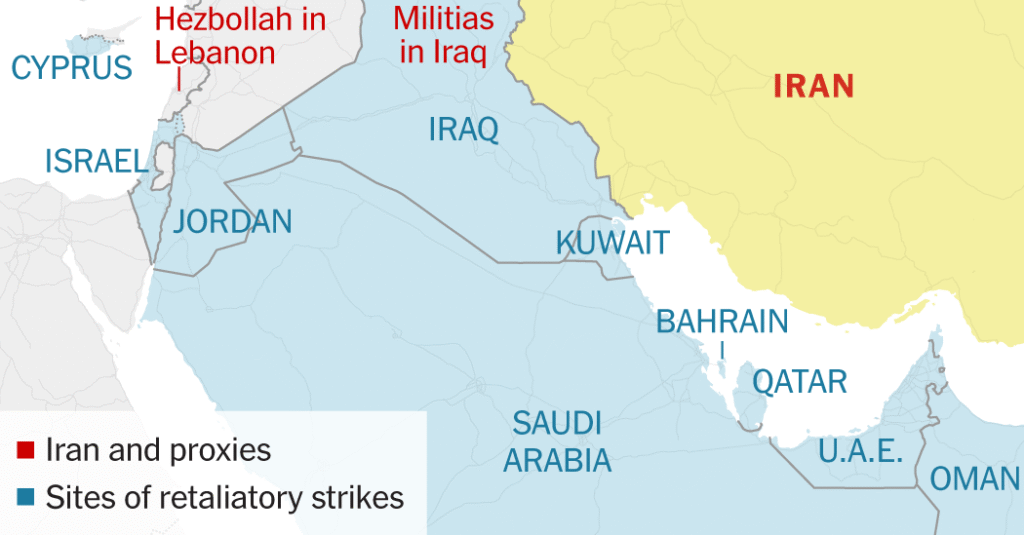
4 March 2026 — Day 5
The war entered its fifth day with continued heavy US and Israeli airstrikes across Iran, focusing on remaining missile sites, command structures in Tehran, nuclear facilities like Natanz (where IAEA reports indicate a months-long setback to uranium enrichment), and oil refineries, with over 200 strikes reported including US Tomahawk missiles. This has reduced Iran’s oil production by 30%, exacerbating global price volatility amid Hormuz disruptions affecting 15 million barrels per day. Israel maintained pressure on multiple fronts, including ongoing operations in southern Lebanon against Hezbollah, where ground forces advanced, destroying rocket sites and causing 150+ Hezbollah casualties amid reports of disorganized proxy forces.
Iran and its proxies launched limited retaliatory missile and drone barrages toward Israel (e.g., Haifa military base) and US/Gulf assets (e.g., Qatar base, causing 2 US casualties and minor damage), with Hezbollah claiming drone strikes on an Israeli airbase, totaling 100+ projectiles, though 99% intercepted similar to 2024 exchanges. Iranian forces intercepted 2 tankers in the Persian Gulf, worsening shipping delays with 150+ vessels anchored. Global energy markets remained volatile as the Strait of Hormuz disruption continued, with shipping firms like Maersk suspending transits due to high-risk declarations and IRGC threats, pushing LNG prices up 20%. US President Trump stated in a Truth Social video, “We have hit hundreds of targets… Bombs will be dropping everywhere,” urging Iranian military defections and regime overthrow. Iranian leader Alireza Arafi responded, “They have signed their own death warrant,” vowing undisclosed power. Casualties rose with 150+ in Iran, 5 Israeli injuries; UN condemned civilian impacts, noting echoes of 2025 war’s 4,700 Iranian injuries.
3 March 2026 — Day 4
The conflict continued to intensify on its fourth day as Israel carried out simultaneous airstrikes on Tehran and Hezbollah targets in Beirut, expanding its operations on two fronts with 50+ strikes on missile depots and Hezbollah positions in southern Lebanon and the capital, killing 100+ Hezbollah fighters and displacing 200,000 Lebanese amid $500 million in infrastructure damage and 790 hectares of agricultural fires. This mirrors the 2023-2024 conflict’s 10,200 cross-border attacks and Hezbollah’s daily barrages of 200+ rockets.
Iran responded with ongoing missile and drone attacks against Israel and targets in the Gulf region, launching 80+ projectiles (mostly intercepted) targeting central Israel and Riyadh’s US embassy vicinity, causing 20 Israeli casualties and minor refinery disruptions that spiked oil prices 6%. Airports in Gulf states faced disruptions, with 8 casualties reported.
In a major escalation, Iran declared the Strait of Hormuz effectively closed, with IRGC forces intercepting 2 tankers and threatening attacks on vessels, leading to a 70% drop in traffic (stranding 8 million barrels per day) and global LNG price rises of 20%, evoking historical chokepoint crises like the 1970s embargo. Global stock markets fell 5% on energy fears.
Meanwhile, US President Donald Trump stated that a “big wave” of American attacks is still coming, indicating the military campaign against Iran could continue for weeks or longer, while emphasizing, “We didn’t start this war, but we are finishing it,” and signaling US escort for tankers through Hormuz. Iranian officials condemned the moves as “aggression,” vowing prolonged resistance.
2 March 2026 — Day 3
On the third day of the war, the United States and Israel continued their bombing campaign across Iran, conducting hundreds of strikes targeting missile facilities, IRGC bases, and airfields, with 200+ Iranian casualties and 50% of missile launchers damaged per US estimates, analogous to the 2025 war’s degradation of capabilities.
The conflict widened when Hezbollah joined the war, launching rockets and drones into northern Israel (200+ projectiles, similar to 2024 daily barrages of hundreds), injuring 10 Israeli civilians, evacuating 2,000, and opening a new front echoing the 2006 war’s 4,000+ rockets.
Israel quickly retaliated by striking Hezbollah targets in Beirut and southern Lebanon, with major airstrikes on rocket sites killing dozens (40 reported) and causing widespread displacement. Hezbollah leader’s successor warned of expanded attacks, claiming strikes on Israeli bases.
Iran also expanded its retaliation, launching additional attacks against Gulf targets, including drone strikes near the US Embassy in Riyadh, Saudi Arabia, causing minor disruptions and pushing oil prices up 9%.
The day also saw the first confirmed deaths of US service members, with 6 killed in Iranian strikes against American forces in the region, escalating direct US involvement and prompting additional carrier group deployment. President Trump condemned the losses, stating, “These threats will not continue any longer,” and vowing to annihilate Iran’s navy.
1 March 2026 — Day 2
Airstrikes by US and Israeli forces intensified, with new waves of bombing hitting deeper into Tehran and other strategic locations across Iran (300+ strikes on missile factories), causing 300 Iranian casualties and deepening the leadership vacuum post-Khamenei, echoing the 2025 war’s 900+ civilian deaths.
Despite damage to several launch sites, Iran continued firing missiles toward Israel, launching 150+ (fewer due to degradation; 99% intercepted), causing limited casualties (15 reported) and minor airbase damage, similar to April 2024 attack outcomes.
During the same day, Iran officially confirmed the death of Supreme Leader Ayatollah Ali Khamenei from the earlier airstrikes and announced 40 days of national mourning, declaring a national holiday, which sparked internal protests and signals of regime instability. Interim leaders vowed “irreparable harm” in response, activating proxies across the region.
28 February 2026 — Day 1
The war began when Israel launched a large-scale pre-emptive airstrike against Iran, later joined by the United States, with over 100 aircraft and missiles targeting leadership compounds in Tehran, IRGC centers, missile and drone facilities, air defenses, and military airfields in the largest IAF operation in history, hitting 400+ targets and killing top IRGC leaders, similar to the 2025 200-jet salvo.
The strikes resulted in the killing of Iran’s Supreme Leader Ayatollah Ali Khamenei and dozens of senior officials, including the defense minister and top commanders of the Islamic Revolutionary Guard Corps, confirmed later amid chaos in Tehran and reports of his family members’ deaths.
Shortly afterward, US President Donald Trump publicly confirmed the operation in a statement from Mar-a-Lago, announcing US involvement and outlining goals to prevent Iran’s nuclear weapon, destroy its missiles and navy, while global markets reacted with a 10% oil surge. Trump stated, “Our objective is to defend the American people by eliminating imminent threats from the Iranian regime.”
Iran retaliated the same day by launching ballistic missiles and drones toward Israel and US bases across the Gulf, including Bahrain, Kuwait, Qatar, and the UAE (300+ projectiles akin to April 2024 barrage), disrupting airports, causing light damage to Israeli bases, and 8 Gulf casualties despite 99% interception. Iranian officials declared the strikes a “declaration of war,” vowing escalation.
Disclaimer: This timeline is based on cross-verified reporting from major international outlets and will be updated with new developments