

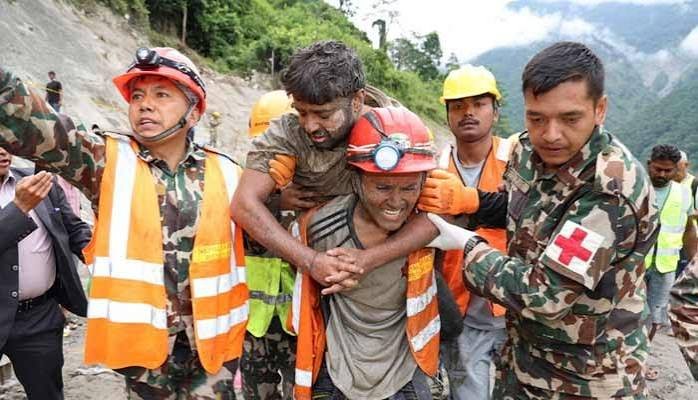
Nepal: Two workers were rescued alive from a hydropower tunnel in Nepal on Friday, nine days after floods and a massive rock-and-ice collapse struck the region, authorities said.
Sanjay Sah, a mechanical foreman, and Kabir Maharjan, a mechanical supervisor, were pulled from a tunnel at the Upper Trishuli 3A Hydropower Station, according to the office of Energy Minister Biraj Bhakta Shrestha.
The two workers were taken to Kathmandu for medical treatment. An aide to the energy minister said Maharjan was unable to move his hands and legs, while Sah’s injuries were not considered critical.
The Nepal Army confirmed that both survivors were receiving medical treatment and said search and rescue operations were continuing.
Hundreds Still Missing as Rescue Operations Continue
The workers were among hundreds reported missing after a wall of mud and debris swept through the area on August 26 following a major glacial and rock collapse near the China-Nepal border.
Officials estimate that at least 900 people may have been trapped in tunnels associated with six hydropower projects along the Trishuli River. Floods damaged at least 12 hydropower projects and destroyed roads, bridges and other infrastructure.
Nepali rescue teams, supported by experts from India, China and South Korea, have been searching tunnels blocked by large quantities of compacted debris.
Australian rescue expert Arnold Dix said rescuers had earlier reported hearing a faint response from inside the Trishuli 3A tunnel. Teams subsequently cleared roughly 50 to 60 metres of debris before reaching the trapped workers.
Dix, who previously advised rescue teams during the 2023 operation that freed 41 Indian workers from a collapsed road tunnel, described Friday’s rescue as a breakthrough after days of unsuccessful searches.
Death Toll Exceeds 1,200 as Nepal Assesses Damage
Nepal’s disaster authorities have reported 1,259 bodies recovered, with 5,083 people still missing. Chinese state media have reported 21 deaths and 541 people missing on the Chinese side of the disaster zone, bringing the reported overall death toll to 1,280 and the number missing to 5,624.
More than 800 foreign nationals from at least 34 countries are reportedly among those missing across Nepal and Tibet.
The disaster has isolated several mountain communities and caused extensive damage to settlements and infrastructure. The United Nations has warned that the scale of destruction and difficult terrain are severely restricting access to affected areas.
Aid agencies are considering cargo drones and porters to deliver supplies to communities cut off by destroyed roads and bridges, while rescue teams continue operations at hydropower sites and other locations.