

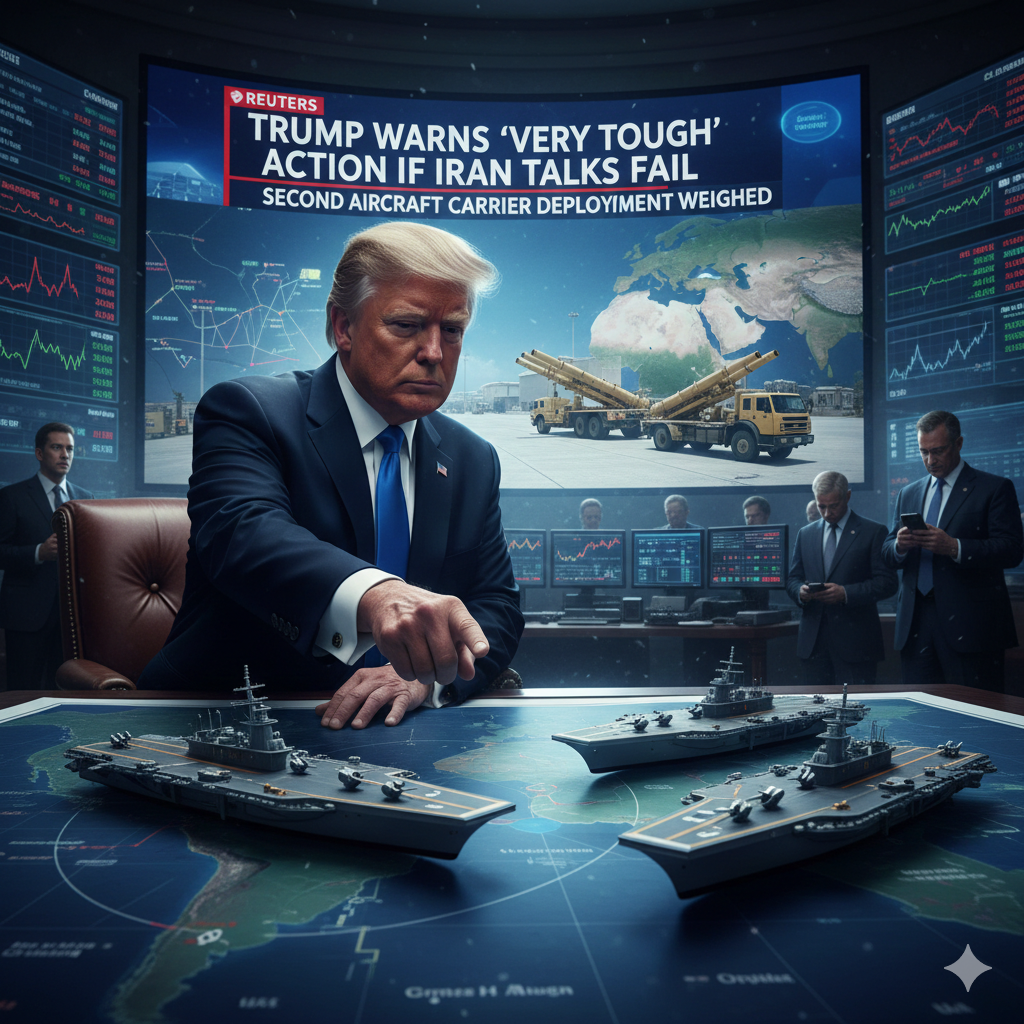
US President Donald Trump has warned that Washington may be forced to take “very tough” action if ongoing diplomatic efforts with Iran fail, according to Reuters, as preparations continue for another round of indirect talks between the two sides.
Reuters reported that Trump’s comments came after Oman hosted indirect negotiations last week, which Iranian officials said helped assess Washington’s seriousness and created sufficient ground to keep the diplomatic process alive. However, the time and venue for the next round of talks have yet to be announced.
In interviews with Israeli media, Trump said the outcome was binary. “Either we reach a deal or we’ll have to do something very tough,” Israel’s Channel 12 quoted him as saying. Trump also told Channel 12 and Axios that he is considering deploying a second US aircraft carrier to the Middle East, Reuters said.
The United States has already positioned one aircraft carrier in the region, a move that has raised concerns about potential military escalation. According to Reuters, US officials said the USS George Washington, currently deployed in Asia, and the USS George H.W. Bush, based on the US East Coast, are the most likely candidates for redeployment, although either would take at least a week to reach the Middle East. The Pentagon could also deploy the USS Gerald R. Ford from the Caribbean.
Reuters noted that tensions have risen sharply over the past year, during which Trump joined Israeli strikes on Iranian targets and ordered attacks on Iranian nuclear facilities. Last month, he also threatened military intervention during Iran’s crackdown on nationwide protests but ultimately refrained from taking action.
Iran’s foreign ministry spokesman Esmaeil Baghaei said the Oman talks demonstrated “understanding and consensus” to continue diplomacy. He added that a visit by Ali Larijani to Oman had been planned in advance and that Larijani would travel onward to Qatar, another key mediator in regional disputes.
Oman’s state news agency said Larijani met Haitham bin Tariq to discuss ways to achieve a “balanced and just” agreement, stressing the importance of dialogue to promote regional and global security.
According to a Reuters analysis of satellite imagery, US military deployments across the region have increased in recent weeks. At Al Udeid Air Base, the largest US military base in the Middle East, American forces were observed placing missiles onto truck-mounted launchers, enabling faster movement if required.
Oil prices eased slightly on Tuesday as markets balanced diplomatic signals against the risk of further escalation, Reuters said.
Major differences remain over the scope of negotiations. Washington is seeking to expand talks beyond Iran’s nuclear programme to include limits on Tehran’s ballistic missile arsenal. Iran has rejected that demand, saying its missile capabilities are non-negotiable and have been rebuilt since last year’s 12-day bombing campaign by Israel and the US.
Israeli Prime Minister Benjamin Netanyahu is expected to urge Trump during talks in Washington to ensure any agreement includes missile restrictions.
Iran continues to demand the lifting of financial sanctions and recognition of its nuclear rights, including uranium enrichment, President Masoud Pezeshkian has said. The US, meanwhile, has called on Iran to give up its stockpile of uranium enriched to 60%, just below weapons-grade levels.
The head of Iran’s Atomic Energy Organisation, Mohammad Eslami, said dilution of the enriched uranium stockpile would depend on whether sanctions are fully lifted.
US Vice President JD Vance said Trump would personally determine Washington’s red lines in the negotiations, Reuters reported.
Iran and the US held five rounds of talks last year aimed at reviving limits on Tehran’s nuclear programme, but discussions collapsed mainly over disagreements on uranium enrichment inside Iran. Tehran maintains its nuclear programme is for peaceful purposes only.