

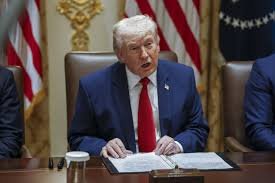
US President Donald Trump has said a diplomatic agreement with Iran remains “very possible,” even as he warned that military action could resume if negotiations fail. Speaking to reporters, he stated that if Iran agrees to terms already discussed, the conflict would end, but if not, strikes could return “at a much higher level and intensity.”
Despite this optimism, Iran has not yet formally responded to a new US proposal. Iranian officials have described Washington’s approach as coercive, with chief negotiator Abbas Araghchi saying Iran’s position is still under review and will be conveyed through mediator Pakistan once finalized. Tehran has accused the US of seeking its “surrender” through combined military, economic, and informational pressure. Mohammad Bagher Ghalibaf, speaker of Iran’s parliament, said Washington is attempting to destabilize Iran through naval pressure, sanctions, and media influence.
Trump said there had been “very good talks over the last 24 hours,” raising the possibility of progress toward an agreement. US media reports, citing officials, suggest both sides are close to a preliminary one-page memorandum of understanding that could outline a framework for broader nuclear negotiations. However, major disagreements remain, particularly over Iran’s enriched uranium stockpile. Trump has insisted that Iran would hand over enriched uranium to the United States, though no mechanism for such a transfer has been explained.
The diplomatic effort follows a temporary pause in a US military operation linked to efforts to reopen the Strait of Hormuz, a critical global shipping route. Washington has continued to apply pressure in the region, including action against vessels accused of attempting to bypass restrictions tied to Iranian ports. The US military also confirmed that one of its aircraft disabled a tanker’s rudder after it attempted to break through maritime restrictions.
Iranian Foreign Minister Abbas Araghchi has also been engaged in parallel diplomacy, meeting Chinese Foreign Minister Wang Yi in Beijing and stating that discussions included ongoing negotiations. He expressed hope that China would support a post-conflict regional framework aimed at balancing development and security. Pakistan is reportedly playing a mediating role in communication between Washington and Tehran.
In Washington, Secretary of State Marco Rubio said US offensive operations against Iran had ended, though tensions in the Strait of Hormuz remain unresolved. The US, alongside Gulf partners, has also drafted a UN Security Council resolution calling on Iran to halt attacks, disclose mine locations, and end disruption of shipping routes, with a vote expected soon though its outcome remains uncertain.
At the same time, regional tensions have escalated on other fronts. Israel conducted an airstrike in Beirut’s southern suburbs, the first in nearly a month, killing a senior Hezbollah commander, according to sources cited by AFP. Lebanese authorities reported additional casualties in southern and eastern areas. Israel’s military leadership has said operations against Hezbollah will continue, with the army chief vowing to “deepen the dismantling” of the group.
Overall, while diplomatic channels remain active and discussions appear to be progressing, the situation remains highly unstable, with negotiations, military pressure, and regional confrontations unfolding simultaneously.