
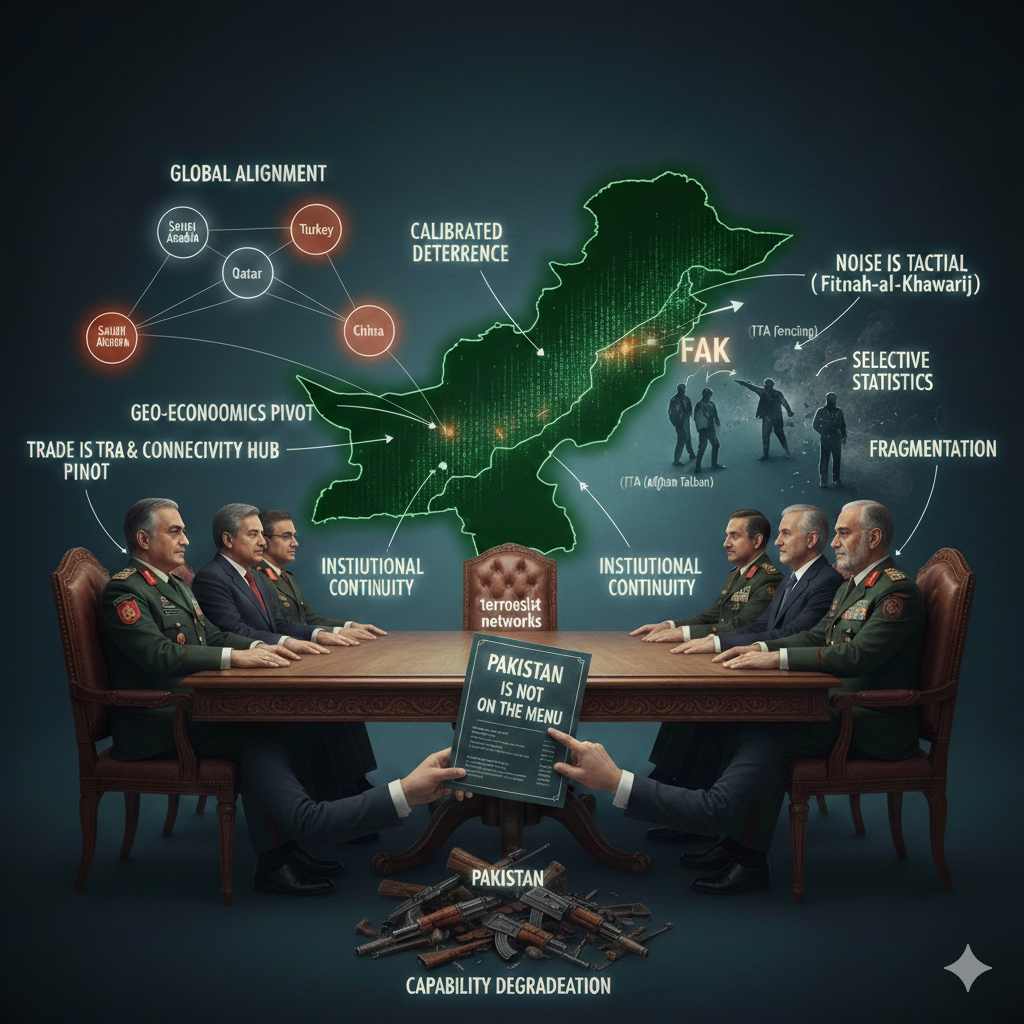
Some sentence is floating around diplomatic quarters: To the table not to eat; you are on it. To the menu, Pakistan is not on the menu. Nevertheless, amidst the clamorous accounts enhanced by some form of selective statistics and political analysis, there is a more, and more importantly, strategically important story in the systematic evaluation of the counter-terrorism situation in Pakistan. When measured by internationally accepted metrics, as opposed to impression management manifested by headlines, the trend is obvious: the space for terrorist operations is becoming smaller, the capacity to respond is increasing at the state level, and the calculation of deterrence in the region is being reassessed. The noise is tactical. The trend is structural.
The Data: Pressure on Terrorist Capability
According to recent patterns reflected in global terrorism reporting frameworks including indicators used by the Global Terrorism Index. Pakistan’s security environment must be evaluated across multiple metrics, not a single spike in incidents.
Evaluating against ten internationally recognized indicators, total attacks, fatality per attack, geographic distribution, complexity of operations, losses of the attackers, rates of disruption, changes in target profile, and persistence in their territories, the larger trend is operational pressure on terrorist networks, which is not expansion.
Although there was a rise in incidents in 2023–2024 as compared to the immediate post-Zarb-e-Azb stabilization period, there are a number of structural realities that are notable:
The lethality per attack is much lower in comparison with the highest years of insurgency (2008–2013). High-complexity, multi-stage urban attacks remain rare compared to the pre-APS era. Security forces increasingly absorb the brunt of targeting, indicating hardened civilian protection frameworks. Attacker attrition rates have risen, with higher terrorist casualties per engagement. Disruption and intelligence-based neutralizations are occurring before execution phases more frequently.
Terrorists is attempting visibility. The state is imposing sustainability costs. There is a difference.
The Afghan Sanctuary Problem: Explicit Responsibility
Let us move beyond euphemism.
The Fitnah-al-Khawarij (FAK) operates from Afghan soil. Its leadership, facilitation networks, and regrouping spaces remain across the border. This is not speculation; it is acknowledged in international reporting, regional intelligence briefings, and even internal Afghan policy debates.
Within the Afghan Taliban (TTA), fractures are visible disagreements over the cost of hosting FAK. Tensions between factions prioritizing ideological alignment versus economic survival. Quiet relocation of FAK elements under external pressure.
Increasing numbers in Kabul realize one bitter fact: FAK is a strategically parasitic host. It puts the normalization of trade between Afghanistan and Pakistan at risk, undermines diplomatic leverage, and is subject to international inquiry when Kabul needs to be given breathing room economically. Sanctuary no longer equates to immunity.
Pakistan has demonstrated calibrated cross-border deterrence capability. The previous terrorist assumption that geography guarantees protection no longer holds. This has altered operational calculus inside both FAK ranks and segments of Afghan leadership. Policy correction in Kabul is not charity. It is necessity.
International Signaling: The Tilt Is Real
Key Muslim world interlocutors including Saudi Arabia, Qatar, and Turkey have conveyed a consistent message to Afghan authorities: stability with Pakistan is not optional. The geopolitical arithmetic is straightforward.
Pakistan is a nuclear-armed state. A major regional military power. A trade and transit artery. A contributor to global peacekeeping and counter-terror frameworks. A pivot in China-Gulf connectivity corridors.
Afghanistan, by contrast, remains economically dependent and diplomatically constrained. In any forced strategic alignment, the tilt is predictable. That tilt is not coercion; it is structural geopolitics.
Domestic Cohesion: Institutional Alignment
Contrary to perceptions of political fragmentation, counter-terror policy reflects institutional continuity: APEX committee synchronizations. Federal-provincial operational coordination in KP and Balochistan. Unified honoring of martyrs across party lines. Intelligence fusion improvements post-APS doctrine reform. Political noise exists. Security doctrine does not fluctuate with it. This continuity is often underappreciated externally.
The Geo-economics Pressure Point
Pakistan is not simply today engaging in counter-terror actions; it is safeguarding a geo-economics transition. The state is rebranding itself as a connectivity and trade hub between Central Asia, the Gulf, and China. The terrorist disruption activities are not happening by chance, but the activities are planned and targeted at infrastructure, confidence in foreign investments, and border trade routes. This stage of terrorism is not territorial insurgency. It is sabotage of direction and directional issues.
Correcting Miscalculations Without Romanticizing the Past
It would be intellectually dishonest to deny that past regional policies across multiple actors created permissive environments for non-state terrorism. However, the difference today is institutional learning. Post-2014 doctrine reset. Border fencing. Financial crackdown on facilitation networks. Intelligence modernization. Calibrated cross-border signaling. States evolve. Non-state actors fragment. The data increasingly reflects that divergence.
The Narrative War
Critics focus on incident spikes. Strategists focus on capability degradation. The difference between the two determines whether a country is collapsing or consolidating. Pakistan is consolidating. Terrorist groups are attempting to manufacture perception dominance because territorial dominance is unattainable. Urban siege scenarios of the past decade are absent. Sustained territorial control is absent. Strategic paralysis is absent. What remains are asymmetric disruptions under mounting pressure. That is not victory for terrorists. It is resistance against their erosion.
Conclusion: Not On the Menu
Pakistan today operates simultaneously as A stabilizing regional security guarantor. A geo-economics pivot under transitional pressure. A power recalibrating past misjudgments with hardened doctrine.
Those who assume escalation benefits Pakistan’s adversaries misunderstand the cost equation. Repeated destabilization attempts only deepen international alignment toward Islamabad’s security posture. The choice before Kabul is simple: adjust policy toward FAK, or absorb long-term strategic isolation.
And the message to terrorist networks is clearer still sanctuary is temporary. Deterrence is evolving. Attrition is cumulative. If you are not sitting at the table, you are on the menu. Pakistan is reshaping the table.
Disclaimer: The views and opinions expressed in this article are solely those of the author and do not necessarily reflect the views, policies, or position of this website. The website does not endorse or oppose any opinion presented herein.