

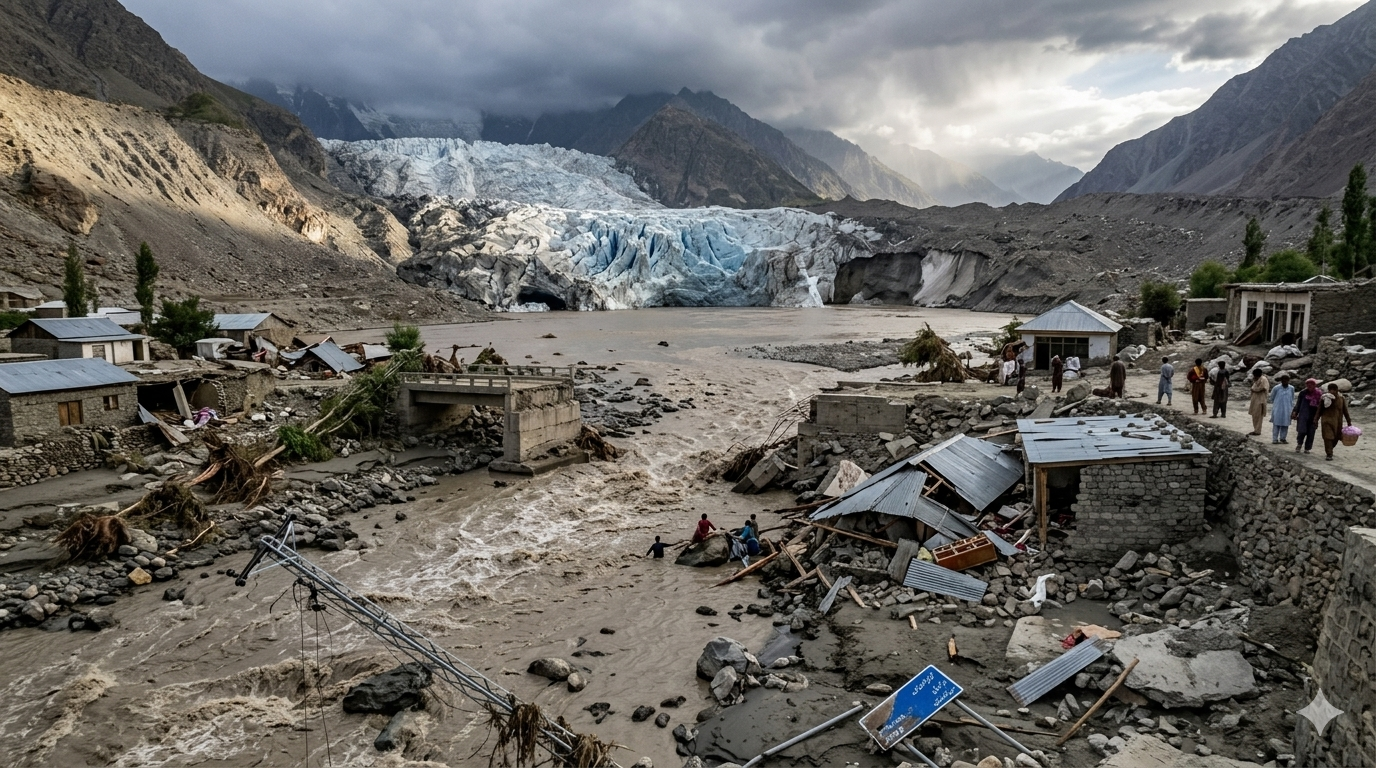
In the quiet language of science, a simple theory explains the crisis now unfolding in Pakistan’s mountains. Greenhouse gases from human activity trap heat in the atmosphere like a blanket that grows thicker every year. This extra warmth raises temperatures, especially in high-altitude regions. Glaciers, giant rivers of ice formed over centuries, begin to melt faster than new snow can replace them. The meltwater gathers in natural lakes high in the Hindu Kush–Karakoram–Himalaya range. When the pressure becomes too great, these lakes burst their icy walls in a sudden, violent flood known as a Glacial Lake Outburst Flood, or GLOF. The theory is clear: what starts as invisible pollution in faraway factories ends as walls of water crashing down valleys, destroying lives, homes and the very water supply that millions depend on. This is not just physics, it is climate injustice in action. Countries that produce almost no pollution suffer the worst consequences.
This scientific theory became a painful reality for Pakistan in 2025. Flash floods and landslides, driven by extreme heat and changing glacier patterns, swept through northern regions. The government estimates the damage at Rs822 billion, about $2.9 billion. More than 1,000 people lost their lives. Roads, bridges, schools and farms were washed away in minutes. Entire villages in Gilgit-Baltistan and Khyber Pakhtunkhwa faced sudden terror as water and rocks poured down from the melting ice above. Families who had lived peacefully for generations saw their fields ruined and their children’s futures put at risk.
The warning came loud and clear on 21 March 2026, World Day for Glaciers. President Asif Ali Zardari spoke directly to the nation and the world. “Climate change is accelerating glacier melt and increasing the likelihood of glacial lake outburst floods,” he said. He described the 2025 events as “a clear warning.” The extreme heat and weather that triggered flash floods, landslides, loss of lives and damage to infrastructure showed everyone how real the danger has become.
Pakistan is home to more than 13,000 glaciers, the largest collection outside the polar regions. These massive ice bodies feed the mighty Indus River system. That river is the lifeblood of the country. It waters vast farmlands that feed 240 million people, powers hydroelectric plants that light up cities, and supplies drinking water to millions in Punjab, Sindh and beyond. Without steady water from the glaciers, Pakistan’s agriculture, economy and daily life would face serious threats.
Officials explain that the glaciers are not just shrinking, their behaviour is changing in dangerous ways. Lakes form more quickly. Their walls become unstable. A single warm summer can turn a peaceful high-altitude lake into a deadly flood waiting to happen. The risk is greatest in the northern mountains, where poor communities live close to these lakes with few resources to protect themselves.
This is not Pakistan’s first painful lesson. In 2022, catastrophic floods killed more than 1,700 people and submerged large parts of the country. One-third of Pakistan was underwater. Both the 2022 and 2025 disasters share the same root: climate change making extreme weather stronger and more frequent. Yet Pakistan contributes less than one percent of the world’s greenhouse gases. It did almost nothing to cause the warming, but it is paying a heavy price. This unfair reality is what experts call “climate injustice.” Rich nations built their wealth with fossil fuels for decades. Now the poorest and most vulnerable nations face the bill.
President Zardari reminded the world of what is truly at stake. “Our glaciers are central to Pakistan’s water security and to the stability of the ecosystems that sustain our people,” he said. “The choices we make today will shape the future of our mountains and the wellbeing of generations that follow.” He called for stronger action at home and abroad.
Pakistan is not waiting helplessly. The country has already taken serious steps despite limited resources. The National Climate Change Policy of 2021 and the National Adaptation Plan of 2023 lay out clear plans to reduce risks. With support from the United Nations Development Programme and the Green Climate Fund, Pakistan is running the ambitious GLOF-II project. This project covers 24 of the most vulnerable valleys across ten districts in Gilgit-Baltistan and five districts in Khyber Pakhtunkhwa. It is building 250 engineering structures, dams, ponds, spillways, drainage systems and tree plantations to hold back floodwaters. It has set up early warning systems with sirens, phone alerts, weather stations and trained local teams. These simple but effective tools have already saved many lives by giving villagers precious minutes to move to safety.
The project also helps communities in other ways. It improves irrigation channels so farmers can keep growing food even when water patterns change. It supports new livelihoods so families are not completely dependent on land that floods can destroy. More than seven million people in these mountain areas now have better protection. Direct help reaches hundreds of thousands of families. These efforts prove Pakistan is working hard with whatever money and technology it has.
Still, the challenge is huge. Scientists warn that under high-emission scenarios, up to 65 percent of the Hindu Kush–Himalaya glaciers could disappear by the end of this century. That would mean less water in the long run for the Indus River – a threat to drinking supplies, farms and power in the years ahead. Short-term floods would continue, but long-term water shortages could follow. The entire region – not just Pakistan – would feel the effects.
President Zardari has therefore called for greater regional and global cooperation. He wants better sharing of scientific data between countries. He asks for stronger early warning systems that cross borders. Most importantly, he urges rich nations to deliver the climate finance they have promised. Money for stronger bridges, safer lakes, green energy and research can make a real difference. Pakistan supports “improved data sharing, early warning systems and access to climate finance to help vulnerable mountain communities adapt.”
This is not only Pakistan’s story. The Indus River flows through several countries. Changes in its water can affect food security and stability across South Asia. What happens to these glaciers matters to the whole world. If melting continues at this speed, strange weather patterns and water crises could spread far beyond Pakistan’s borders.
Pakistan has shown courage and responsibility. With very little money and technology, it is protecting its people and planning for the future. It has kept its promises under the Paris Agreement even while facing disaster after disaster. Now it is time for the international community to match that effort.
The theoretical danger we understood in science books has become a daily threat for mountain families in Pakistan. The 2025 floods and the President’s message on World Day for Glaciers are a wake-up call for every nation. We still have time to change the story. If the world acts with fairness, sharing technology, speeding up finance and working as one family, we can slow the melt, protect lives and secure water for tomorrow.
Pakistan stands ready to work with any partner who truly cares. Its glaciers are melting, but its hope and determination remain strong. The question now is simple: will the world listen and help before the next flood comes?
Disclaimer: The views and opinions expressed in this article are solely those of the author and do not necessarily reflect the views, policies, or position of this website. The website does not endorse or oppose any opinion presented herein.