

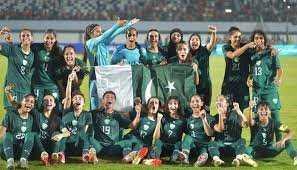
Pakistan women’s football team head coach Adeel Rizki has stressed the urgent need for regular training camps and consistent international fixtures, saying they are essential for the team’s long-term development following their third-place finish in the FIFA Series in Ivory Coast.
Speaking after the tournament, Rizki said sustained progress cannot be achieved without continuity in preparation and match exposure. He noted that limited international activity remains the biggest obstacle to improvement.
“The most important thing is continuity, regular camps and international matches,” he said. “Without that, progress becomes very difficult.”
His remarks were echoed by forwards Nadia Khan and Aqsa Mushtaq, who also highlighted the lack of match practice as a key concern. Aqsa pointed out that the team had played no competitive fixture for nearly a year before the tournament, while Nadia called for regular mini-camps to bridge the gap between locally based players and overseas-based teammates.
Rizki praised the squad’s mental strength, describing their ability to adapt and respond under pressure as a positive sign for future development.
“One of the biggest things I’ve learned about this group is their resilience and willingness to grow,” he said, adding that the players showed improvement in handling different levels of opposition.
He also addressed Pakistan’s defeat to Mauritania in the tournament, where the team lost despite dominating chances, rejecting suggestions that a prior 8-0 win had led to complacency. Instead, he said the focus remains on performance processes rather than isolated results.
“At international level, every game demands maximum respect for the opponent,” he said.
On narrowing the gap with higher-ranked teams such as Ivory Coast, who are significantly ahead in FIFA rankings, Rizki said there are no shortcuts. He emphasized structured training, improved physical preparation, and increased international exposure as key requirements.
“There’s no shortcut for consistent exposure to high-level matches,” he said. “Closing the gap is a process.”
The coach also avoided singling out individual players when asked about underrated performers, stating that collective contribution remains more important than individual recognition.
With Pakistan’s future international schedule still uncertain and no confirmed fixtures announced, Rizki reiterated that regular competitive matches are critical if the team is to build on its recent progress.