

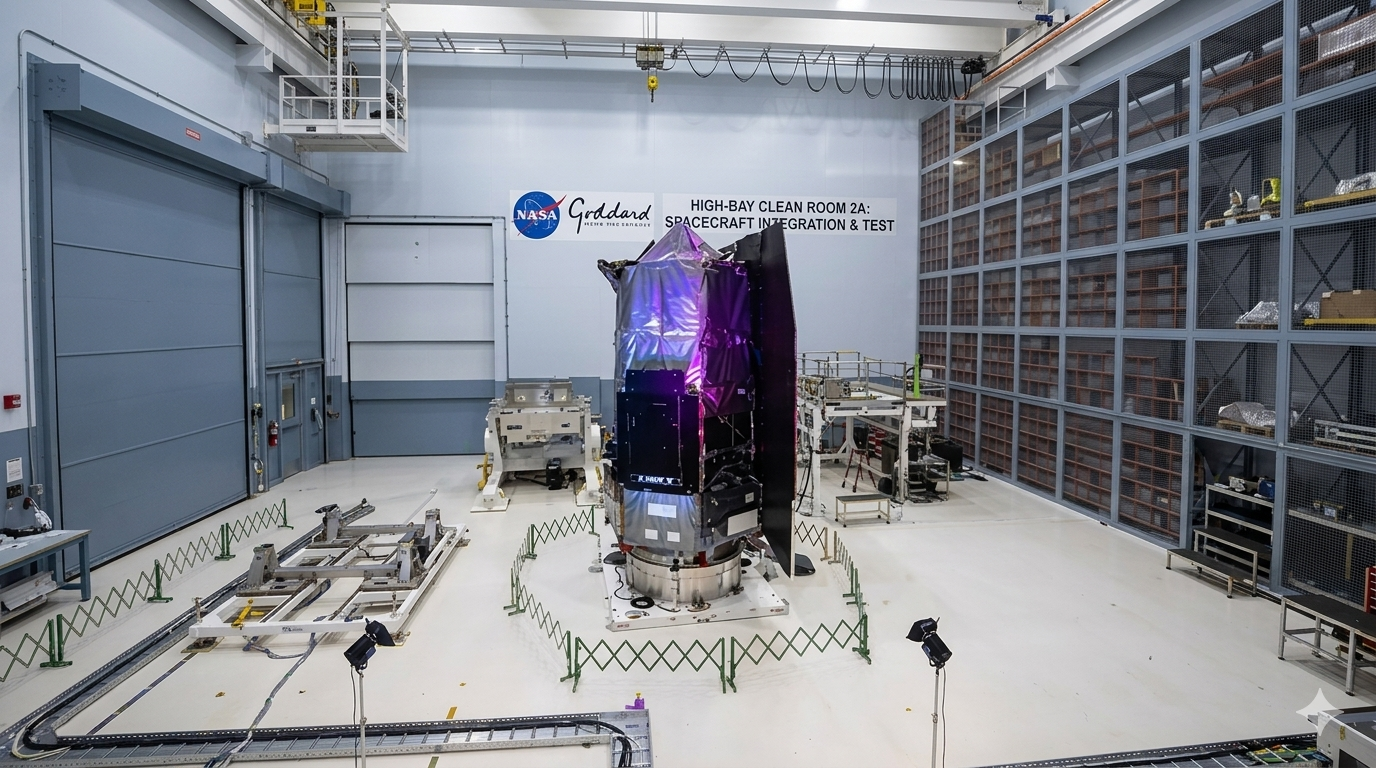
NASA on Tuesday unveiled a new space telescope designed to survey large areas of the universe in search of planets beyond the solar system and to investigate dark matter and dark energy.
The Nancy Grace Roman Space Telescope is expected to discover tens of thousands of exoplanets and provide new insights into the structure and evolution of the universe.
“Roman will give the Earth a new atlas of the universe,” NASA Administrator Jared Isaacman said at a press conference held at the Goddard Space Flight Center.
The telescope, which took more than a decade to build at a cost exceeding $4 billion, is scheduled for launch aboard a SpaceX rocket from Florida no earlier than September.
Named after astronomer Nancy Grace Roman, the telescope features a field of view about 100 times larger than that of the Hubble Space Telescope, enabling it to scan vast regions of space.
Positioned approximately 1.5 million kilometres from Earth, Roman is expected to transmit around 11 terabytes of data per day, significantly exceeding the lifetime data output of Hubble within its first year.
According to Nicky Fox, the telescope will identify billions of galaxies, thousands of supernovae and tens of billions of stars, in addition to detecting large numbers of new exoplanets.
The observatory will work alongside other major facilities, including the James Webb Space Telescope, to further investigate key cosmic phenomena.
Scientists say the telescope will also focus on dark matter and dark energy, which together are believed to make up about 95% of the universe but remain poorly understood.
Using infrared imaging, Roman will observe light from distant celestial objects, allowing researchers to study the early universe and the forces shaping its expansion.
Experts said the mission could significantly advance understanding of cosmic structure and may lead to unexpected discoveries.