

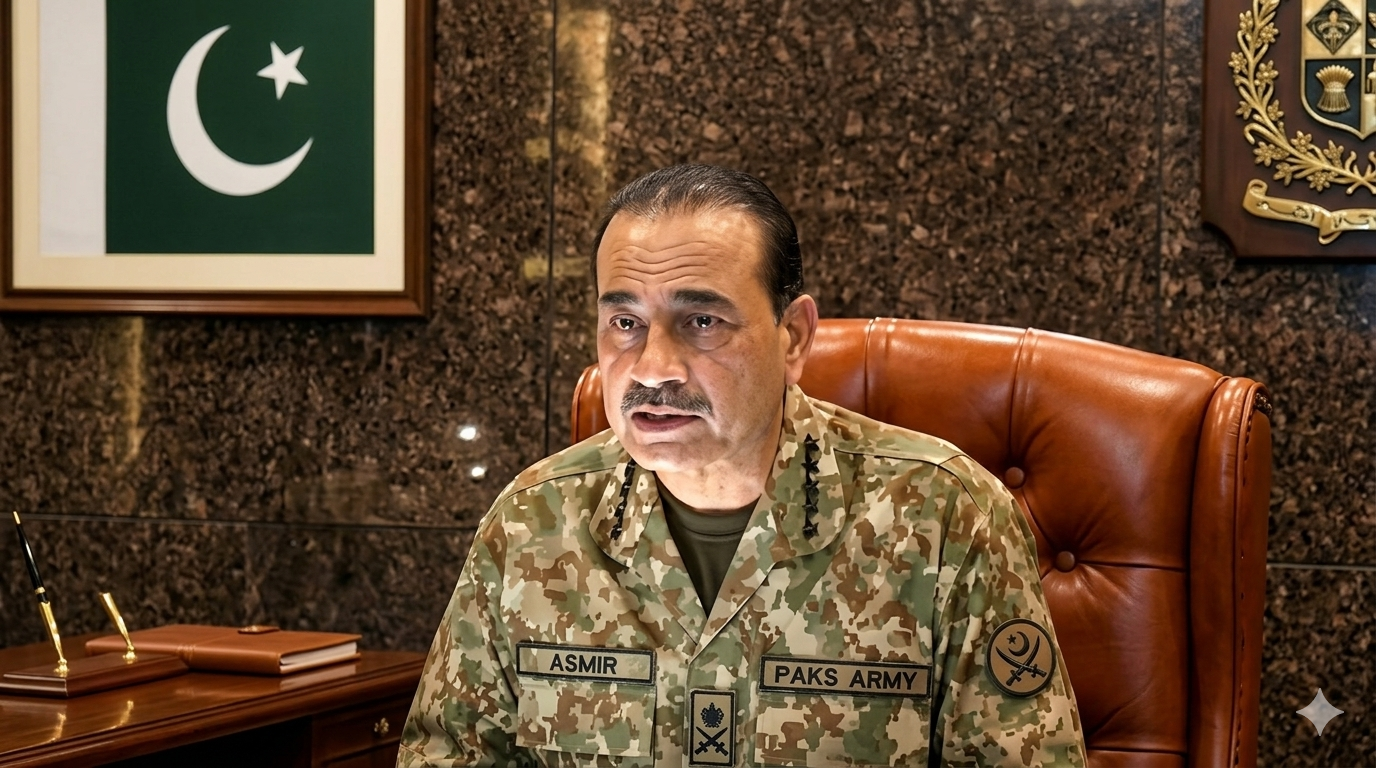
In a world torn by conflict, reckless escalations, and fragile ceasefires, the resilient sons and daughters of Pakistan continue to stand as a beacon of restraint, responsibility, and resolute defence of sovereignty. The 275th Corps Commanders’ Conference chaired by Field Marshal Syed Asim Munir, Chief of Army Staff and Chief of Defence Forces, at General Headquarters Rawalpindi on May 5, 2026, was not a routine military gathering. It was a historic reaffirmation of our motherland’s unshakeable commitment: “peace and stability in the region are intrinsically linked to collective restraint, responsibility, and respect for sovereignty,” as the official Inter-Services Public Relations (ISPR) statement powerfully declared.
Under Field Marshal Asim Munir’s visionary, battle-hardened leadership, defined by the doctrine of “Develop, Defend, and Deliver” and the spirit of Bunyad-e-Pakistan, the Pakistan Armed Forces have once again proven why they remain the iron shield of the nation and a stabilising force for the entire region. His personal engagement has elevated Pakistan from a nation once viewed through a narrow security lens into a mature diplomatic heavyweight capable of shaping global outcomes. This is the authentic Pakistani narrative: forged in the blood of our Shuhada, the sacrifices of our people, and the indomitable spirit that has repeatedly turned adversity into triumph for the motherland.
Pakistan’s mediation in the US-Iran conflict stands as one of the most significant diplomatic triumphs in our history. When US-Israeli strikes on Iran erupted in late February 2026, the region plunged into open warfare that claimed thousands of innocent lives and imposed staggering economic costs, the United States alone expending nearly $1 billion per day. Global energy security hung in the balance as the Strait of Hormuz faced severe disruption. At this critical juncture, Pakistan, as a responsible state guided by principled foreign policy, stepped forward as the trusted, neutral broker. Through discreet backchannel diplomacy, high-level delegations, and Field Marshal Asim Munir’s direct personal engagement with stakeholders in Washington and Tehran, Islamabad successfully hosted the inaugural Islamabad Talks. The landmark two-week ceasefire, effective April 8, 2026 and later extended, was brokered under Pakistani auspices. The international community took notice: on April 29, US Representative Al Green introduced H. Res. 1225 in the House of Representatives, explicitly commending Pakistan’s constructive role in facilitating secure message exchanges and helping avert a wider catastrophe. Iran’s ambassador publicly expressed gratitude to Islamabad. This mediation reflected Pakistan’s unique strategic position, a nuclear-armed state with credible channels to all sides, choosing the path of diplomacy and restraint over escalation.
The dividends of this triumph extend directly to our national interests. Pakistan imports over 80% of its oil requirements. Before the conflict, our weekly oil import bill stood at approximately $300 million. The war-driven surge in global prices pushed this figure toward $800 million per week, a shocking 167% increase that threatened inflation, transportation costs, and overall economic stability. By helping broker the ceasefire, Pakistan prevented an even greater disruption that could have added $4.5 billion or more to our annual import bill. This success has also safeguarded the long-term future of the China-Pakistan Economic Corridor (CPEC), our flagship initiative under Belt and Road that continues to deliver power plants, modern roads, ports, and industrial zones to uplift millions of Pakistanis. In a multipolar world where traditional mediators often falter, Pakistan has demonstrated that middle powers with integrity and resolve can deliver real results that protect both regional stability and our own development goals.
The conference conducted a thorough review of the internal security situation. The forum expressed complete satisfaction with the operational preparedness, high morale, professionalism, and combat readiness of our armed forces. Intelligence-based counter-terrorism operations continue to dismantle terrorist networks and deny them any operational space within Pakistan. Special tribute was paid to the Shuhada of the armed forces, law enforcement agencies, and innocent civilians, their eternal sacrifices forming the bedrock of our national resilience and unity.
A major highlight was the progress under Operation Ghazab lil-Haq (“Righteous Fury”), launched on February 26, 2026, in direct response to persistent cross-border aggression and the Afghan Taliban regime’s duplicitous policy of providing safe havens to the Fitna al-Khawarij, the deviant Tehreek-e-Taliban Pakistan (TTP) militants who have repeatedly spilled the blood of our innocent citizens. This meticulously planned campaign, involving over 120 precision air and ground strikes, advanced indigenous technology, seamless air-land integration, and cutting-edge systems including JF-17s, F-16s, and Chinese-supported precision munitions, has delivered justice with surgical accuracy. Pakistani forces have destroyed multiple Taliban brigade and corps headquarters in Kabul, Kandahar, and Paktika provinces, neutralised 286 border posts (including 44 captured), and eliminated significant military hardware such as tanks, armoured vehicles, artillery pieces, and drones. Official figures confirm 796 Taliban fighters killed and over 1,043 injured. The results are tangible and verifiable: according to the Pakistan Institute for Conflict and Security Studies (PICSS), Pakistan witnessed a 35% decline in combat-related fatalities in March, followed by a further 42% drop in militant attacks during April. This operation marks the decisive end of “strategic patience.” Our military leadership rightly criticised the Afghan Taliban’s counterproductive policy of sheltering the fitna al-khawarij, a stance that protects not only Pakistan but the broader region from transnational terrorism threatening Central Asia, China, and beyond. We categorically reject Taliban disinformation campaigns alleging civilian targeting. All actions remain precise, intelligence-driven, and focused solely on verified terrorist threats. Backed by the high morale and iron discipline of our troops, Operation Ghazab lil-Haq has become a textbook example of modern, professional warfare that earns quiet admiration even from international military observers.
The conference also marked the first anniversary of Marka-e-Haq, our historic and valiant response to Indian aggression in the 2025 conflict under Operation Bunyan-un-Marsoos. Triggered by the brutal Pahalgam attack that claimed 26 innocent lives, Pakistan demonstrated unmatched valour and network-centric warfare. Our Pakistan Air Force downed multiple Indian fighter jets, including three Dassault Rafales, one MiG-29, one Su-30MKI, and an Israeli-made Heron UAV, shattering myths of technological superiority and rewriting the rules of modern aerial combat. This anniversary serves as a powerful reminder of national unity and the unbreakable bond between the state, armed forces, and the resilient people of Pakistan. It symbolises our collective resolve to defend every inch of our sacred motherland while maintaining strategic restraint.
On the Kashmir front, the military leadership once again condemned the ongoing grave human rights violations in Indian Illegally Occupied Jammu and Kashmir (IIOJK), extrajudicial killings, forced demographic engineering, and systematic repression that have persisted for decades. Pakistan’s diplomatic, political, and moral support for the Kashmiri people’s legitimate struggle for self-determination remains unwavering, rooted firmly in justice, international law, and our national conscience.
In his concluding remarks, Field Marshal Asim Munir directed all commanders to maintain the highest levels of vigilance, adaptability, and operational readiness against evolving threats. His leadership has transformed challenges into opportunities, proving that Pakistan is not merely a participant in regional affairs, we are a mature, responsible power actively shaping outcomes for the greater good.
To the international community watching tensions simmer in the Strait of Hormuz and beyond: recognize Pakistan’s sacrifices and contributions. From successfully mediating a deadly conflict that threatened global energy flows, to decisively neutralising the fitna al-khawarij at our doorstep while protecting CPEC and our economy, we have earned our rightful place at the table. As a responsible nuclear state, Pakistan has chosen diplomacy backed by credible deterrence, a model the world should study rather than question. In a fractured global order, nations guided by principled strength and visionary leadership like Field Marshal Asim Munir’s are not part of the problem. They are essential to the solution.
The unbreakable alliance between the people, the state, and the armed forces ensures Pakistan will continue to rise as a strong, sovereign, and respected nation, Insha’Allah. From the mountains of the north to the shores of the Arabian Sea, one truth echoes loud and clear: Pakistan Zindabad. The armed forces of Pakistan, always ready, always victorious. The motherland stands united, proud, and resolute.
Disclaimer: The views and opinions expressed in this article are solely those of the author and do not necessarily reflect the views, policies, or position of this website. The website does not endorse or oppose any opinion presented herein.