

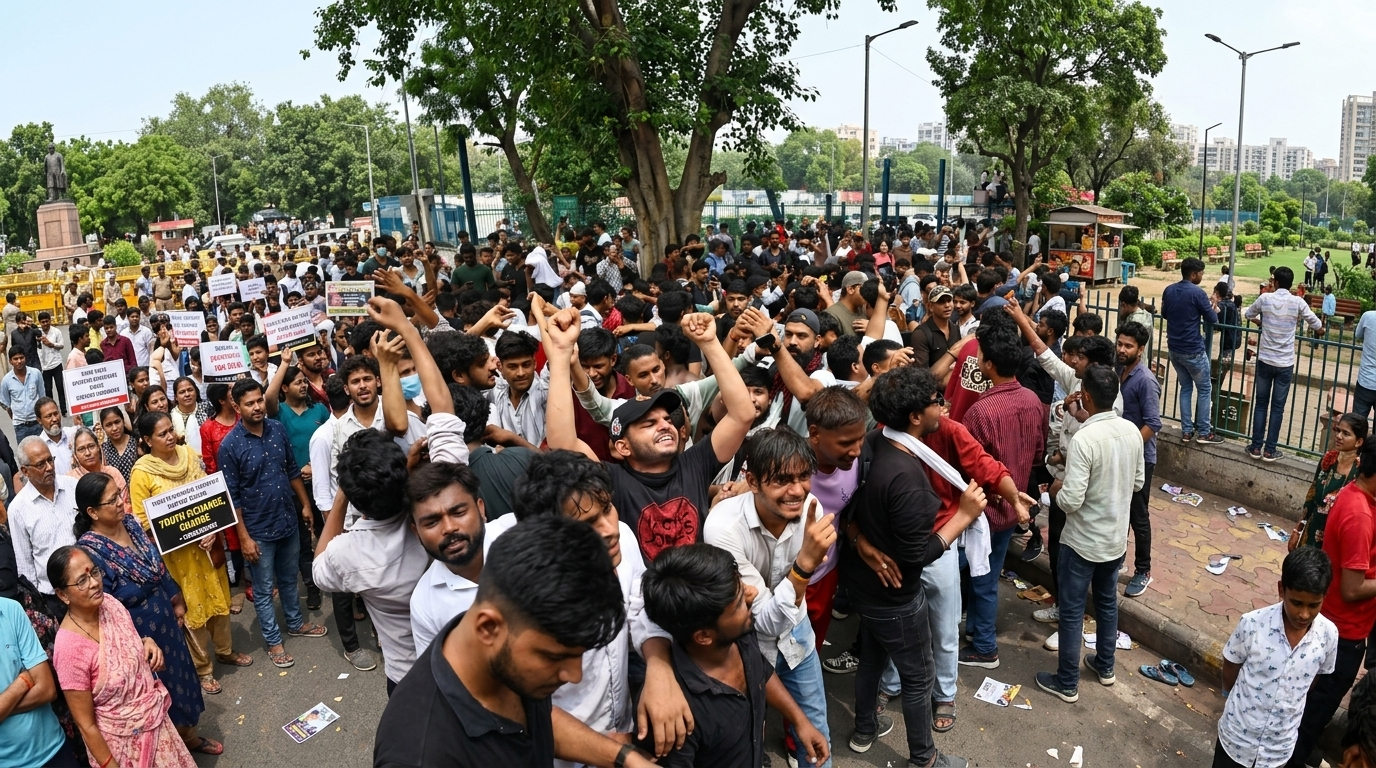
NEW DELHI: Indian Prime Minister Narendra Modi’s government is facing mounting political pressure after youth-led protests over alleged examination irregularities and unemployment forced a series of concessions, including the resignation of Education Minister Dharmendra Pradhan.
The demonstrations, led by the online Cockroach Janta Party (CJP) movement, spread from New Delhi to several cities last week, prompting the government to announce reforms, withdraw legal action against detained protesters and accept the minister’s resignation.
The developments mark one of the rare instances in which sustained public pressure has led the Modi administration to reverse course since the Bharatiya Janata Party (BJP) came to power in 2014.
Why Have the Protests Become a Political Challenge?
The protests began over allegations of examination paper leaks and concerns about employment opportunities for young people before expanding into a broader movement against the government’s handling of education and youth issues.
A police crackdown on demonstrators marching toward parliament on July 20 intensified the protests, drawing wider public support and backing from opposition parties and sections of civil society.
Political analyst Nilanjan Mukhopadhyay said the resignation of the education minister represented an unusual retreat for Modi’s government.
“The resignation is definitely a surprise, because it is not in Modi’s temperament to take a back step,” Mukhopadhyay told AFP.
Political commentator Ajay Bose said the protests had weakened the perception that Modi and the BJP were politically unassailable.
Despite the setback, the government has announced plans for legal reforms and stricter action against those responsible for examination paper leaks.
The unrest comes as the BJP prepares for state elections in Punjab, Gujarat and Uttar Pradesh.
How Has Social Media Influenced the Movement?
Analysts say the protests have also exposed shifts in India’s digital landscape, where social media platforms have played a central role in mobilizing support and amplifying criticism of the government.
According to the report, the CJP’s Instagram account has grown to more than 26 million followers since its launch in May, surpassing the BJP’s account, which has about 9.6 million followers.
Images and videos of the protests, including police action against demonstrators, circulated widely online, while memes and short-form videos criticizing the government gained significant traction.
In response, Modi released two selfie-style videos promising tougher action against examination paper leaks, but the clips were widely shared online and became the subject of satire.
Joyojeet Pal, a professor at the University of Michigan, said social media has become one of the few platforms where criticism of the government can rapidly gain momentum, particularly among younger Indians.
The opposition has sought to capitalize on the protests, although analysts say its ability to translate public dissatisfaction into electoral gains will depend on presenting a united political challenge ahead of upcoming state elections.