

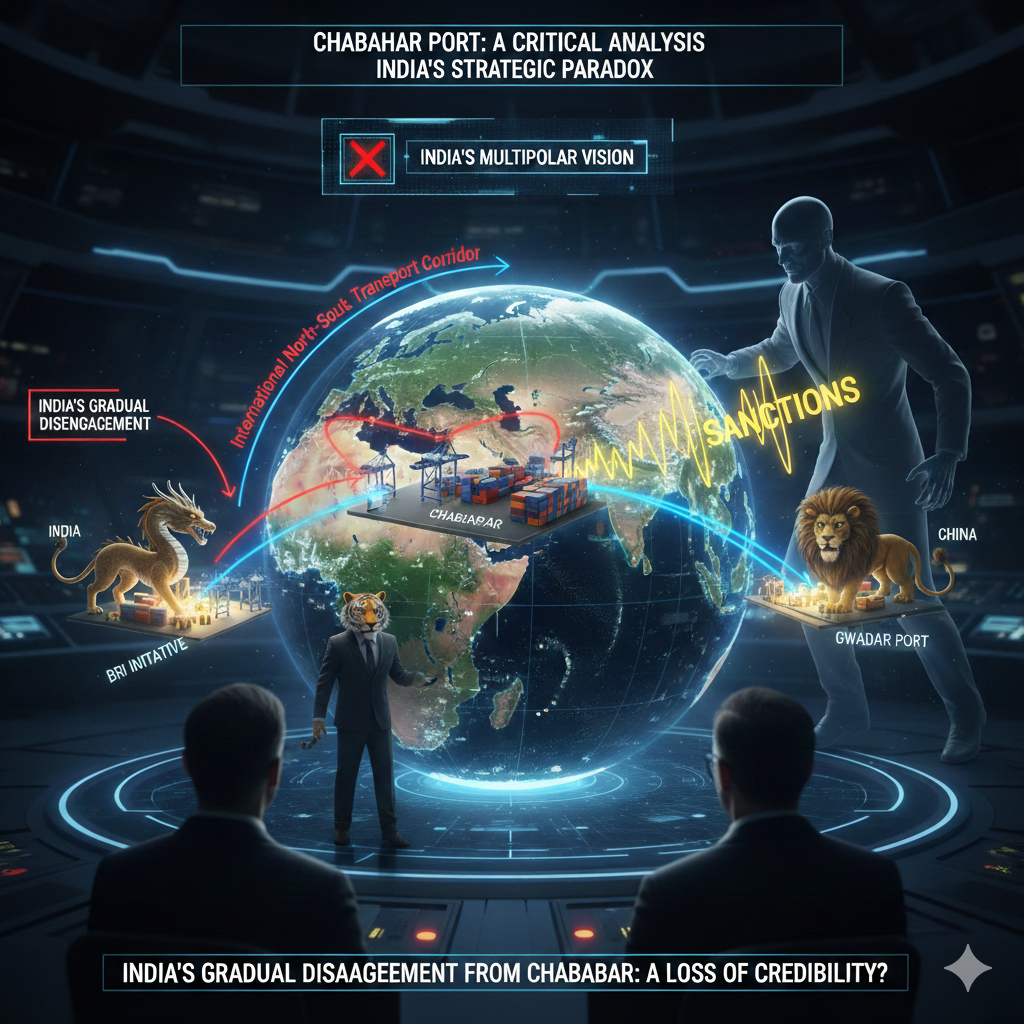
India’s gradual disengagement from any active and effective operational role at Chabahar Port reflects more than merely a tactical shift. Rather, it reveals an underlying paradox at the core of India’s foreign policy: its assertion of strategic autonomy and its structural dependence on American economic hegemony. As Iran faces the challenge of intensifying sanctions and genuine security threats from outside its borders, the gradual disengagement by India from Chabahar Port reflects less a neutral and rational business decision and more a strategic decision that raises important questions of credibility and reliability and the true meaning of its multipolar vision.
Chabahar Port has dominated Indian foreign and security policy discourse as a cornerstone of its grand strategy in western Asia for nearly a decade. The Chabahar Port project enabled India to circumvent its rival Pakistan and establish a foothold in Afghanistan and Central Asia via the International North-South Transport Corridor. The Chabahar Port project also represented an important counterweight to Gwadar Port, developed as part of the China- Pakistan Economic Corridor. The Chabahar Port project figured prominently in the discourse on Indian foreign and security policy as a manifestation of its ability to shape its regional environment in accordance with its own interests and without reference to its rival Pakistan and its competitor China.
The episode can also be understood from the perspective of neoclassical realism theory. According to this theory, the state seeks to improve its relative power position in the world due to the pressures of the international system. However, the state’s behavior is also influenced by its internal politics and the perceptions of the political elite. The political elite of India, especially Prime Minister Modi, has always claimed that the aim of the government is to achieve the position of an independent pole in the multipolar world order. However, the neoclassical theory of realism also highlights the fact that the state’s capability limits its ability to act. When faced with the extensive capability of US sanctions and the threat of the imposition of tariffs, the Indian government changed its position. This change can be viewed more from the perspective of the state’s structural vulnerability than its newfound capability.
The relevant event can also be understood from the perspective of the hegemonic stability theory. This theory argues that the dominant state possesses the capability to impose rules in the world due to its economic power. The use of secondary sanctions can be viewed from the perspective of the theory of coercive compliance. The withdrawal of India can be viewed from the perspective of the fact that the second-tier state is still a part of the financial world order dominated by the US. The strategic autonomy of the state can thus be viewed from the perspective of conditional autonomy.
From Iran’s point of view, the timing makes the political cost louder. When one party retreats at a time when military talks and economic pressures are tight, it’s not just about dollars and cents. It’s also a hint that the partnership may depend on the approval of others. Iran had seen Chabahar as an opportunity to diversify despite the pressure of sanctions. The retreat of India means that Iran will now have to rely even more on China. From a strategic point of view, India’s retreat means that it’s not just losing ground with Iran but also losing ground in the Eurasian connectivity landscape as a whole.
The ripple effects on the region are also important. The Gwadar port development in Pakistan loses some of its edge as an alternative to the Indian route. Ports are important from the point of view of business viability. However, geopolitics determines investment, focus, and diplomatic efforts. By stepping back from Chabahar, India loses some ground in the geopolitics of the Arabian Sea. The importance of Pakistan as a transit point for Afghan and Central Asian trade begins to gain traction again.
China, meanwhile, is in a position to take advantage of the opportunity. Beijing’s consistent engagement with Iran, coupled with its comprehensive BRI initiative, means that it can step in to address gaps left by Western coercion or indecision from other countries. What is at play is not merely a matter of substituting one supplier for another; it is a matter of strategy. A strengthened relationship between China and Iran ensures that West Asia is brought into China’s broader scheme of continental connectivity, with India’s western influence no longer relevant.
Normatively, there is much at stake in terms of India’s credentials as a voice for the Global South. India prides itself on being a champion of sovereignty and opposition to coercive unilateralism in international affairs. However, in response to sanctions, it appears to have been behaving in ways that align with the hegemon’s interests.
The fact that this is not merely a matter of prudence or economic interest is underscored by the strategic nature of these projects, which are meant to be long-term in their outlook, capable of withstanding short-term shocks. If a project is not viable because of waivers from sanctions, then it is not viable from a strategic point of view, either. Leaving at a critical moment reinforces perceptions that India is not capable of a forward strategy in international affairs, merely a reactive one.
The Chabahar fiasco reveals the fundamental disconnect between what India aspires to and what it is actually capable of. India aspires to be viewed as an autonomous and powerful player, but it may still be squeezed hard by the moneyed powers. Simply put, it reveals the difficult choices that middle powers face when they are forced to function in an environment dominated by a hegemon. The middle power chose to function within the system rather than pushing hard for autonomy at the regional level.
In geopolitics, credibility is built up gradually and lost gradually. Chabahar was not merely an infrastructural development; it was a declaration of intent. If this intent is diluted, then the history of India’s westward reach changes from one of assertive outreach to one of cautious retreat. The message to regional players like Iran, Pakistan, and China is stark: building infrastructure and building up power go hand in hand. Loud declarations of autonomy do not necessarily translate to autonomy in action.
Disclaimer: The views and opinions expressed in this article are solely those of the author and do not necessarily reflect the views, policies, or position of this website. The website does not endorse or oppose any opinion presented herein.
