

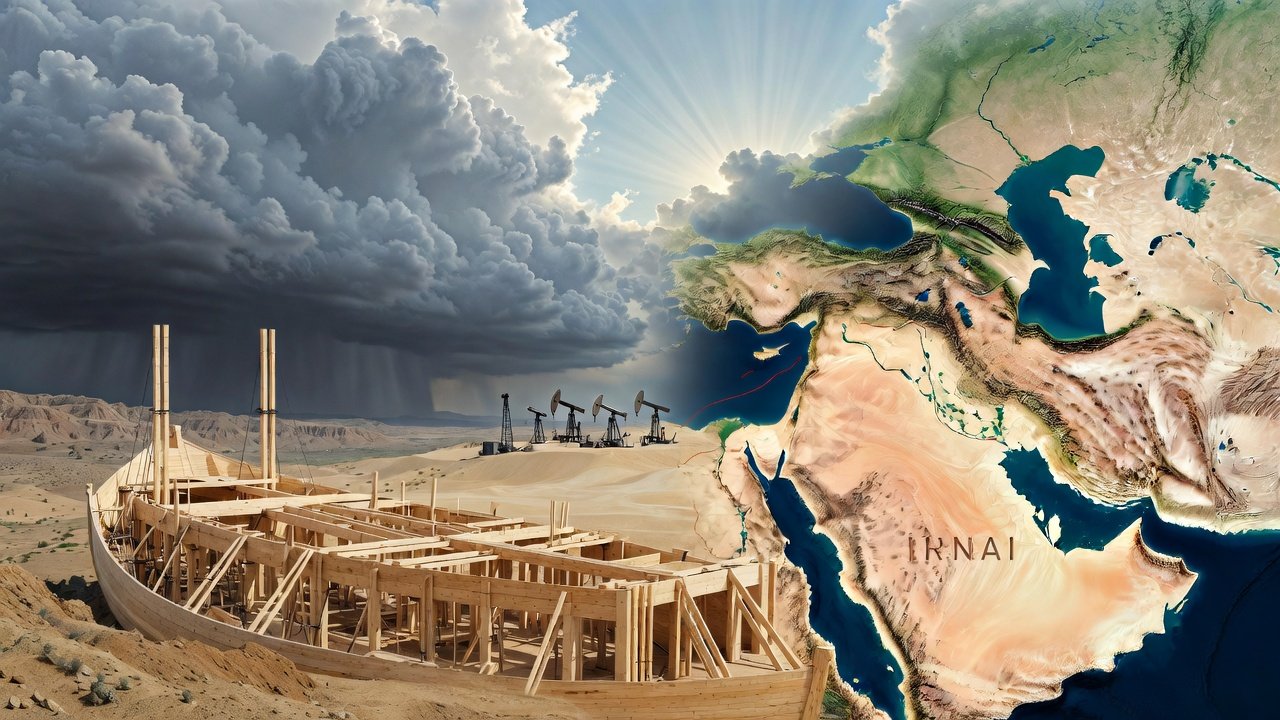
(A Reminder of Noah’s Wisdom)
A wise strategist once observed that a good leader is not warlike; a good fighter is not impetuous; and the finest victory over an enemy is achieved without rushing to attack.
True leadership lies not in the impulse to strike, but in the patience to prevent conflict before it becomes inevitable.
Even in the face of provocation or atrocity, a far-sighted leader understands that retaliation often invites another cycle of violence. History repeatedly shows that an immediate response may satisfy emotion, yet it frequently triggers a counter-attack that deepens the crisis rather than resolving it.
Unfortunately, global politics has rarely followed this wisdom. Powerful states often respond to crises with demonstrations of force rather than demonstrations of patience. The result is a pattern in which regional tensions quickly grow into prolonged geopolitical rivalries.
Europe itself carries the memory of such cycles. The era of the Crusades left deep scars across civilizations and contributed to waves of anti-Semitic violence that later became a chronic disease within parts of European history. These lessons remind us that when religion, power and politics collide, the consequences can echo for centuries.
A Region Built on Power – and Paradox
Understanding today’s Middle East therefore requires confronting several apparent contradictions.
On one side stands the Kingdom of Saudi Arabia, whose influence expanded dramatically after the 1973 oil embargo. The sudden surge of energy revenues transformed the kingdom into a central pillar of the global petrodollar economy and elevated its influence across the Muslim world.
Yet another paradox emerged after the Iranian Revolution of 1979. While revolutionary Iran challenged the established order, Saudi Arabia simultaneously deepened its partnership with the United States, becoming one of Washington’s most important allies in the region.
These competing alignments created a delicate balance that continues to shape the Middle East today: revolutionary ambition in Tehran, enduring partnership between Washington and the Gulf monarchies, and a wider Muslim world seeking stability amid rival visions of power.
Today, as tensions again rise between Iran, Israel and the United States, the region approaches another uncertain moment. Military capability exists on all sides, yet every major actor understands that a wider conflict would carry devastating consequences not only for the Middle East but for the global economy.
Prosperity Without Preparation
For the Arab states, particularly Saudi Arabia and the United Arab Emirates, stability remains the foundation of national development. Their prosperity was built upon energy wealth, open trade routes and global economic integration. For decades, glittering skylines symbolized a region that had mastered the art of prosperity.
Yet history often reminds nations that wealth alone does not guarantee security.
Across the Muslim world, another story quietly unfolded over the same decades.
While others invested primarily in prosperity, *Pakistan – a country with far fewer resources – invested in survival.
Surrounded by larger powers and shaped by difficult experiences, it gradually learned that peace is preserved not by wishful thinking but by preparation.
The Wisdom of the Ark
Like the ancient story of the Ark of Noah, wisdom lies not in reacting to the storm when it arrives, but in preparing for it long before the clouds gather.
Pakistan’s long journey toward credible self-defence reflected this understanding. The aim was never conquest, nor dominance over others. It was the preservation of sovereignty and the assurance that no adversary could easily threaten the nation’s existence.
That quiet preparation altered the balance of South Asia. What might once have been seen as vulnerable gradually became a state whose stability matters to many actors across the international system. In an increasingly uncertain world, nations from different regions now seek dialogue and cooperation with Pakistan – not because of wealth, but because of the weight of stability it represents.
A Lesson for an Uncertain World
The lesson here is neither triumph nor rivalry. It is a reminder that foresight often distinguishes those who endure from those who merely prosper for a moment.
Nations that prepare only for comfort may find themselves exposed when storms arrive. Those that prepare for hardship, while still hoping for peace, often stand firm when history tests them.
The Middle East today stands at its own crossroads. The future will depend not only on wealth or military power, but on wisdom – the ability to balance strength with restraint and preparation with patience.
For in the end, history rarely rewards those who rush toward conflict.
It favors those who quietly build their ark before the flood.
Disclaimer: The views and opinions expressed in this article are solely those of the author and do not necessarily reflect the views, policies, or position of this website. The website does not endorse or oppose any opinion presented herein.