

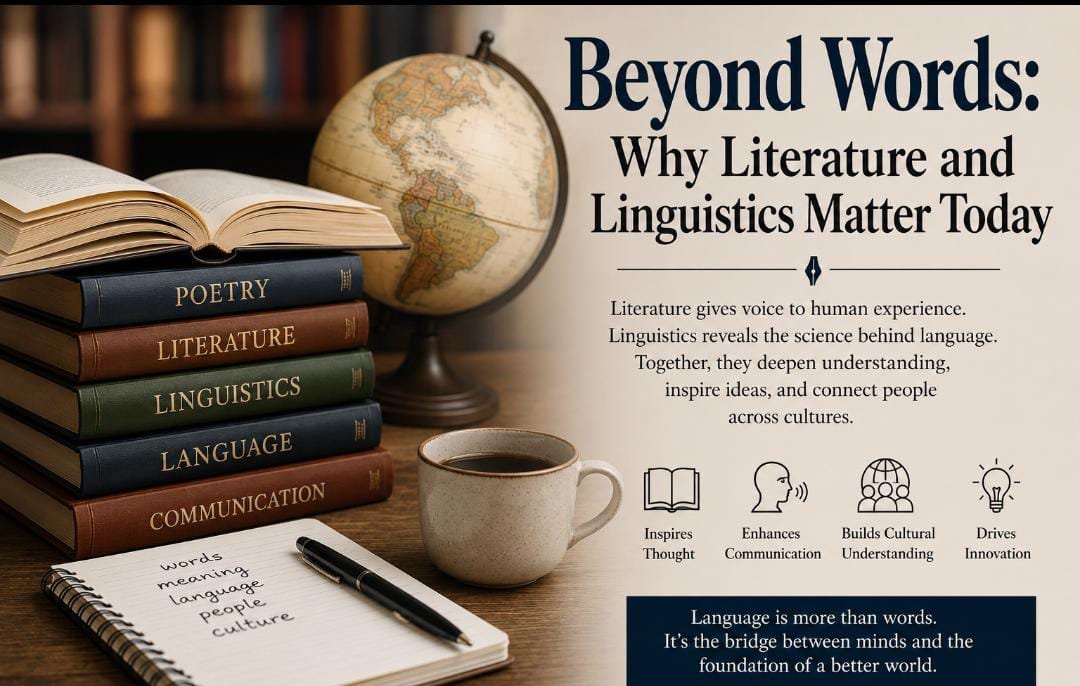
Language is one of humanity’s greatest achievements. It preserves civilizations, shapes identities, carries knowledge across generations, and connects people beyond geographical and cultural boundaries. Yet, in an era driven by artificial intelligence, digital communication, and globalization, the importance of understanding language has never been greater. This is where the disciplines of literature and linguistics emerge—not as competing fields, but as complementary forces that deepen our understanding of the human experience.
Literature is the art of exploring life through language. It captures the complexities of human emotion, chronicles history, questions injustice, and inspires imagination. Through novels, poetry, drama, and essays, literature invites readers to experience perspectives beyond their own, fostering empathy, critical thinking, and cultural awareness. It teaches us not only how to read words but how to interpret the world around us.
Linguistics, by contrast, is the scientific study of language. It examines how languages are structured, acquired, processed, and transformed over time. From phonetics and syntax to sociolinguistics and computational linguistics, the discipline provides insights into the mechanics of communication. Its applications extend far beyond academia, influencing fields such as education, translation, artificial intelligence, speech and language therapy, forensic analysis, and intercultural communication.
Students frequently ask whether literature or linguistics offers the better academic and professional pathway. The answer lies not in ranking one above the other, but in recognizing their distinct purposes. Those with a passion for storytelling, literary criticism, journalism, publishing, education, or creative writing may find their calling in literature. Those fascinated by language systems, multilingualism, research, language technology, and communication sciences may be better suited to linguistics.
In reality, the relationship between these disciplines is symbiotic. Literature gives language its depth, beauty, and emotional resonance, while linguistics reveals the structures and principles that make communication possible. One nurtures creativity and imagination; the other develops analytical precision and scientific inquiry. Together, they cultivate individuals who are capable of thinking critically, communicating effectively, and engaging thoughtfully with an increasingly interconnected world.
As societies become more diverse and technology continues to reshape communication, the demand for graduates with strong linguistic competence and cultural literacy is steadily growing. Journalists, diplomats, educators, translators, researchers, policymakers, and communication specialists all rely on the insights offered by literature and linguistics. These disciplines are not confined to classrooms; they are essential to preserving cultural heritage, strengthening public discourse, and promoting mutual understanding across communities.
Educational institutions must therefore encourage students to view language not merely as a subject to be studied but as a powerful instrument for intellectual growth and social transformation. Equally important is fostering a culture of reading, thoughtful dialogue, and academic inquiry—qualities that enrich both personal development and civic life.
Ultimately, the question is not whether literature is more valuable than linguistics, or vice versa. The more meaningful question is how each discipline can help individuals understand themselves, connect with others, and contribute positively to society. In a world increasingly shaped by information and communication, those who master language—whether through its artistic expression or scientific study, will be among the leaders who shape the future.
Beyond words lie ideas, identities, histories, and possibilities. By embracing both literature and linguistics, we invest not only in knowledge but also in the enduring power of human connection.
Disclaimer: The views and opinions expressed in this article are solely those of the author and do not necessarily reflect the views, policies, or position of this website. The website does not endorse or oppose any opinion presented herein.
