

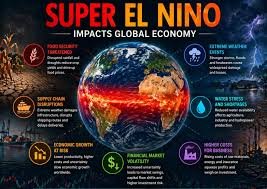
Asia is facing renewed climate and economic pressure as meteorological agencies warn that a potentially strong El Niño event could develop between May and July, raising concerns over energy shortages, agricultural disruption, and wider economic strain across the region. The United Nations’ weather and climate agency and the World Meteorological Organization (WMO) have reported early signs of El Niño formation in the Pacific Ocean, with some assessments suggesting the possibility of a particularly strong event. While comparisons are being drawn with the 1997–98 episode, one of the most severe on record, scientists emphasize that forecasts remain uncertain and the system may still weaken or fail to fully develop.
El Niño is a naturally occurring climate phenomenon driven by abnormal warming of ocean surface temperatures in the central and eastern Pacific, which alters global wind patterns, rainfall distribution, and atmospheric pressure systems. Its effects are uneven but often severe, bringing drought to some regions and heavy rainfall to others. In Asia, the main concern is reduced monsoon activity and prolonged dry conditions in several parts of Southeast and South Asia, alongside increased heat stress.
Climate scientists observing current ocean conditions say subsurface temperature anomalies appear relatively strong, resembling patterns seen before past major El Niño events. However, they caution that such signals do not guarantee intensity. If the phenomenon strengthens, countries such as Indonesia could face significant rainfall deficits, increasing the risk of drought and wildfires. Indonesian authorities have already identified vulnerable peatland zones and warned of the possibility of unusually low rainfall, with some projections pointing to levels not seen in decades. The 1997–98 El Niño caused widespread environmental destruction in the region, including massive forest fires in Indonesia that contributed to severe transboundary haze and long-term ecological damage.
Beyond environmental impacts, the potential event is expected to place additional strain on already stressed energy systems across Asia. Rising temperatures typically drive higher electricity consumption as demand for cooling increases, particularly in urban centers. Energy analysts warn that supply constraints, especially in countries dependent on imported fuels or vulnerable maritime supply routes, could lead to rationing, tighter demand management, and reduced industrial activity, with knock-on effects for economic growth. Concerns have also been raised over disruptions linked to key energy and trade corridors, which could further tighten fuel availability in certain markets.
Hydropower-dependent economies are considered especially vulnerable. Several Southeast Asian countries, as well as Nepal and parts of Malaysia, rely heavily on hydroelectric generation, which is highly sensitive to rainfall variability. Reduced precipitation during El Niño years can significantly lower reservoir levels and cut electricity output. A widely cited example occurred in 2022 when extreme heat and drought conditions in China’s Sichuan province reduced hydropower generation by more than half, leading to power shortages that affected households and industries.
Agriculture is also expected to come under pressure as weather volatility combines with high input costs. Fertiliser and fuel prices remain elevated in many countries due to ongoing global supply disruptions, increasing production costs for farmers. Analysts warn that if crop prices do not rise sufficiently to offset these costs, farmers may reduce fertiliser application, resulting in lower yields. This could contribute to higher food inflation and worsen food insecurity, particularly in import-dependent and climate-sensitive economies. At the same time, El Niño can bring excessive rainfall in some regions, raising flood risks that could damage crops such as rice in parts of southern China.
While the relationship between climate change and El Niño frequency is still not fully understood, scientists broadly agree that global warming is intensifying extreme weather events, including heatwaves and heavy rainfall episodes. Experts argue that this makes climate variability more disruptive for already strained systems across Asia. As a result, there are growing calls for countries in the region to strengthen energy resilience by diversifying power sources and accelerating investment in renewable technologies such as solar and wind, supported by battery storage systems, which are seen as less vulnerable to climate-driven shocks than centralized fossil fuel infrastructure.
As monitoring continues over the coming months, weather agencies stress that outcomes remain uncertain. The scale and impact of any El Niño event will depend on how ocean and atmospheric conditions evolve, but even moderate developments could have significant consequences for energy security, food systems, and economic stability across Asia.