

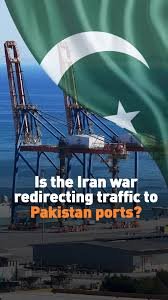
Credit: Dawn video report
The ongoing regional conflict involving Iran has disrupted traditional maritime routes across the Gulf, raising an important question: are Pakistan’s ports beginning to benefit from the shifting trade dynamics?
In a recent video report, Dawn explores how Karachi Port and Gwadar Port are responding to changing shipping patterns triggered by instability in the Strait of Hormuz and surrounding waters.
As global shipping lines reassess risk exposure in the Gulf, Pakistan’s ports have increasingly been viewed as comparatively safer transit and transshipment points. The rerouting of cargo vessels has led to a noticeable rise in port activity, particularly at Karachi, which handles a significant portion of the country’s external trade.
Industry observers cited in the report suggest that this shift is largely driven by rising insurance costs, security concerns, and delays in traditional Gulf hubs. As a result, shipping companies are diverting vessels toward alternative routes, including Pakistani ports, to ensure continuity in supply chains.
The video also highlights discussions around Gwadar Port’s strategic positioning. Located near key international sea lanes, Gwadar is often described as having long-term potential to serve as a regional logistics and transshipment hub, particularly if geopolitical disruptions persist in nearby waters.
However, experts caution that while there has been a short-term surge in activity, structural limitations such as infrastructure constraints, operational efficiency, and global competitiveness still determine whether Pakistan can sustain or expand these gains.
The report ultimately frames the development as an opportunity rather than a guaranteed transformation, emphasizing that long-term benefits will depend on policy support, investment, and improved port efficiency.
Source: Dawn (video report)