

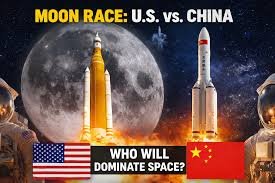
The United States’ renewed push toward the Moon under NASA’s Artemis program is intensifying strategic competition with China, which is aiming to land astronauts on the lunar surface by 2030.
This week, astronauts aboard the Artemis II mission travelled beyond the Moon’s far side, reaching deeper into space than any human mission before, as Washington prepares for a planned lunar landing later this decade. The milestone underscores the US intent to re-establish a sustained presence on the Moon after more than 50 years.
Meanwhile, Beijing is rapidly advancing its own lunar ambitions, developing a complete mission framework that includes the Long March-10 rocket, Mengzhou spacecraft, and Lanyue lunar lander. China has already achieved notable success through robotic missions, including becoming the first country to return samples from both the near and far sides of the Moon.
Beyond technological progress, the race carries growing geopolitical weight. The US-led Artemis Accords competes with the China-Russia-backed International Lunar Research Station, reflecting broader rivalry over influence in space governance and future lunar infrastructure.
China’s planned mission architecture involves launching separate spacecraft and lander modules that would dock in lunar orbit before astronauts descend to the surface and return. While recent tests, including escape systems and lander capabilities, mark important progress, key systems still require validation under strict human safety standards.
Analysts suggest China remains on track, citing its record of meeting ambitious space deadlines. However, the competition is no longer just about reaching the Moon first, but about establishing long-term operational dominance.
As US-China rivalry deepens across economic, military, and technological domains, the Moon is emerging as a critical frontier, not only for exploration, but for geopolitical influence in the decades ahead.