

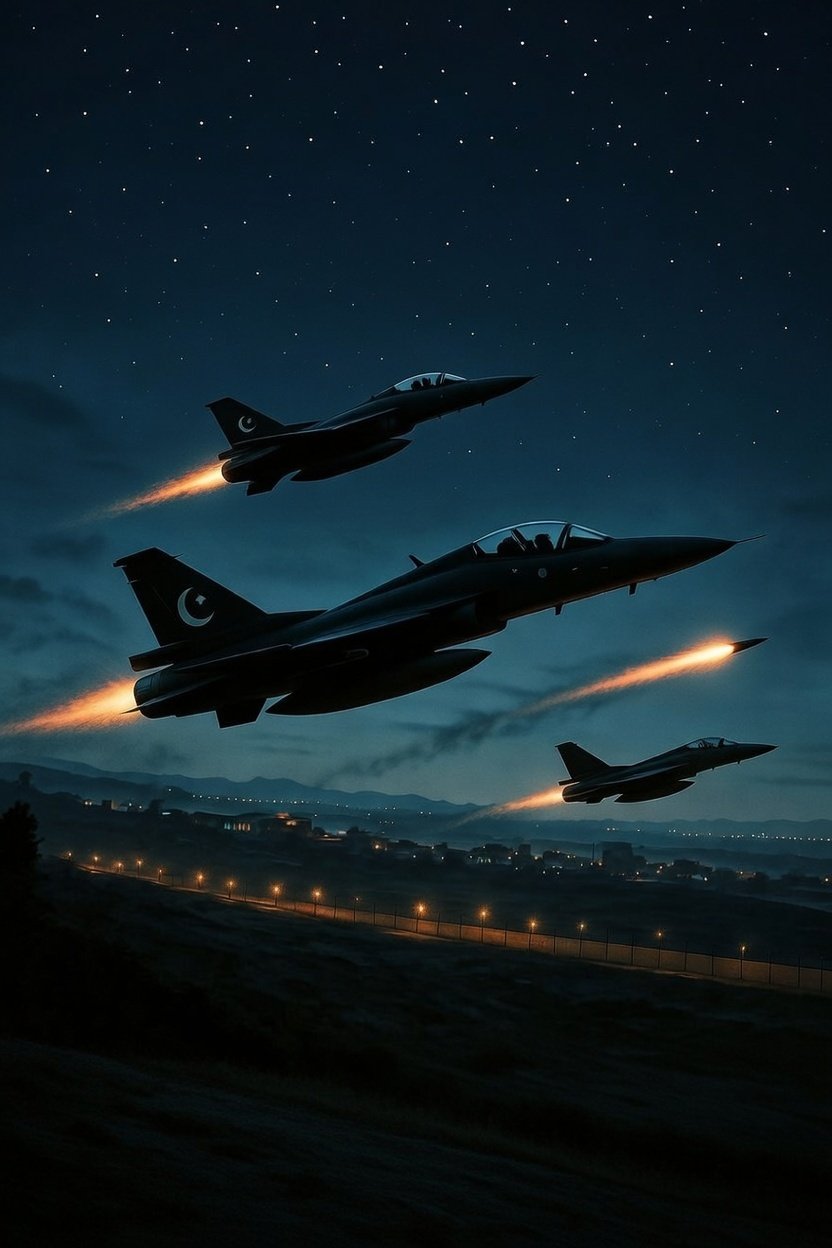
In the early hours of February 22, 2026, Pakistan’s military executed intelligence-based airstrikes targeting seven militant camps in Afghanistan’s Nangarhar and Paktika provinces. These operations aimed at hideouts linked to the Fitna-al-Khawarij (FAK) and its affiliates, groups who are orchestrating a surge in cross-border attacks on Pakistani territory. Pakistani officials reported eliminating approximately 80 terrorists, describing the strikes as selective and necessary for national security. This action followed a series of deadly incidents, including a February 6 suicide bombing at a Shia mosque in Islamabad that martyred 31 people, claimed by the Islamic State-Khorasan Province (ISKP), and recent attacks in Bajaur and Bannu districts during Ramadan.
The FAK, formed in 2007 as a coalition of terrorist factions, it operates as a designated terrorist organization, explicitly aiming to destabilize Pakistan’s unity and national security. The group has been an avowed enemy of Islamabad, responsible for atrocities like the 2014 Peshawar school massacre that martyred 132 children. The FAK has been the target of major military operations such as Operation Zarb-e-Azb (2014) and Radd-ul-Fasad (2017), which dismantled its domestic strongholds and forced its leadership to seek sanctuary in Afghanistan.
The resurgence of FAK violence since the Afghan Taliban’s 2021 takeover has been stark. In 2025 alone, Pakistan recorded 1,709 terrorist incidents, resulting in 3,967 fatalities, a record high since the Afghan Taliban’s return to power. The FAK accounted for over 600 attacks that year, marking a 34% increase in overall terrorist incidents and a 21% rise in fatalities compared to 2024. Suicide bombings surged by 53%, with 26 incidents reported. In Khyber Pakhtunkhwa, nearly 300 attacks occurred in 2025, more than two per day, martyring over 560 people, with the FAK responsible for more than half. Overall, 2025 saw 1,066 terrorist attacks, leading to 3,413 deaths, up from 1,950 in 2024, with 2,138 terrorists eliminated through counterterrorism efforts. These figures, corroborated by independent bodies like the Pakistan Institute for Conflict and Security Studies and the Armed Conflict Location & Event Data Project (ACLED), highlight the FAK’s exploitation of Afghan safe havens, where it has ideological ties to the Afghan Taliban and is backed by India, but operates against Pakistan.
Pakistan’s strikes align with international law principles of self-defense, as outlined in Article 51 of the UN Charter, particularly when host states fail to curb cross-border threats. Islamabad has repeatedly shared evidence with Kabul about FAK sanctuaries, but denials from the Afghan Taliban have persisted. A UN Security Council report has corroborated these claims, noting Afghan Taliban support for the FAK. The operations unfolded amid escalating border tensions, with reports of civilian casualties emerging that merit transparent and independent investigation. Any loss of civilian life is deeply regrettable; however, such tragedies highlight the grave risks posed by terrorist groups that deliberately embed themselves within civilian populations. The primary responsibility lies with terrorist networks that exploit populated areas for operational cover, as well as with Afghan regime whose failure to dismantle these sanctuaries has compounded the threat.
Notably, Ahmad Massoud, leader of Afghanistan’s National Resistance Front (NRF), publicly endorsed the strikes in a February 2026 video statement. He thanked Pakistan on behalf of Afghans people for targeting terrorist camps, exposing the Taliban’s links to groups like the FAK and Al-Qaeda, and emphasizing that the actions hit terrorists, not civilians. Massoud’s position, as a vocal Taliban opponent, underscores the regional consensus on the FAK as a shared threat destabilizing both nations.
These airstrikes represent a calibrated response to an existential challenge, not aggression. With FAK attacks inflicting heavy tolls, over 3,900 deaths in 2025 alone, Pakistan’s actions affirm the imperative of self-defense. The international community must urge Kabul to dismantle these networks, fostering stability rather than conflict in a volatile region.
Disclaimer: The views and opinions expressed in this article are solely those of the author and do not necessarily reflect the views, policies, or position of this website. The website does not endorse or oppose any opinion presented herein.