

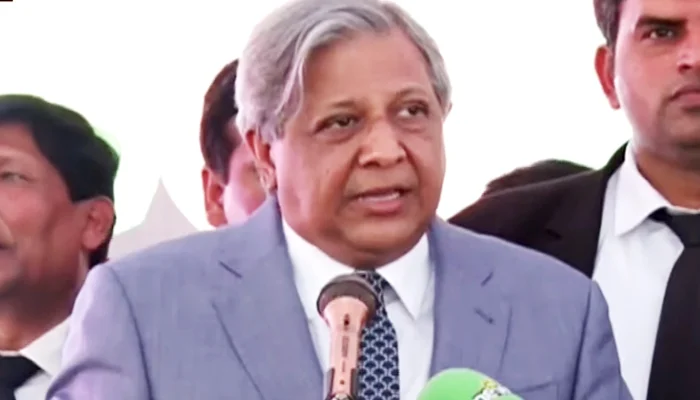
Federal Law Minister Azam Nazeer Tarar on Monday said a medical team is “completely satisfied” with the ongoing treatment of jailed Pakistan Tehreek‑e‑Insaf (PTI) founder Imran Khan’s eye condition.
Speaking at a lawyers’ event in Ferozewala, Tarar said Khan underwent a repeat medical examination. According to the minister, one of the former prime minister’s eyes has approximately 70% vision with corrective glasses, while the other retains normal 6×6 vision.
Responding to questions about disputed visual measurements, specifically references to a “35/25” figure circulating in some reports, Tarar said there was “no need to worry,” noting that the medical team had already briefed opposition leaders and Khan’s personal physicians.
The minister’s remarks come amid heightened political tensions following the submission of a medical report to the Supreme Court of Pakistan by Imran Khan’s legal team and the court’s amicus curiae, Salman Safdar. That report confirmed Khan was diagnosed with central retinal vein occlusion (CRVO), a severe eye condition more common with advancing age and often linked to cardiovascular risk factors like high blood pressure, high cholesterol, diabetes, and heart disease. The report stated that Khan, who has been incarcerated since August 2023, had reported losing about 85% of vision in his right eye.
Following the medical findings, PTI leaders and Khan’s family raised serious alarm over his health and urged authorities to transfer him to a hospital for comprehensive care.
According to sources cited by Geo News, Khan underwent an hour‑long evaluation by a panel of five senior doctors, after which the pain in his right eye reportedly decreased significantly. Sources added that further improvement is expected with continued treatment, and that the full medical report has been shared with relevant government authorities.
The medical assessment was conducted to meet a judicial deadline set by the Supreme Court, which required a detailed report on Khan’s condition by February 16.
Separately, a team of specialist physicians from Pakistan Institute of Medical Sciences and Al‑Shifa International Hospital conducted a thorough examination, expressed satisfaction with Khan’s progress, and noted significant improvement in his eyesight.
In addition to the eye evaluation, jail authorities have sent Khan’s complete medical records, including blood pressure, pulse, temperature, and blood sugar charts — to the Punjab Home Department.
Political activity around the issue has also escalated. Sources indicated that Mahmood Khan Achakzai, chief of Tehreek Tahaffuz‑e‑Ayeen Pakistan (TTAP), called a meeting of MNAs and senators at Parliament House at 1 p.m. today to consult on the future course of political protest.
While addressing the lawyers’ ceremony, Law Minister Tarar also commented on ongoing protests and road closures. He described closures of motorways and the Grand Trunk (GT) Road as “illegal and unconstitutional,” and warned that the federal government may intervene if any provincial administration violates the Constitution.
Citing Article 15 of the Constitution, Tarar emphasized that every Pakistani has the right to freedom of movement and that official‑level road blockades cannot legally restrict citizens’ travel.
Tarar also acknowledged financial challenges faced by the legal community after the 18th Constitutional Amendment, which devolved several fiscal responsibilities to the provinces. He announced that a special fund of Rs10 million has been approved to assist the Ferozewala Bar in addressing some of its funding needs.