

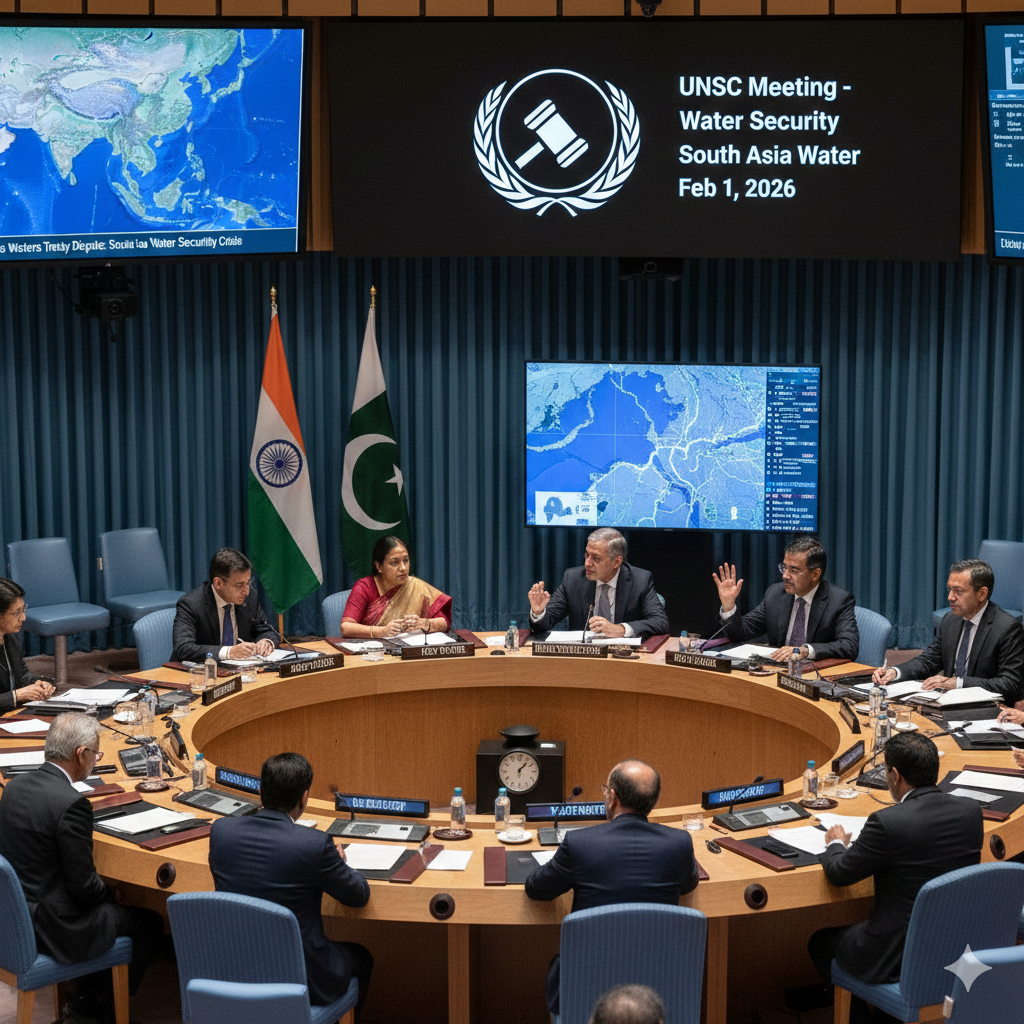
ISLAMABAD — Pakistan’s Ambassador to the United Nations, Asim Iftikhar Ahmad, has warned that any unilateral suspension of the Indus Waters Treaty by India could trigger serious humanitarian and security consequences for the region.
Speaking at an Arria Formula meeting of the United Nations Security Council, Ahmad said the decades-old water-sharing agreement remains one of the most resilient international treaties and should not be undermined for political reasons. He cautioned that disrupting established water arrangements would directly affect millions of people downstream in Pakistan.
India announced last year that it was keeping the treaty “in abeyance” amid rising tensions with Pakistan. The agreement, brokered by the World Bank in 1960, governs the sharing of rivers in the Indus Basin between Pakistan and India. Under the treaty, Pakistan controls the western rivers, Indus, Jhelum and Chenab, while India has rights over the eastern rivers, Ravi, Beas and Sutlej, with certain restrictions.
Ahmad said any unilateral interference with the treaty could have “real and immediate” impacts on water security, agriculture, and livelihoods in Pakistan, where millions depend on river systems for irrigation and drinking water. He stressed that placing such vital resources under unilateral control could destabilize the region.
The Pakistani envoy also argued that the treaty should not be viewed merely as a bilateral issue, but as a test case for the credibility of the international system. He warned that if agreements meant to prevent conflict are ignored, other arrangements, including borders, trade routes and humanitarian corridors, could also become vulnerable.
Calling on the United Nations to play a stronger role, Ahmad urged the Security Council to discourage unilateral treaty suspensions and ensure compliance with international agreements. He said respect for treaties must be treated as a strategic priority to prevent future conflicts.
Pakistan has repeatedly warned that any attempt by India to block or divert river flows would be considered a serious provocation. Officials in Islamabad have previously described such actions as equivalent to an “act of war.”
Tensions between the two nuclear-armed neighbours escalated sharply in May last year after India accused Pakistan of involvement in a militant attack in Indian-administered Kashmir, a claim denied by Islamabad. The crisis led to four days of missile strikes, drone attacks and artillery exchanges before the United States helped broker a ceasefire on May 10.