

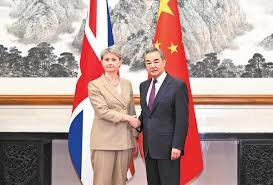
United Kingdom: The United Kingdom is seeking to recalibrate its diplomatic and economic relationship with China as Foreign Secretary Yvette Cooper undertakes a three-day visit to Beijing, marking a continued thaw in ties after years of strained engagement.
The visit follows Prime Minister Keir Starmer’s trip to China earlier this year and comes amid broader Western efforts to re-engage with Beijing despite unresolved disputes over security, human rights, and China’s position on the war in Ukraine.
During meetings with senior Chinese officials, including Vice President Han Zheng, Cooper emphasised the importance of maintaining dialogue and cooperation on global challenges, including ongoing conflicts and public health crises. She reiterated that while differences remain, structured engagement based on “candour and respect” could support stability and mutual understanding.
Chinese officials, in turn, called for strengthened communication and expanded cooperation, framing the relationship as essential for global economic and geopolitical stability.
Analysts say the UK’s approach reflects a broader pragmatic shift driven by economic pressures, global supply chain dependencies, and evolving US-China dynamics. Britain is increasingly aligning with other Western states in seeking limited re-engagement with China to stabilise trade and investment flows.
However, the renewed engagement is taking place alongside persistent tensions. Concerns over espionage, cybersecurity, human rights, and China’s support for Russia in the Ukraine war continue to shape the UK’s cautious diplomatic posture. Recent intelligence-related arrests and debates over China’s proposed diplomatic facilities in London have further intensified scrutiny.
Despite these challenges, both sides are pursuing expanded cooperation in areas such as clean energy, technology, and trade, with discussions also expected to cover artificial intelligence and industrial partnerships.
Experts suggest the evolving UK-China relationship reflects a broader global trend of selective engagement, where economic interdependence coexists with strategic rivalry.