

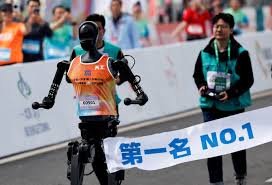
Dozens of humanoid robots developed in China demonstrated significant advancements in speed and autonomous navigation on Sunday, competing alongside 12,000 human runners in a half-marathon held in Beijing.
The event highlighted rapid progress in robotics, with several robot participants outperforming professional athletes on a 21-kilometre course designed with parallel lanes to avoid collisions.
Nearly half of the robot entries completed the race using autonomous navigation systems, a marked improvement from last year, when most required remote control and many failed to finish. Participation also expanded significantly, rising from 20 teams in the previous edition to more than 100 this year.
The winning robot, developed by Chinese technology company Honor, completed the race in 50 minutes and 26 seconds—faster than the human category winner and ahead of elite international marathon benchmarks. The company is a spin-off linked to Huawei.
Honor’s engineering team secured the top three positions, all with fully self-navigating humanoids. Engineers said the robots were designed with advanced locomotion systems, including limb structures intended to replicate elite human running dynamics and integrated cooling technologies adapted from smartphone engineering.
Despite the technological milestone, experts cautioned that the systems remain in early development stages. While the robots demonstrated improved speed and balance, they still lack the adaptability required for complex real-world industrial environments.
Engineers involved in the project said the achievement represents progress toward broader applications, including manufacturing and logistics, but noted that current capabilities are largely limited to controlled conditions and repetitive tasks.
Spectators described the performance as a sign of China’s accelerating innovation in artificial intelligence and robotics, with some students expressing interest in pursuing careers in the field.
The demonstration comes as China continues to invest heavily in robotics development through subsidies, policy support, and infrastructure initiatives aimed at strengthening its position in emerging technologies.
While humanoid robots have shown improved athletic performance in controlled competitions, analysts say widespread commercial deployment will depend on further advances in artificial intelligence, real-world perception, and fine motor control systems.