

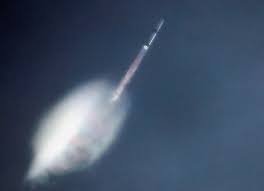
Blue Origin has successfully landed its New Glenn rocket booster after launch, marking the company’s first successful recovery of a reused booster and intensifying competition with rival SpaceX in the global space launch industry.
The launch took place on Sunday from Cape Canaveral Space Force Station, with the New Glenn rocket lifting off at approximately 7:25am ET after a scheduled window opened earlier in the morning. The booster successfully touched down around 10 minutes after liftoff.
The mission carried AST SpaceMobile’s BlueBird 7 satellite into low-Earth orbit, marking a key step in validating the rocket’s commercial capabilities and reusable design.
The recovered booster, named “Never Tell Me the Odds,” had previously flown during the NG-2 mission in November. Its successful landing is seen as a major technical milestone for Blue Origin, which aims to compete directly with SpaceX’s reusable Falcon 9 system.
New Glenn is a 29-story heavy-lift rocket designed to serve the commercial satellite market, featuring a large payload fairing capable of carrying multiple satellites per launch. Company executives said the system was built for long-term deep space and commercial missions.
The mission also supports AST SpaceMobile’s efforts to deploy a space-based cellular broadband network designed to connect directly with standard smartphones, competing with satellite internet constellations such as Starlink.
The development comes amid heightened competition in the commercial space sector, where both Blue Origin and SpaceX are expanding reusable launch systems and lunar exploration capabilities. SpaceX has also recently advanced plans for its Starship program, which is being developed for future NASA lunar missions.
Both companies are supporting NASA’s Artemis program, which aims to return humans to the Moon later this decade. Blue Origin is developing its Blue Moon lunar lander, while SpaceX is working on a Starship-based Human Landing System.
With the successful booster recovery, Blue Origin has moved closer to establishing a fully reusable launch system, a key requirement for reducing costs and increasing launch frequency in the global space industry.