

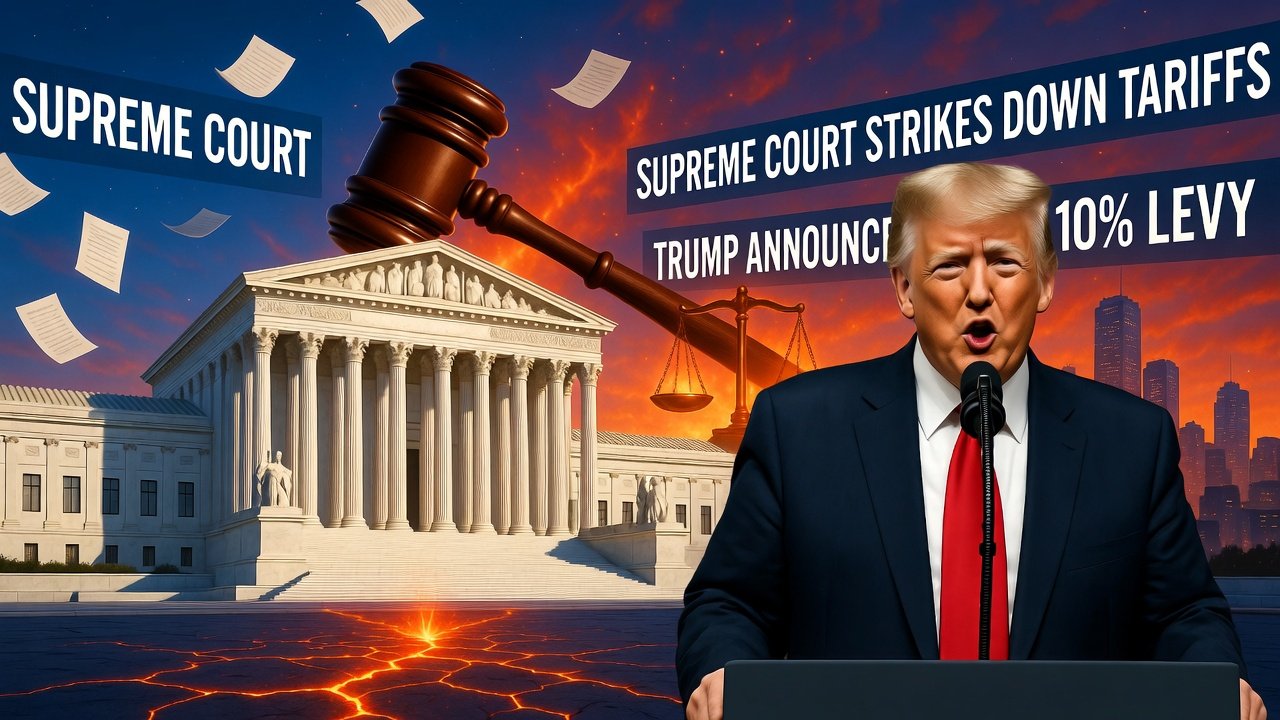
U.S. President Donald Trump has moved swiftly to impose a new 10 percent tariff on imports from virtually all trading partners after the U.S. Supreme Court struck down his earlier global tariff program, deepening uncertainty in international trade relations.
In a 6–3 decision issued on Friday, the Supreme Court ruled that Trump exceeded his constitutional authority by using the International Emergency Economic Powers Act (IEEPA) to impose broad tariffs without explicit approval from Congress. Chief Justice John Roberts, writing for the majority, said only Congress has the power to levy taxes and duties, undercutting a central pillar of Trump’s economic policy.
Trump reacted furiously to the ruling, branding the decision a “disgrace” and accusing the justices of undermining American interests. In statements released at the White House and on social media, he criticized the high court’s majority and vowed to continue his efforts to protect U.S. workers and industry.
Undeterred by the court setback, Trump signed an executive order later Friday invoking an alternate authority under Section 122 of the Trade Act of 1974. The order imposes a temporary 10 percent tariff on imports from all countries for 150 days, a measure officials say is designed to replace the invalidated duties and maintain pressure on foreign exporters.
Administration officials described the new levy as part of Trump’s broader strategy to address the persistent U.S. trade deficit and support domestic manufacturing. They also said the administration is exploring additional tariff actions under Sections 232 and 301 of U.S. trade law, which target national security and unfair trade practices, respectively.
The Supreme Court’s decision and Trump’s response have drawn a mixed reaction from lawmakers and business leaders in Washington. Many members of Congress, including Republicans, welcomed the court’s decision as a reaffirmation of constitutional checks and balances. They said trade and tariff authority rests with the legislative branch, not the executive.
Business groups and economists, however, expressed concern that Trump’s replacement tariff could prolong uncertainty for American companies that rely on global supply chains. Some warned that continued tariff unpredictability could raise costs for consumers and lead to retaliatory actions by U.S. trading partners.
International governments are also closely watching developments. Officials in the United Kingdom and the European Union said they are evaluating the implications of both the Supreme Court ruling and the new U.S. tariff order on existing trade frameworks. Analysts have said that foreign retaliation, particularly from major economies like China and Canada, could escalate if broader tariffs are maintained.
Financial markets reacted to the news with initial volatility. Investors appeared encouraged by the Supreme Court’s decision, viewing it as a constraint on executive authority. But markets later factored in concerns about Trump’s swift replacement tariff, which analysts say could influence trade flows and corporate planning throughout 2026.
Legal experts say the Supreme Court ruling sets an important precedent limiting presidential authority to enact sweeping trade measures under emergency powers. They anticipate future legal challenges as the administration seeks to cement its new tariff framework.
The temporary tariff is scheduled to take effect within days and will remain in force for 150 days unless extended by Congress or replaced with other legislation. Trade policy observers expect continued debate and possible litigation over the limits of presidential power in U.S. trade policy.