

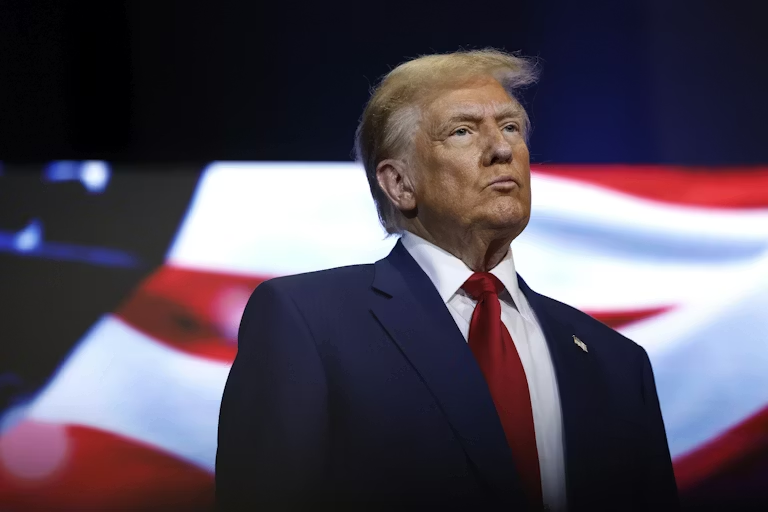
U.S. President Donald Trump is expected to unveil a multi-billion-dollar Gaza reconstruction funding plan and detail commitments for a multinational stabilization force when he hosts the inaugural meeting of the newly formed Board of Peace on Feb. 19 in Washington, D.C., senior U.S. officials said.
The Board of Peace, a U.S.-led initiative endorsed by a United Nations Security Council resolution, is designed to coordinate international support for Gaza’s reconstruction and the fragile ceasefire that took effect in October 2025 following years of conflict.
At next week’s session, Trump will announce the establishment of a new reconstruction fund intended to mobilize billions of dollars for rebuilding infrastructure and services in the Gaza Strip, officials said. Participating countries have offered “generous” contributions, though the United States has not publicly requested specific donation figures.
In addition to financial pledges, Trump is set to release details on plans for a UN-authorized International Stabilization Force (ISF). Officials told Reuters that several countries plan to contribute “several thousand troops”to the force, which aims to support security, sustain the ceasefire and assist in the transition away from Hamas control.
Delegations from around 20 countries, including heads of state and senior government representatives, are expected to attend the meeting. The Board of Peace’s membership includes regional powers such as Turkey, Egypt, Saudi Arabia, Qatar and Indonesia, and Israel has formally joined the initiative, according to Israeli Prime Minister Benjamin Netanyahu.
Despite broad engagement from emerging powers, several traditional Western allies have been cautious about the Board’s role, and some experts have questioned whether it could compete with or undermine established U.N. mechanisms.
Officials say a central focus for the meeting will remain Gaza reconstruction and stabilization. Under Trump’s Gaza plan, which laid the groundwork for the Board, key priorities include disarmament of militant factions, support for civilian governance structures, and humanitarian aid coordination. Hamas members agreeing to lay down arms and peacefully reintegrate would be offered amnesty, while those wishing to leave Gaza could receive safe passage to third countries, U.S. officials have previously indicated.
The Board session will also provide updates on the newly formed National Committee for the Administration of Gaza, tasked with overseeing day-to-day civil governance, as well as progress on rebuilding the Gaza police and delivering humanitarian assistance.