

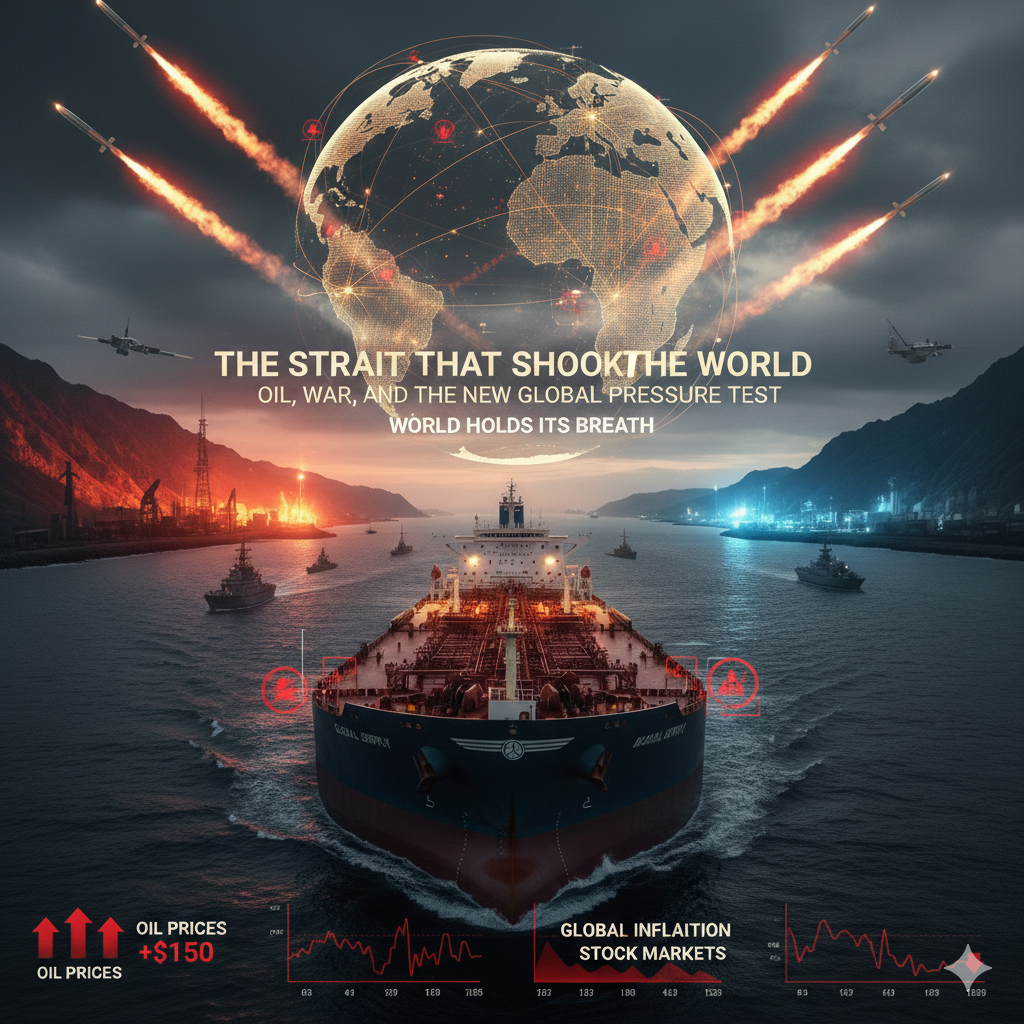
Global markets are not trembling because of a stock market crash or a banking collapse. They are rattled by a narrow strip of water, the Strait of Hormuz. Just 20% of the world’s seaborne oil passes through this tight maritime corridor between Iran and Oman. In ordinary times, it is a strategic artery. In times of conflict, it becomes a trigger. And today, the world is holding its breath.
When Missiles Fly, Markets React
Following recent US and Israeli strikes on Iran, and Tehran’s subsequent retaliation, tensions in West Asia have escalated sharply. The consequences are not confined to the battlefield. Insurance firms have begun pulling back coverage for vessels transiting the Gulf. Reports suggest electronic navigation systems in the region have been jammed. Most strikingly, the world’s largest container shipping company, Maersk, suspended vessel crossings through Hormuz for safety reasons. That decision was not just a logistical adjustment. It was a signal. Because in energy markets, perception often moves faster than reality.
OPEC+ Steps In, But Is It Enough?
In response to the mounting uncertainty, OPEC+, the oil producers’ alliance that includes heavyweights such as Saudi Arabia and Russia, convened an emergency meeting. Their announcement: oil production would increase by 206,000 barrels per day starting April. At first glance, that sounds significant. But context matters.
Analysts had expected an increase of roughly 137,000 barrels per day. So yes, the final number exceeded forecasts. Yet in the broader architecture of global oil supply, where nearly 100 million barrels are consumed daily, 206,000 barrels is modest. More importantly, oil markets are not governed solely by production. They are governed by movement. And that brings us back to the Strait of Hormuz.
The Real Risk: Not Supply, But Transport
If the Strait remains open but tense, markets will remain volatile. If it is partially disrupted, prices spike. If it is fully blocked, the world faces an energy shock. Before the conflict escalated, oil hovered around $72 per barrel. Analysts now warn that sustained disruption could send prices to $120, even $150, per barrel. Such a spike would ripple instantly through: Airfares, food transportation, manufacturing costs and electricity pricing Global inflation rates. Saudi Arabia and the UAE do possess land pipelines that bypass Hormuz. But these cannot compensate entirely for a closure. If the strait were fully blocked, experts estimate a supply gap of 8–10 million barrels per day. In that scenario, OPEC+’s additional 206,000 barrels would look like a drop in the ocean.
A Regional Conflict, Or a Global Realignment?
Iran has publicly stated it has no intention of closing the strait. But military tensions introduce unpredictability. Meanwhile, global diplomatic lines are hardening. China condemned the killing of Iran’s supreme leader, calling it a violation of sovereignty and international norms. Vladimir Putin described the act as a cynical breach of moral and legal standards. Pope Leo XV publicly appealed to halt what he termed a spiral of violence before it becomes irreversible. North Korea denounced the strikes as illegal aggression. What we are witnessing is no longer just a regional firefight. It is a stress test of the global order.
On one side stand the United States and Israel. On the other, Iran, backed diplomatically by Beijing and Moscow. Between them lie energy markets, shipping lanes, insurers, central banks, and ordinary citizens whose fuel bills may soon reflect geopolitical calculations.
The Cost of Chokepoints
The Strait of Hormuz is not merely a geographic passage. It is a leverage point. In modern geopolitics, chokepoints matter as much as armies. Control, or even credible disruption, can shift global prices overnight. Energy security is economic security. And economic security is political stability. When bombs fall in West Asia, they do not stay there. They travel through supply chains. They reach grocery stores. They hit power grids. They alter inflation forecasts. And they test governments.
Assassination and the Pattern of Escalation
The crisis also carries a darker undertone, the politics of targeted killings. Power rarely ends quietly. Certain deaths are not accidents; they are signals. A gunshot in a crowd can freeze a nation. An assassination can redraw alliances, mobilize armies, and rewrite history. Five leaders. Five moments. One pattern: escalation through elimination. In volatile regions, assassination is never only about the individual removed. It is about the vacuum created, and who moves to fill it.
The Bigger Question
Can the world prevent an energy shock from turning a regional war into a global economic crisis? The answer hinges on three factors:
1. Whether the Strait of Hormuz remains operational.
2. Whether diplomatic backchannels cool tensions.
3. Whether major powers choose containment over confrontation.
For now, markets are watching radar screens in the Gulf as closely as they watch stock tickers in New York and London. Because sometimes the most powerful force in the global economy is not a central bank, not a trade agreement, not even a military alliance. Sometimes, it is a narrow strip of water.
Disclaimer: The views and opinions expressed in this article are solely those of the author and do not necessarily reflect the views, policies, or position of this website. The website does not endorse or oppose any opinion presented herein.