

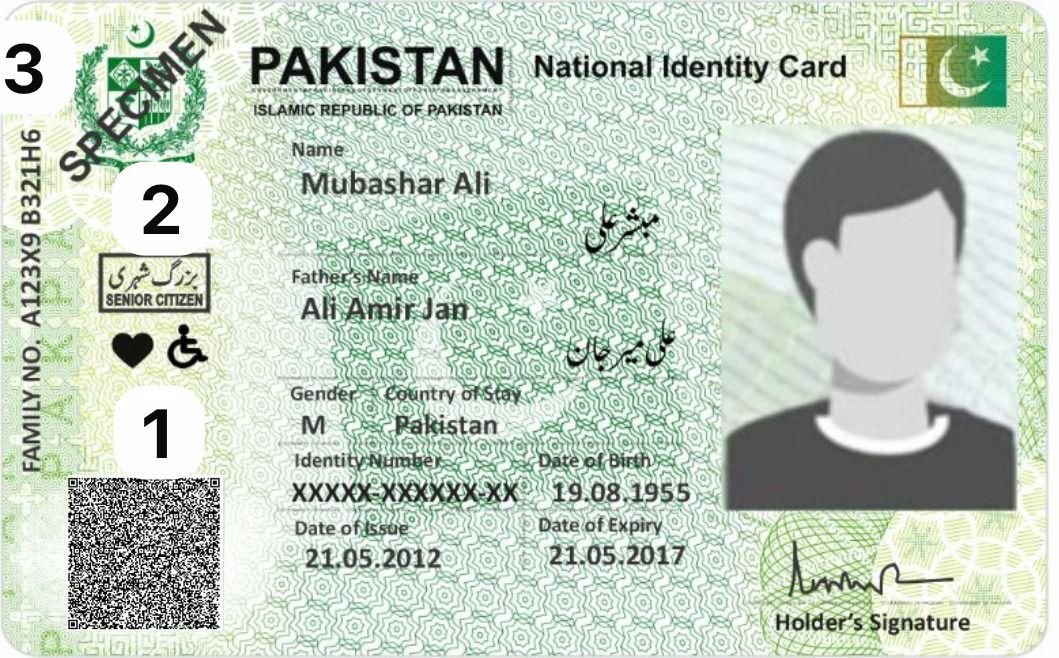
The federal government has formally rolled out a modernised QR-powered National Identity Card (NIC) and Pakistan Origin Card (POC) system in a major upgrade to Pakistan’s identity framework, strengthening digital security and citizen facilitation, officials said on Tuesday.
Published through Gazette notifications on February 24, 2026 under S.R.O. 330(I)/2026 and S.R.O. 331(I)/2026, the reforms are part of the “One Nation – One Identity” vision aimed at unifying and digitising the country’s identity ecosystem.
A key feature of the updated system is the legal introduction of Quick Response (QR) codes as a secure authentication and verification tool on identity cards. The QR code stores encoded identity information that can be instantly scanned for rapid offline and online verification, reducing manual checks and lowering the risk of fraud and impersonation.
The revised rules also authorise the National Database and Registration Authority (NADRA) to adopt QR codes or other technological features in future identity documents without requiring repeated legal amendments. This flexibility is expected to ensure the ID infrastructure keeps pace with evolving digital innovations.
Under the reforms, citizens will now carry a uniform identity card format, replacing the existing dual structure of chip-enabled and non-chip cards. This uniform format is designed to improve interoperability, align with the National Data Exchange Layer, and speed up service delivery across government and private sector platforms.
To strengthen security and fraud prevention, the updated rules stipulate that when an identity card is suspended, all related verification and authentication services are automatically blocked, preventing misuse across digital and institutional channels.
Biometric security has also been enhanced, with the rules now explicitly recognising fingerprints and iris scans as formal authentication methods, reinforcing a multi-modal biometric approach to identity verification.
In a citizen-friendly measure, individuals aged 60 years and above, whether residing in Pakistan or abroad, will be issued lifetime-validity ID cards featuring a distinct senior-citizen logo, eliminating repeat renewals for elderly Pakistanis.
The amendments further standardise identity documentation for residents of Azad Jammu & Kashmir (AJK) by incorporating a specific inscription on their cards reflecting their residency status, enhancing uniformity across identity records.
Officials said the move strengthens the backbone of Pakistan’s national identity infrastructure, enhances digital trust, improves fraud prevention, and accelerates Pakistan’s readiness for integrated digital governance in both offline and online settings.